{"title":"新型GQDs和CuO修饰TiO2基异质结构光催化剂协同增强PEC制氢","authors":"Farman Ullah , Beh Hoe Guan , Mudasar Zafar , Noor e Hira , Hizbullah Khan , Mohamed Shuaib Mohamed Saheed","doi":"10.1016/j.matchemphys.2025.130781","DOIUrl":null,"url":null,"abstract":"<div><div>Photoelectrochemical (PEC) water splitting technique is one of the most promising, cost-effective, and environmentally friendly techniques for solar H<sub>2</sub> production. However, the widely accepted TiO<sub>2</sub> semiconductor photocatalyst for a PEC system portrays less visible light absorption due to its wide bandgap and rapid recombination of e<sup>−</sup>/h<sup>+</sup> pairs that ultimately lead to its low hydrogen production efficiency. Herein this work, heterostructure graphene quantum dots (GQDs) and cupric oxide (CuO) modified TiO<sub>2</sub> based photocatalyst were prepared to elucidate the optoelectronic and charge transfer properties of the TiO<sub>2</sub> based photocatalysts to enhance their photocatalytic performances. The GQD and CuO modified TiO<sub>2</sub> based photocatalysts were synthesized via hydrothermal synthesis technique at calcination temperature of 450 °C for calcination durations up to 3 h. The effect of the dopants was investigated on various physiochemical properties including structural, morphological, chemical, elemental, optoelectronic and as well as, photoelectrochemical properties. The developed CuO/GQD@TiO<sub>2</sub> heterostructure photocatalyst presented the lowest energy bandgap (2.16 eV), enhanced visible light absorption (up to ∼745 nm), and reduced recombination of the charge carriers. The optimized tri-layered novel CuO/GQD@TiO<sub>2</sub> photocatalyst demonstrated maximum H<sub>2</sub> production up to 34,466 μmol g<sup>−1</sup>h<sup>−1</sup> with photoconversion efficiency ∼9.01 %. Overall, the presented mechanistic insight and targeted strategy of incorporating CuO and GQD into TiO<sub>2</sub> photocatalyst provides a fresh perspective in producing H<sub>2</sub> efficiently using PEC approach.</div></div>","PeriodicalId":18227,"journal":{"name":"Materials Chemistry and Physics","volume":"340 ","pages":"Article 130781"},"PeriodicalIF":4.7000,"publicationDate":"2025-08-01","publicationTypes":"Journal Article","fieldsOfStudy":null,"isOpenAccess":false,"openAccessPdf":"","citationCount":"0","resultStr":"{\"title\":\"Synergistic enhancement in PEC hydrogen production using novel GQDs and CuO modified TiO2 based heterostructure photocatalyst\",\"authors\":\"Farman Ullah , Beh Hoe Guan , Mudasar Zafar , Noor e Hira , Hizbullah Khan , Mohamed Shuaib Mohamed Saheed\",\"doi\":\"10.1016/j.matchemphys.2025.130781\",\"DOIUrl\":null,\"url\":null,\"abstract\":\"<div><div>Photoelectrochemical (PEC) water splitting technique is one of the most promising, cost-effective, and environmentally friendly techniques for solar H<sub>2</sub> production. However, the widely accepted TiO<sub>2</sub> semiconductor photocatalyst for a PEC system portrays less visible light absorption due to its wide bandgap and rapid recombination of e<sup>−</sup>/h<sup>+</sup> pairs that ultimately lead to its low hydrogen production efficiency. Herein this work, heterostructure graphene quantum dots (GQDs) and cupric oxide (CuO) modified TiO<sub>2</sub> based photocatalyst were prepared to elucidate the optoelectronic and charge transfer properties of the TiO<sub>2</sub> based photocatalysts to enhance their photocatalytic performances. The GQD and CuO modified TiO<sub>2</sub> based photocatalysts were synthesized via hydrothermal synthesis technique at calcination temperature of 450 °C for calcination durations up to 3 h. The effect of the dopants was investigated on various physiochemical properties including structural, morphological, chemical, elemental, optoelectronic and as well as, photoelectrochemical properties. The developed CuO/GQD@TiO<sub>2</sub> heterostructure photocatalyst presented the lowest energy bandgap (2.16 eV), enhanced visible light absorption (up to ∼745 nm), and reduced recombination of the charge carriers. The optimized tri-layered novel CuO/GQD@TiO<sub>2</sub> photocatalyst demonstrated maximum H<sub>2</sub> production up to 34,466 μmol g<sup>−1</sup>h<sup>−1</sup> with photoconversion efficiency ∼9.01 %. Overall, the presented mechanistic insight and targeted strategy of incorporating CuO and GQD into TiO<sub>2</sub> photocatalyst provides a fresh perspective in producing H<sub>2</sub> efficiently using PEC approach.</div></div>\",\"PeriodicalId\":18227,\"journal\":{\"name\":\"Materials Chemistry and Physics\",\"volume\":\"340 \",\"pages\":\"Article 130781\"},\"PeriodicalIF\":4.7000,\"publicationDate\":\"2025-08-01\",\"publicationTypes\":\"Journal Article\",\"fieldsOfStudy\":null,\"isOpenAccess\":false,\"openAccessPdf\":\"\",\"citationCount\":\"0\",\"resultStr\":null,\"platform\":\"Semanticscholar\",\"paperid\":null,\"PeriodicalName\":\"Materials Chemistry and Physics\",\"FirstCategoryId\":\"88\",\"ListUrlMain\":\"https://www.sciencedirect.com/science/article/pii/S0254058425004274\",\"RegionNum\":3,\"RegionCategory\":\"材料科学\",\"ArticlePicture\":[],\"TitleCN\":null,\"AbstractTextCN\":null,\"PMCID\":null,\"EPubDate\":\"2025/3/27 0:00:00\",\"PubModel\":\"Epub\",\"JCR\":\"Q2\",\"JCRName\":\"MATERIALS SCIENCE, MULTIDISCIPLINARY\",\"Score\":null,\"Total\":0}","platform":"Semanticscholar","paperid":null,"PeriodicalName":"Materials Chemistry and Physics","FirstCategoryId":"88","ListUrlMain":"https://www.sciencedirect.com/science/article/pii/S0254058425004274","RegionNum":3,"RegionCategory":"材料科学","ArticlePicture":[],"TitleCN":null,"AbstractTextCN":null,"PMCID":null,"EPubDate":"2025/3/27 0:00:00","PubModel":"Epub","JCR":"Q2","JCRName":"MATERIALS SCIENCE, MULTIDISCIPLINARY","Score":null,"Total":0}
Synergistic enhancement in PEC hydrogen production using novel GQDs and CuO modified TiO2 based heterostructure photocatalyst
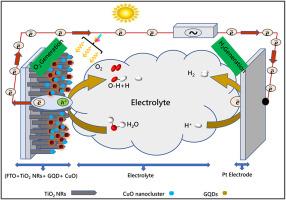
Photoelectrochemical (PEC) water splitting technique is one of the most promising, cost-effective, and environmentally friendly techniques for solar H2 production. However, the widely accepted TiO2 semiconductor photocatalyst for a PEC system portrays less visible light absorption due to its wide bandgap and rapid recombination of e−/h+ pairs that ultimately lead to its low hydrogen production efficiency. Herein this work, heterostructure graphene quantum dots (GQDs) and cupric oxide (CuO) modified TiO2 based photocatalyst were prepared to elucidate the optoelectronic and charge transfer properties of the TiO2 based photocatalysts to enhance their photocatalytic performances. The GQD and CuO modified TiO2 based photocatalysts were synthesized via hydrothermal synthesis technique at calcination temperature of 450 °C for calcination durations up to 3 h. The effect of the dopants was investigated on various physiochemical properties including structural, morphological, chemical, elemental, optoelectronic and as well as, photoelectrochemical properties. The developed CuO/GQD@TiO2 heterostructure photocatalyst presented the lowest energy bandgap (2.16 eV), enhanced visible light absorption (up to ∼745 nm), and reduced recombination of the charge carriers. The optimized tri-layered novel CuO/GQD@TiO2 photocatalyst demonstrated maximum H2 production up to 34,466 μmol g−1h−1 with photoconversion efficiency ∼9.01 %. Overall, the presented mechanistic insight and targeted strategy of incorporating CuO and GQD into TiO2 photocatalyst provides a fresh perspective in producing H2 efficiently using PEC approach.
期刊介绍:
Materials Chemistry and Physics is devoted to short communications, full-length research papers and feature articles on interrelationships among structure, properties, processing and performance of materials. The Editors welcome manuscripts on thin films, surface and interface science, materials degradation and reliability, metallurgy, semiconductors and optoelectronic materials, fine ceramics, magnetics, superconductors, specialty polymers, nano-materials and composite materials.




 京公网安备 11010802042870号
京ICP备2023020795号-1
京公网安备 11010802042870号
京ICP备2023020795号-1

 分享
分享
 求助内容:
求助内容: 应助结果提醒方式:
 扫码关注我们
