Emilia A Hermann, Jesse X Yang, Elsa Angelini, Pallavi Balte, David A Bluemke, James Carr, Katja Derlin, Antoinette S Gomes, Mohammadali Habibi, Eric A Hoffman, Chris Johns, Steven M Kawut, David G Kiely, Andrew Laine, Joao A C Lima, Martin R Prince, Benjamin Smith, Jens Vogel-Claussen, Karol Watson, Jim M Wild, Andrew J Swift, R Graham Barr
{"title":"磁共振成像估计的CT肺气肿亚型和心脏血流动力学:MESA COPD研究。","authors":"Emilia A Hermann, Jesse X Yang, Elsa Angelini, Pallavi Balte, David A Bluemke, James Carr, Katja Derlin, Antoinette S Gomes, Mohammadali Habibi, Eric A Hoffman, Chris Johns, Steven M Kawut, David G Kiely, Andrew Laine, Joao A C Lima, Martin R Prince, Benjamin Smith, Jens Vogel-Claussen, Karol Watson, Jim M Wild, Andrew J Swift, R Graham Barr","doi":"10.1016/j.chest.2025.03.009","DOIUrl":null,"url":null,"abstract":"<p><strong>Background: </strong>COPD is traditionally associated with pulmonary hypertension, but treatments targeting elevated pulmonary artery pressure in COPD have largely failed, possibly due to an incomplete understanding of subphenotypes of the disease.</p><p><strong>Research question: </strong>Are novel machine-learned CT emphysema subtypes associated with specific cardiac hemodynamic profiles?</p><p><strong>Study design and methods: </strong>The Multi-Ethnic Study of Atherosclerosis (MESA) COPD Study recruited participants with and without COPD aged 50 to 79 years with ≥ 10 pack-years of smoking and without clinical cardiovascular disease, predominantly from MESA and a lung cancer screening cohort. COPD and COPD severity were defined by standard spirometric criteria. CT emphysema subtypes were defined by unsupervised machine learning in an independent study and labeled on chest CT scans. Hemodynamics were estimated on cardiac MRI using validated equations. Linear regression models were weighted by the inverse probability of sampling and adjusted for potential confounders.</p><p><strong>Results: </strong>The mean age of the 300 participants was 68 ± 7 years, 60% were male, 28% currently smoked, and 47% had COPD (45% of mild and 41% of moderate severity). More severe COPD was associated with lower estimated pulmonary arterial wedge pressure (ePAWP; P trend = .02) and greater estimated pulmonary vascular resistance (ePVR; P trend = .03) but not estimated pulmonary artery pressure (ePAP; P trend = 0.83). Only the combined bronchitic-apical emphysema subtype was associated with greater ePAP (1.08 mm Hg/10%; 95% CI, 0.40-1.75). The diffuse emphysema subtype was associated with lower ePAWP (-0.49 mm Hg/10%; 95% CI, -0.75 to -0.24) and greater ePVR (0.36 Wood units/10%; 95% CI, 0.10-0.61).</p><p><strong>Interpretation: </strong>In this case-control study of predominantly mild-moderate COPD, greater ePAP was specific to the combined bronchitic-apical emphysema subtype whereas the diffuse emphysema subtype and COPD severity were associated with lower ePAWP and greater ePVR. The CT emphysema subtype findings suggest more precise avenues to therapeutic interventions in cardiopulmonary dysfunction.</p>","PeriodicalId":9782,"journal":{"name":"Chest","volume":" ","pages":"364-378"},"PeriodicalIF":8.6000,"publicationDate":"2025-08-01","publicationTypes":"Journal Article","fieldsOfStudy":null,"isOpenAccess":false,"openAccessPdf":"https://www.ncbi.nlm.nih.gov/pmc/articles/PMC12313324/pdf/","citationCount":"0","resultStr":"{\"title\":\"CT Emphysema Subtypes and Cardiac Hemodynamics Estimated on MRI: The Multi-Ethnic Study of Atherosclerosis COPD Study.\",\"authors\":\"Emilia A Hermann, Jesse X Yang, Elsa Angelini, Pallavi Balte, David A Bluemke, James Carr, Katja Derlin, Antoinette S Gomes, Mohammadali Habibi, Eric A Hoffman, Chris Johns, Steven M Kawut, David G Kiely, Andrew Laine, Joao A C Lima, Martin R Prince, Benjamin Smith, Jens Vogel-Claussen, Karol Watson, Jim M Wild, Andrew J Swift, R Graham Barr\",\"doi\":\"10.1016/j.chest.2025.03.009\",\"DOIUrl\":null,\"url\":null,\"abstract\":\"<p><strong>Background: </strong>COPD is traditionally associated with pulmonary hypertension, but treatments targeting elevated pulmonary artery pressure in COPD have largely failed, possibly due to an incomplete understanding of subphenotypes of the disease.</p><p><strong>Research question: </strong>Are novel machine-learned CT emphysema subtypes associated with specific cardiac hemodynamic profiles?</p><p><strong>Study design and methods: </strong>The Multi-Ethnic Study of Atherosclerosis (MESA) COPD Study recruited participants with and without COPD aged 50 to 79 years with ≥ 10 pack-years of smoking and without clinical cardiovascular disease, predominantly from MESA and a lung cancer screening cohort. COPD and COPD severity were defined by standard spirometric criteria. CT emphysema subtypes were defined by unsupervised machine learning in an independent study and labeled on chest CT scans. Hemodynamics were estimated on cardiac MRI using validated equations. Linear regression models were weighted by the inverse probability of sampling and adjusted for potential confounders.</p><p><strong>Results: </strong>The mean age of the 300 participants was 68 ± 7 years, 60% were male, 28% currently smoked, and 47% had COPD (45% of mild and 41% of moderate severity). More severe COPD was associated with lower estimated pulmonary arterial wedge pressure (ePAWP; P trend = .02) and greater estimated pulmonary vascular resistance (ePVR; P trend = .03) but not estimated pulmonary artery pressure (ePAP; P trend = 0.83). Only the combined bronchitic-apical emphysema subtype was associated with greater ePAP (1.08 mm Hg/10%; 95% CI, 0.40-1.75). The diffuse emphysema subtype was associated with lower ePAWP (-0.49 mm Hg/10%; 95% CI, -0.75 to -0.24) and greater ePVR (0.36 Wood units/10%; 95% CI, 0.10-0.61).</p><p><strong>Interpretation: </strong>In this case-control study of predominantly mild-moderate COPD, greater ePAP was specific to the combined bronchitic-apical emphysema subtype whereas the diffuse emphysema subtype and COPD severity were associated with lower ePAWP and greater ePVR. The CT emphysema subtype findings suggest more precise avenues to therapeutic interventions in cardiopulmonary dysfunction.</p>\",\"PeriodicalId\":9782,\"journal\":{\"name\":\"Chest\",\"volume\":\" \",\"pages\":\"364-378\"},\"PeriodicalIF\":8.6000,\"publicationDate\":\"2025-08-01\",\"publicationTypes\":\"Journal Article\",\"fieldsOfStudy\":null,\"isOpenAccess\":false,\"openAccessPdf\":\"https://www.ncbi.nlm.nih.gov/pmc/articles/PMC12313324/pdf/\",\"citationCount\":\"0\",\"resultStr\":null,\"platform\":\"Semanticscholar\",\"paperid\":null,\"PeriodicalName\":\"Chest\",\"FirstCategoryId\":\"3\",\"ListUrlMain\":\"https://doi.org/10.1016/j.chest.2025.03.009\",\"RegionNum\":1,\"RegionCategory\":\"医学\",\"ArticlePicture\":[],\"TitleCN\":null,\"AbstractTextCN\":null,\"PMCID\":null,\"EPubDate\":\"2025/3/27 0:00:00\",\"PubModel\":\"Epub\",\"JCR\":\"Q1\",\"JCRName\":\"CRITICAL CARE MEDICINE\",\"Score\":null,\"Total\":0}","platform":"Semanticscholar","paperid":null,"PeriodicalName":"Chest","FirstCategoryId":"3","ListUrlMain":"https://doi.org/10.1016/j.chest.2025.03.009","RegionNum":1,"RegionCategory":"医学","ArticlePicture":[],"TitleCN":null,"AbstractTextCN":null,"PMCID":null,"EPubDate":"2025/3/27 0:00:00","PubModel":"Epub","JCR":"Q1","JCRName":"CRITICAL CARE MEDICINE","Score":null,"Total":0}
CT Emphysema Subtypes and Cardiac Hemodynamics Estimated on MRI: The Multi-Ethnic Study of Atherosclerosis COPD Study.
Background: COPD is traditionally associated with pulmonary hypertension, but treatments targeting elevated pulmonary artery pressure in COPD have largely failed, possibly due to an incomplete understanding of subphenotypes of the disease.
Research question: Are novel machine-learned CT emphysema subtypes associated with specific cardiac hemodynamic profiles?
Study design and methods: The Multi-Ethnic Study of Atherosclerosis (MESA) COPD Study recruited participants with and without COPD aged 50 to 79 years with ≥ 10 pack-years of smoking and without clinical cardiovascular disease, predominantly from MESA and a lung cancer screening cohort. COPD and COPD severity were defined by standard spirometric criteria. CT emphysema subtypes were defined by unsupervised machine learning in an independent study and labeled on chest CT scans. Hemodynamics were estimated on cardiac MRI using validated equations. Linear regression models were weighted by the inverse probability of sampling and adjusted for potential confounders.
Results: The mean age of the 300 participants was 68 ± 7 years, 60% were male, 28% currently smoked, and 47% had COPD (45% of mild and 41% of moderate severity). More severe COPD was associated with lower estimated pulmonary arterial wedge pressure (ePAWP; P trend = .02) and greater estimated pulmonary vascular resistance (ePVR; P trend = .03) but not estimated pulmonary artery pressure (ePAP; P trend = 0.83). Only the combined bronchitic-apical emphysema subtype was associated with greater ePAP (1.08 mm Hg/10%; 95% CI, 0.40-1.75). The diffuse emphysema subtype was associated with lower ePAWP (-0.49 mm Hg/10%; 95% CI, -0.75 to -0.24) and greater ePVR (0.36 Wood units/10%; 95% CI, 0.10-0.61).
Interpretation: In this case-control study of predominantly mild-moderate COPD, greater ePAP was specific to the combined bronchitic-apical emphysema subtype whereas the diffuse emphysema subtype and COPD severity were associated with lower ePAWP and greater ePVR. The CT emphysema subtype findings suggest more precise avenues to therapeutic interventions in cardiopulmonary dysfunction.
期刊介绍:
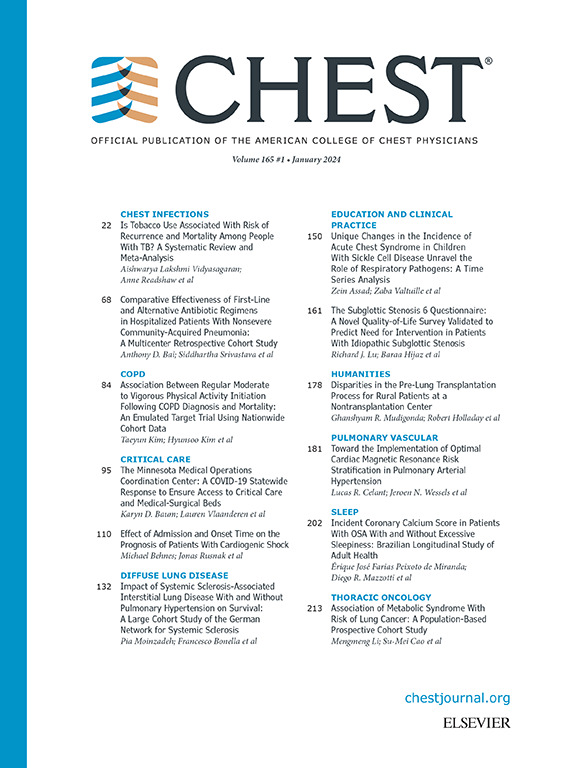
At CHEST, our mission is to revolutionize patient care through the collaboration of multidisciplinary clinicians in the fields of pulmonary, critical care, and sleep medicine. We achieve this by publishing cutting-edge clinical research that addresses current challenges and brings forth future advancements. To enhance understanding in a rapidly evolving field, CHEST also features review articles, commentaries, and facilitates discussions on emerging controversies. We place great emphasis on scientific rigor, employing a rigorous peer review process, and ensuring all accepted content is published online within two weeks.




 京公网安备 11010802042870号
京ICP备2023020795号-1
京公网安备 11010802042870号
京ICP备2023020795号-1

 分享
分享
 求助内容:
求助内容: 应助结果提醒方式:
 扫码关注我们
