Linyan He , Jinze Li , Lizhan Tang , Yifei Wang , Xueyu Zhao , Keke Ding , Linji Xu , Li Gu , Shang Cheng , Yi yuan Wei
{"title":"氨胁迫下应用侧流气体再循环促进食物垃圾厌氧消化:气态环境对微生物的影响被忽视","authors":"Linyan He , Jinze Li , Lizhan Tang , Yifei Wang , Xueyu Zhao , Keke Ding , Linji Xu , Li Gu , Shang Cheng , Yi yuan Wei","doi":"10.1016/j.watres.2025.123571","DOIUrl":null,"url":null,"abstract":"<div><div>High ammonia concentrations can be toxic to microorganisms, leading to the accumulation of hydrogen (H<sub>2</sub>) and acids in anaerobic digestion (AD) system. In this study, a side gas recycling strategy (SGR), coupled with a primary reactor and a small side-stream reactor, which recirculates biogas between primary reactor and side reactor was employed to mitigate ammonia inhibition. This approach enabled the mesophilic side-stream gas recirculation system (SMGR) and the thermophilic side-stream gas recirculation system (STGR) to ultimately withstand ammonia stress levels of 2.5 g/L and 3.5 g/L, respectively, while maintaining lower hydrogen partial pressures. In contrast, the control group experienced system failure at an ammonia concentration of 2 g/L. Enzyme activity, microbial community, and metaproteomic analysis indicated that the side reactor enriched microorganisms with strong hydrogen-utilizing capacity, while the primary reactor was enriched with Methanosaeta. Furthermore, key pathways related to propionate metabolism, ABC transporters, and methane production were enhanced in the primary reactor, along with increased ATPase activity. The activity of key enzymes involved in AD was also significantly enhanced. This study enhances the understanding of the impact of gas atmosphere control on the microbial ecology and metabolic characteristics of AD system, providing valuable insights and practical guidance for the development of Engineering applications in this field.</div></div>","PeriodicalId":443,"journal":{"name":"Water Research","volume":"281 ","pages":"Article 123571"},"PeriodicalIF":12.4000,"publicationDate":"2025-08-01","publicationTypes":"Journal Article","fieldsOfStudy":null,"isOpenAccess":false,"openAccessPdf":"","citationCount":"0","resultStr":"{\"title\":\"Applying side-stream gas recirculation to promote anaerobic digestion of food waste under ammonia stress: Overlooked impact of gaseous atmospheres on microorganisms\",\"authors\":\"Linyan He , Jinze Li , Lizhan Tang , Yifei Wang , Xueyu Zhao , Keke Ding , Linji Xu , Li Gu , Shang Cheng , Yi yuan Wei\",\"doi\":\"10.1016/j.watres.2025.123571\",\"DOIUrl\":null,\"url\":null,\"abstract\":\"<div><div>High ammonia concentrations can be toxic to microorganisms, leading to the accumulation of hydrogen (H<sub>2</sub>) and acids in anaerobic digestion (AD) system. In this study, a side gas recycling strategy (SGR), coupled with a primary reactor and a small side-stream reactor, which recirculates biogas between primary reactor and side reactor was employed to mitigate ammonia inhibition. This approach enabled the mesophilic side-stream gas recirculation system (SMGR) and the thermophilic side-stream gas recirculation system (STGR) to ultimately withstand ammonia stress levels of 2.5 g/L and 3.5 g/L, respectively, while maintaining lower hydrogen partial pressures. In contrast, the control group experienced system failure at an ammonia concentration of 2 g/L. Enzyme activity, microbial community, and metaproteomic analysis indicated that the side reactor enriched microorganisms with strong hydrogen-utilizing capacity, while the primary reactor was enriched with Methanosaeta. Furthermore, key pathways related to propionate metabolism, ABC transporters, and methane production were enhanced in the primary reactor, along with increased ATPase activity. The activity of key enzymes involved in AD was also significantly enhanced. This study enhances the understanding of the impact of gas atmosphere control on the microbial ecology and metabolic characteristics of AD system, providing valuable insights and practical guidance for the development of Engineering applications in this field.</div></div>\",\"PeriodicalId\":443,\"journal\":{\"name\":\"Water Research\",\"volume\":\"281 \",\"pages\":\"Article 123571\"},\"PeriodicalIF\":12.4000,\"publicationDate\":\"2025-08-01\",\"publicationTypes\":\"Journal Article\",\"fieldsOfStudy\":null,\"isOpenAccess\":false,\"openAccessPdf\":\"\",\"citationCount\":\"0\",\"resultStr\":null,\"platform\":\"Semanticscholar\",\"paperid\":null,\"PeriodicalName\":\"Water Research\",\"FirstCategoryId\":\"93\",\"ListUrlMain\":\"https://www.sciencedirect.com/science/article/pii/S0043135425004841\",\"RegionNum\":1,\"RegionCategory\":\"环境科学与生态学\",\"ArticlePicture\":[],\"TitleCN\":null,\"AbstractTextCN\":null,\"PMCID\":null,\"EPubDate\":\"2025/3/31 0:00:00\",\"PubModel\":\"Epub\",\"JCR\":\"Q1\",\"JCRName\":\"ENGINEERING, ENVIRONMENTAL\",\"Score\":null,\"Total\":0}","platform":"Semanticscholar","paperid":null,"PeriodicalName":"Water Research","FirstCategoryId":"93","ListUrlMain":"https://www.sciencedirect.com/science/article/pii/S0043135425004841","RegionNum":1,"RegionCategory":"环境科学与生态学","ArticlePicture":[],"TitleCN":null,"AbstractTextCN":null,"PMCID":null,"EPubDate":"2025/3/31 0:00:00","PubModel":"Epub","JCR":"Q1","JCRName":"ENGINEERING, ENVIRONMENTAL","Score":null,"Total":0}
Applying side-stream gas recirculation to promote anaerobic digestion of food waste under ammonia stress: Overlooked impact of gaseous atmospheres on microorganisms
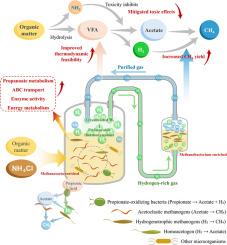
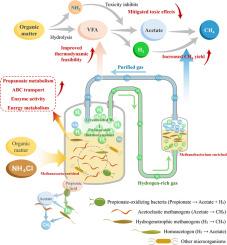
High ammonia concentrations can be toxic to microorganisms, leading to the accumulation of hydrogen (H2) and acids in anaerobic digestion (AD) system. In this study, a side gas recycling strategy (SGR), coupled with a primary reactor and a small side-stream reactor, which recirculates biogas between primary reactor and side reactor was employed to mitigate ammonia inhibition. This approach enabled the mesophilic side-stream gas recirculation system (SMGR) and the thermophilic side-stream gas recirculation system (STGR) to ultimately withstand ammonia stress levels of 2.5 g/L and 3.5 g/L, respectively, while maintaining lower hydrogen partial pressures. In contrast, the control group experienced system failure at an ammonia concentration of 2 g/L. Enzyme activity, microbial community, and metaproteomic analysis indicated that the side reactor enriched microorganisms with strong hydrogen-utilizing capacity, while the primary reactor was enriched with Methanosaeta. Furthermore, key pathways related to propionate metabolism, ABC transporters, and methane production were enhanced in the primary reactor, along with increased ATPase activity. The activity of key enzymes involved in AD was also significantly enhanced. This study enhances the understanding of the impact of gas atmosphere control on the microbial ecology and metabolic characteristics of AD system, providing valuable insights and practical guidance for the development of Engineering applications in this field.
期刊介绍:
Water Research, along with its open access companion journal Water Research X, serves as a platform for publishing original research papers covering various aspects of the science and technology related to the anthropogenic water cycle, water quality, and its management worldwide. The audience targeted by the journal comprises biologists, chemical engineers, chemists, civil engineers, environmental engineers, limnologists, and microbiologists. The scope of the journal include:
•Treatment processes for water and wastewaters (municipal, agricultural, industrial, and on-site treatment), including resource recovery and residuals management;
•Urban hydrology including sewer systems, stormwater management, and green infrastructure;
•Drinking water treatment and distribution;
•Potable and non-potable water reuse;
•Sanitation, public health, and risk assessment;
•Anaerobic digestion, solid and hazardous waste management, including source characterization and the effects and control of leachates and gaseous emissions;
•Contaminants (chemical, microbial, anthropogenic particles such as nanoparticles or microplastics) and related water quality sensing, monitoring, fate, and assessment;
•Anthropogenic impacts on inland, tidal, coastal and urban waters, focusing on surface and ground waters, and point and non-point sources of pollution;
•Environmental restoration, linked to surface water, groundwater and groundwater remediation;
•Analysis of the interfaces between sediments and water, and between water and atmosphere, focusing specifically on anthropogenic impacts;
•Mathematical modelling, systems analysis, machine learning, and beneficial use of big data related to the anthropogenic water cycle;
•Socio-economic, policy, and regulations studies.




 京公网安备 11010802042870号
京ICP备2023020795号-1
京公网安备 11010802042870号
京ICP备2023020795号-1

 分享
分享
 求助内容:
求助内容: 应助结果提醒方式:
 扫码关注我们
