Qingrong Li , Yang-Yang Zhang , Guo-Hao Zhang , Yilin Qin , Wencai Cheng , Xinyu Wang , Liuyuan Fu , Nan Wang , Xiaoan Li , Faqin Dong , Jun Li , Xiaoqin Nie
{"title":"模拟自然环境下植酸和绿泥石对腐坏希瓦氏菌除铀的耦合效应","authors":"Qingrong Li , Yang-Yang Zhang , Guo-Hao Zhang , Yilin Qin , Wencai Cheng , Xinyu Wang , Liuyuan Fu , Nan Wang , Xiaoan Li , Faqin Dong , Jun Li , Xiaoqin Nie","doi":"10.1016/j.watres.2025.123582","DOIUrl":null,"url":null,"abstract":"<div><div>Understanding the transport and transformation of uranium species in surface and underground water environments, including biological migration, is a critical issue in nuclear environmental research. While it is known that uranium is primarily immobilized through reduction and mineralization with clay minerals and microorganisms, the coupled processes involving these motifs and their molecular mechanisms under multiple environmental factors remain elusive. In this work, using phytic acid (denoted as IP<sub>6</sub> hereinafter) as a typical organic ligand and chlorite (a layered hydrous aluminum silicate with Mg<sup>2+</sup>, Fe<sup>2+</sup>, etc.) as a typical inorganic clay mineral, we investigate the immobilization of UO<sub>2</sub><sup>2+</sup> [abbreviated as U(VI) here in after] by <em>S. putrefaciens</em> under simulated natural aerobic conditions. The experimental results show that in aerobic environment, the reduction of uranium by <em>S. putrefaciens</em> is inhibited, and only mineralized products are observed. In the chlorite-U(VI) system, UO<sub>2</sub><sup>2+</sup> enters the chlorite interlayer due to internal channel restriction effects and becomes more firmly fixed over time. When there are decomposed <em>S. putrefaciens</em>, UO<sub>2</sub><sup>2+</sup> is fixed by its stronger binding sites and adsorbed on the surface of chlorite. After adding phytic acid, the process of uranium biomineralization by <em>S. putrefaciens</em> is blocked. In the simulated aerobic four component system, some Fe<sup>2+</sup> and Mg<sup>2+</sup> ions dissolve from the chlorite and replace the UO<sub>2</sub><sup>2+</sup> adsorbed by IP<sub>6</sub>. The released UO<sub>2</sub><sup>2+</sup> combines with the decomposing <em>S. putrefaciens</em>, and the complex deposits on the surface of the chlorite. At low pH values (pH<5.5), IP<sub>6</sub> dissolves the metal ions of the chlorite and reduces their coupling with uranium coordination. Quantum-chemical methods are utilized to understand the experimental results at the molecular level and to provide an analysis of the interlayer structure of uranium in clay minerals. This study delves into the migration and fixation mechanisms of uranium in complex aerobic water environments, providing a theoretical basis for in-situ remediation of uranium contaminated water environments and understanding the biogeochemical behavior of nuclides in aquatic ecological environments.</div></div>","PeriodicalId":443,"journal":{"name":"Water Research","volume":"281 ","pages":"Article 123582"},"PeriodicalIF":12.4000,"publicationDate":"2025-08-01","publicationTypes":"Journal Article","fieldsOfStudy":null,"isOpenAccess":false,"openAccessPdf":"","citationCount":"0","resultStr":"{\"title\":\"Coupling effect of phytic acid and chlorite on uranium removal by Shewanella putrefaciens under simulated natural environment\",\"authors\":\"Qingrong Li , Yang-Yang Zhang , Guo-Hao Zhang , Yilin Qin , Wencai Cheng , Xinyu Wang , Liuyuan Fu , Nan Wang , Xiaoan Li , Faqin Dong , Jun Li , Xiaoqin Nie\",\"doi\":\"10.1016/j.watres.2025.123582\",\"DOIUrl\":null,\"url\":null,\"abstract\":\"<div><div>Understanding the transport and transformation of uranium species in surface and underground water environments, including biological migration, is a critical issue in nuclear environmental research. While it is known that uranium is primarily immobilized through reduction and mineralization with clay minerals and microorganisms, the coupled processes involving these motifs and their molecular mechanisms under multiple environmental factors remain elusive. In this work, using phytic acid (denoted as IP<sub>6</sub> hereinafter) as a typical organic ligand and chlorite (a layered hydrous aluminum silicate with Mg<sup>2+</sup>, Fe<sup>2+</sup>, etc.) as a typical inorganic clay mineral, we investigate the immobilization of UO<sub>2</sub><sup>2+</sup> [abbreviated as U(VI) here in after] by <em>S. putrefaciens</em> under simulated natural aerobic conditions. The experimental results show that in aerobic environment, the reduction of uranium by <em>S. putrefaciens</em> is inhibited, and only mineralized products are observed. In the chlorite-U(VI) system, UO<sub>2</sub><sup>2+</sup> enters the chlorite interlayer due to internal channel restriction effects and becomes more firmly fixed over time. When there are decomposed <em>S. putrefaciens</em>, UO<sub>2</sub><sup>2+</sup> is fixed by its stronger binding sites and adsorbed on the surface of chlorite. After adding phytic acid, the process of uranium biomineralization by <em>S. putrefaciens</em> is blocked. In the simulated aerobic four component system, some Fe<sup>2+</sup> and Mg<sup>2+</sup> ions dissolve from the chlorite and replace the UO<sub>2</sub><sup>2+</sup> adsorbed by IP<sub>6</sub>. The released UO<sub>2</sub><sup>2+</sup> combines with the decomposing <em>S. putrefaciens</em>, and the complex deposits on the surface of the chlorite. At low pH values (pH<5.5), IP<sub>6</sub> dissolves the metal ions of the chlorite and reduces their coupling with uranium coordination. Quantum-chemical methods are utilized to understand the experimental results at the molecular level and to provide an analysis of the interlayer structure of uranium in clay minerals. This study delves into the migration and fixation mechanisms of uranium in complex aerobic water environments, providing a theoretical basis for in-situ remediation of uranium contaminated water environments and understanding the biogeochemical behavior of nuclides in aquatic ecological environments.</div></div>\",\"PeriodicalId\":443,\"journal\":{\"name\":\"Water Research\",\"volume\":\"281 \",\"pages\":\"Article 123582\"},\"PeriodicalIF\":12.4000,\"publicationDate\":\"2025-08-01\",\"publicationTypes\":\"Journal Article\",\"fieldsOfStudy\":null,\"isOpenAccess\":false,\"openAccessPdf\":\"\",\"citationCount\":\"0\",\"resultStr\":null,\"platform\":\"Semanticscholar\",\"paperid\":null,\"PeriodicalName\":\"Water Research\",\"FirstCategoryId\":\"93\",\"ListUrlMain\":\"https://www.sciencedirect.com/science/article/pii/S0043135425004956\",\"RegionNum\":1,\"RegionCategory\":\"环境科学与生态学\",\"ArticlePicture\":[],\"TitleCN\":null,\"AbstractTextCN\":null,\"PMCID\":null,\"EPubDate\":\"2025/3/31 0:00:00\",\"PubModel\":\"Epub\",\"JCR\":\"Q1\",\"JCRName\":\"ENGINEERING, ENVIRONMENTAL\",\"Score\":null,\"Total\":0}","platform":"Semanticscholar","paperid":null,"PeriodicalName":"Water Research","FirstCategoryId":"93","ListUrlMain":"https://www.sciencedirect.com/science/article/pii/S0043135425004956","RegionNum":1,"RegionCategory":"环境科学与生态学","ArticlePicture":[],"TitleCN":null,"AbstractTextCN":null,"PMCID":null,"EPubDate":"2025/3/31 0:00:00","PubModel":"Epub","JCR":"Q1","JCRName":"ENGINEERING, ENVIRONMENTAL","Score":null,"Total":0}
引用次数: 0
摘要
了解铀在地表水和地下水环境中的迁移和转化,包括生物迁移,是核环境研究的关键问题。虽然已知铀主要是通过粘土矿物和微生物的还原和矿化来固定化的,但涉及这些基序的耦合过程及其在多种环境因素下的分子机制仍然难以捉摸。本文以植酸(以下简称IP6)为典型有机配体,绿泥石(含Mg2+、Fe2+等的层状水合硅酸铝)为典型无机粘土矿物,研究了腐殖质链球菌在模拟自然好氧条件下对UO22+(以下简称U(VI))的固定化。实验结果表明,在好氧环境下,腐坏葡萄球菌对铀的还原受到抑制,只观察到矿化产物。在绿泥石- u (VI)体系中,UO22+由于内部通道的限制作用进入绿泥石夹层,并随着时间的推移变得更加牢固。当存在腐烂的S. putrefaciens时,UO22+被其较强的结合位点固定并吸附在绿泥石表面。添加植酸后,可阻断腐坏葡萄球菌对铀的生物矿化过程。在模拟好氧四组分体系中,部分Fe2+和Mg2+离子从绿泥石中溶解出来,取代了IP6吸附的UO22+。释放出的UO22+与分解的腐杆菌结合,复合物沉积在绿泥石表面。在低pH值(pH<5.5)下,IP6溶解了绿泥石中的金属离子,减少了它们与铀配位的偶联。利用量子化学方法在分子水平上解释实验结果,并对粘土矿物中铀的层间结构进行了深入分析。本研究深入研究了铀在复杂好氧水环境中的迁移和固定机制,为铀污染水环境的原位修复和了解水生生态环境中核素的生物地球化学行为提供理论依据。
Coupling effect of phytic acid and chlorite on uranium removal by Shewanella putrefaciens under simulated natural environment
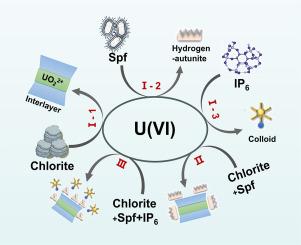
Understanding the transport and transformation of uranium species in surface and underground water environments, including biological migration, is a critical issue in nuclear environmental research. While it is known that uranium is primarily immobilized through reduction and mineralization with clay minerals and microorganisms, the coupled processes involving these motifs and their molecular mechanisms under multiple environmental factors remain elusive. In this work, using phytic acid (denoted as IP6 hereinafter) as a typical organic ligand and chlorite (a layered hydrous aluminum silicate with Mg2+, Fe2+, etc.) as a typical inorganic clay mineral, we investigate the immobilization of UO22+ [abbreviated as U(VI) here in after] by S. putrefaciens under simulated natural aerobic conditions. The experimental results show that in aerobic environment, the reduction of uranium by S. putrefaciens is inhibited, and only mineralized products are observed. In the chlorite-U(VI) system, UO22+ enters the chlorite interlayer due to internal channel restriction effects and becomes more firmly fixed over time. When there are decomposed S. putrefaciens, UO22+ is fixed by its stronger binding sites and adsorbed on the surface of chlorite. After adding phytic acid, the process of uranium biomineralization by S. putrefaciens is blocked. In the simulated aerobic four component system, some Fe2+ and Mg2+ ions dissolve from the chlorite and replace the UO22+ adsorbed by IP6. The released UO22+ combines with the decomposing S. putrefaciens, and the complex deposits on the surface of the chlorite. At low pH values (pH<5.5), IP6 dissolves the metal ions of the chlorite and reduces their coupling with uranium coordination. Quantum-chemical methods are utilized to understand the experimental results at the molecular level and to provide an analysis of the interlayer structure of uranium in clay minerals. This study delves into the migration and fixation mechanisms of uranium in complex aerobic water environments, providing a theoretical basis for in-situ remediation of uranium contaminated water environments and understanding the biogeochemical behavior of nuclides in aquatic ecological environments.
期刊介绍:
Water Research, along with its open access companion journal Water Research X, serves as a platform for publishing original research papers covering various aspects of the science and technology related to the anthropogenic water cycle, water quality, and its management worldwide. The audience targeted by the journal comprises biologists, chemical engineers, chemists, civil engineers, environmental engineers, limnologists, and microbiologists. The scope of the journal include:
•Treatment processes for water and wastewaters (municipal, agricultural, industrial, and on-site treatment), including resource recovery and residuals management;
•Urban hydrology including sewer systems, stormwater management, and green infrastructure;
•Drinking water treatment and distribution;
•Potable and non-potable water reuse;
•Sanitation, public health, and risk assessment;
•Anaerobic digestion, solid and hazardous waste management, including source characterization and the effects and control of leachates and gaseous emissions;
•Contaminants (chemical, microbial, anthropogenic particles such as nanoparticles or microplastics) and related water quality sensing, monitoring, fate, and assessment;
•Anthropogenic impacts on inland, tidal, coastal and urban waters, focusing on surface and ground waters, and point and non-point sources of pollution;
•Environmental restoration, linked to surface water, groundwater and groundwater remediation;
•Analysis of the interfaces between sediments and water, and between water and atmosphere, focusing specifically on anthropogenic impacts;
•Mathematical modelling, systems analysis, machine learning, and beneficial use of big data related to the anthropogenic water cycle;
•Socio-economic, policy, and regulations studies.




 京公网安备 11010802042870号
京ICP备2023020795号-1
京公网安备 11010802042870号
京ICP备2023020795号-1

 分享
分享
 求助内容:
求助内容: 应助结果提醒方式:
 扫码关注我们
