Cheolyong Kim , Philipp Debusmann , Mohammad Sajjad Abdighahroudi , Jochen Schumacher , Holger V. Lutze
{"title":"fenton -混凝法同时处理废水中的微污染物和溶解性有机碳","authors":"Cheolyong Kim , Philipp Debusmann , Mohammad Sajjad Abdighahroudi , Jochen Schumacher , Holger V. Lutze","doi":"10.1016/j.watres.2025.123583","DOIUrl":null,"url":null,"abstract":"<div><div>This study demonstrates the integration of the Fenton reaction into the flocculation process at circumneutral pH (6–7), offering a practical approach for simultaneous micropollutant and organic matter removal in wastewater treatment. Unlike conventional Fenton oxidation, which requires acidic conditions, this approach allows Fe(II) to react with hydrogen peroxide at near-neutral pH, forming Fe(III) flocs that enhance flocculation while also generating reactive species for pollutant degradation. At pH 6, hydroxyl radicals were the dominant oxidants, whereas at pH 7, additional reactive species likely contributed to micropollutant removal. Bisphenol A and benzoic acid were removed by approximately 90% at 1 mM peroxide and 2 mM iron. In addition to micropollutant degradation, the Fenton-coagulation process achieved substantial dissolved organic carbon (DOC) removal, which was not observed with Fenton oxidation alone or ozonation. DOC removal was up to 51% in Suwannee River Natural Organic Matter solutions, whereas only 30% of DOC was removed from municipal wastewater effluent, likely due to differences in organic matter composition. These findings highlight the potential of Fenton-coagulation as an effective and scalable treatment strategy for wastewater reuse, improving both pollutant degradation and organic matter removal under practical conditions.</div></div>","PeriodicalId":443,"journal":{"name":"Water Research","volume":"281 ","pages":"Article 123583"},"PeriodicalIF":12.4000,"publicationDate":"2025-08-01","publicationTypes":"Journal Article","fieldsOfStudy":null,"isOpenAccess":false,"openAccessPdf":"","citationCount":"0","resultStr":"{\"title\":\"Fenton–coagulation process for simultaneous abatement of micropollutants and dissolved organic carbon in treated wastewater\",\"authors\":\"Cheolyong Kim , Philipp Debusmann , Mohammad Sajjad Abdighahroudi , Jochen Schumacher , Holger V. Lutze\",\"doi\":\"10.1016/j.watres.2025.123583\",\"DOIUrl\":null,\"url\":null,\"abstract\":\"<div><div>This study demonstrates the integration of the Fenton reaction into the flocculation process at circumneutral pH (6–7), offering a practical approach for simultaneous micropollutant and organic matter removal in wastewater treatment. Unlike conventional Fenton oxidation, which requires acidic conditions, this approach allows Fe(II) to react with hydrogen peroxide at near-neutral pH, forming Fe(III) flocs that enhance flocculation while also generating reactive species for pollutant degradation. At pH 6, hydroxyl radicals were the dominant oxidants, whereas at pH 7, additional reactive species likely contributed to micropollutant removal. Bisphenol A and benzoic acid were removed by approximately 90% at 1 mM peroxide and 2 mM iron. In addition to micropollutant degradation, the Fenton-coagulation process achieved substantial dissolved organic carbon (DOC) removal, which was not observed with Fenton oxidation alone or ozonation. DOC removal was up to 51% in Suwannee River Natural Organic Matter solutions, whereas only 30% of DOC was removed from municipal wastewater effluent, likely due to differences in organic matter composition. These findings highlight the potential of Fenton-coagulation as an effective and scalable treatment strategy for wastewater reuse, improving both pollutant degradation and organic matter removal under practical conditions.</div></div>\",\"PeriodicalId\":443,\"journal\":{\"name\":\"Water Research\",\"volume\":\"281 \",\"pages\":\"Article 123583\"},\"PeriodicalIF\":12.4000,\"publicationDate\":\"2025-08-01\",\"publicationTypes\":\"Journal Article\",\"fieldsOfStudy\":null,\"isOpenAccess\":false,\"openAccessPdf\":\"\",\"citationCount\":\"0\",\"resultStr\":null,\"platform\":\"Semanticscholar\",\"paperid\":null,\"PeriodicalName\":\"Water Research\",\"FirstCategoryId\":\"93\",\"ListUrlMain\":\"https://www.sciencedirect.com/science/article/pii/S0043135425004968\",\"RegionNum\":1,\"RegionCategory\":\"环境科学与生态学\",\"ArticlePicture\":[],\"TitleCN\":null,\"AbstractTextCN\":null,\"PMCID\":null,\"EPubDate\":\"2025/3/31 0:00:00\",\"PubModel\":\"Epub\",\"JCR\":\"Q1\",\"JCRName\":\"ENGINEERING, ENVIRONMENTAL\",\"Score\":null,\"Total\":0}","platform":"Semanticscholar","paperid":null,"PeriodicalName":"Water Research","FirstCategoryId":"93","ListUrlMain":"https://www.sciencedirect.com/science/article/pii/S0043135425004968","RegionNum":1,"RegionCategory":"环境科学与生态学","ArticlePicture":[],"TitleCN":null,"AbstractTextCN":null,"PMCID":null,"EPubDate":"2025/3/31 0:00:00","PubModel":"Epub","JCR":"Q1","JCRName":"ENGINEERING, ENVIRONMENTAL","Score":null,"Total":0}
Fenton–coagulation process for simultaneous abatement of micropollutants and dissolved organic carbon in treated wastewater
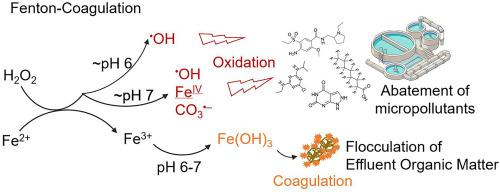
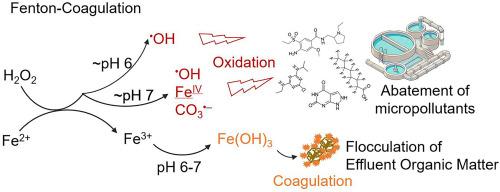
This study demonstrates the integration of the Fenton reaction into the flocculation process at circumneutral pH (6–7), offering a practical approach for simultaneous micropollutant and organic matter removal in wastewater treatment. Unlike conventional Fenton oxidation, which requires acidic conditions, this approach allows Fe(II) to react with hydrogen peroxide at near-neutral pH, forming Fe(III) flocs that enhance flocculation while also generating reactive species for pollutant degradation. At pH 6, hydroxyl radicals were the dominant oxidants, whereas at pH 7, additional reactive species likely contributed to micropollutant removal. Bisphenol A and benzoic acid were removed by approximately 90% at 1 mM peroxide and 2 mM iron. In addition to micropollutant degradation, the Fenton-coagulation process achieved substantial dissolved organic carbon (DOC) removal, which was not observed with Fenton oxidation alone or ozonation. DOC removal was up to 51% in Suwannee River Natural Organic Matter solutions, whereas only 30% of DOC was removed from municipal wastewater effluent, likely due to differences in organic matter composition. These findings highlight the potential of Fenton-coagulation as an effective and scalable treatment strategy for wastewater reuse, improving both pollutant degradation and organic matter removal under practical conditions.
期刊介绍:
Water Research, along with its open access companion journal Water Research X, serves as a platform for publishing original research papers covering various aspects of the science and technology related to the anthropogenic water cycle, water quality, and its management worldwide. The audience targeted by the journal comprises biologists, chemical engineers, chemists, civil engineers, environmental engineers, limnologists, and microbiologists. The scope of the journal include:
•Treatment processes for water and wastewaters (municipal, agricultural, industrial, and on-site treatment), including resource recovery and residuals management;
•Urban hydrology including sewer systems, stormwater management, and green infrastructure;
•Drinking water treatment and distribution;
•Potable and non-potable water reuse;
•Sanitation, public health, and risk assessment;
•Anaerobic digestion, solid and hazardous waste management, including source characterization and the effects and control of leachates and gaseous emissions;
•Contaminants (chemical, microbial, anthropogenic particles such as nanoparticles or microplastics) and related water quality sensing, monitoring, fate, and assessment;
•Anthropogenic impacts on inland, tidal, coastal and urban waters, focusing on surface and ground waters, and point and non-point sources of pollution;
•Environmental restoration, linked to surface water, groundwater and groundwater remediation;
•Analysis of the interfaces between sediments and water, and between water and atmosphere, focusing specifically on anthropogenic impacts;
•Mathematical modelling, systems analysis, machine learning, and beneficial use of big data related to the anthropogenic water cycle;
•Socio-economic, policy, and regulations studies.




 京公网安备 11010802042870号
京ICP备2023020795号-1
京公网安备 11010802042870号
京ICP备2023020795号-1

 分享
分享
 求助内容:
求助内容: 应助结果提醒方式:
 扫码关注我们
