Araz Rawshani, Aidin Rawshani, Gustav Smith, Jan Boren, Deepak L Bhatt, Mats Börjesson, Johan Engdahl, Peter Kelly, Antros Louca, Truls Ramunddal, Erik Andersson, Elmir Omerovic, Zacharias Mandalenakis, Vibha Gupta
{"title":"将深度学习与ECG、心率变异性和人口统计学数据相结合,以改进房颤的检测。","authors":"Araz Rawshani, Aidin Rawshani, Gustav Smith, Jan Boren, Deepak L Bhatt, Mats Börjesson, Johan Engdahl, Peter Kelly, Antros Louca, Truls Ramunddal, Erik Andersson, Elmir Omerovic, Zacharias Mandalenakis, Vibha Gupta","doi":"10.1136/openhrt-2025-003185","DOIUrl":null,"url":null,"abstract":"<p><strong>Background: </strong>Atrial fibrillation (AF) is a common but often undiagnosed condition, increasing the risk of stroke and heart failure. Early detection is crucial, yet traditional methods struggle with AF's transient nature. This study investigates how augmenting ECG data with heart rate variability (HRV) and demographic data (age and sex) can improve AF detection.</p><p><strong>Methods: </strong>We analysed 35 634 12-lead ECG recordings from three public databases (China Physiological Signal Challenge-Extra, PTB-XL and Georgia), each with physician-validated AF labels. A range of convolutional neural network models, including AlexNet, VGG-16, ResNet and transformers, were tested for AF prediction, enriched with HRV and demographic data to explore the effectiveness of the multimodal approach. Each data modality (ECG, HRV and demographic) was assessed for its contribution to model performance using fivefold cross-validation. Performance improvements were evaluated across key metrics, and saliency maps were generated to provide further insights into model behaviour and identify critical features in AF detection.</p><p><strong>Results: </strong>Integrating HRV and demographic data with ECG substantially improved performance. AlexNet and VGG-16 outperformed more complex models, achieving AUROC of 0.9617 (95% CI 0.95 to 0.97) and 0.9668 (95% CI 0.96 to 0.97), respectively. Adding HRV data showed the most significant improvement in sensitivity, with AlexNet increasing from 0.9117 to 0.9225 and VGG-16 from 0.9216 to 0.9225. Combining both HRV and demographic data led to further improvements, with AlexNet achieving a sensitivity of 0.9225 (up from 0.9192 with HRV) and VGG-16 reaching 0.9113 (up from 0.9097 with HRV). The combination of HRV and demographic data resulted in the highest gains in sensitivity and area under the receiver operating characteristic curve. Saliency maps confirmed the models identified key AF features, such as the absence of the P-wave, validating the multimodal approach.</p><p><strong>Conclusions: </strong>AlexNet and VGG-16 excelled in AF detection, with HRV data improving sensitivity, and demographic data providing additional benefits. These results highlight the potential of multimodal approaches, pending further clinical validation.</p>","PeriodicalId":19505,"journal":{"name":"Open Heart","volume":"12 1","pages":""},"PeriodicalIF":3.1000,"publicationDate":"2025-03-31","publicationTypes":"Journal Article","fieldsOfStudy":null,"isOpenAccess":false,"openAccessPdf":"https://www.ncbi.nlm.nih.gov/pmc/articles/PMC11962809/pdf/","citationCount":"0","resultStr":"{\"title\":\"Integrating deep learning with ECG, heart rate variability and demographic data for improved detection of atrial fibrillation.\",\"authors\":\"Araz Rawshani, Aidin Rawshani, Gustav Smith, Jan Boren, Deepak L Bhatt, Mats Börjesson, Johan Engdahl, Peter Kelly, Antros Louca, Truls Ramunddal, Erik Andersson, Elmir Omerovic, Zacharias Mandalenakis, Vibha Gupta\",\"doi\":\"10.1136/openhrt-2025-003185\",\"DOIUrl\":null,\"url\":null,\"abstract\":\"<p><strong>Background: </strong>Atrial fibrillation (AF) is a common but often undiagnosed condition, increasing the risk of stroke and heart failure. Early detection is crucial, yet traditional methods struggle with AF's transient nature. This study investigates how augmenting ECG data with heart rate variability (HRV) and demographic data (age and sex) can improve AF detection.</p><p><strong>Methods: </strong>We analysed 35 634 12-lead ECG recordings from three public databases (China Physiological Signal Challenge-Extra, PTB-XL and Georgia), each with physician-validated AF labels. A range of convolutional neural network models, including AlexNet, VGG-16, ResNet and transformers, were tested for AF prediction, enriched with HRV and demographic data to explore the effectiveness of the multimodal approach. Each data modality (ECG, HRV and demographic) was assessed for its contribution to model performance using fivefold cross-validation. Performance improvements were evaluated across key metrics, and saliency maps were generated to provide further insights into model behaviour and identify critical features in AF detection.</p><p><strong>Results: </strong>Integrating HRV and demographic data with ECG substantially improved performance. AlexNet and VGG-16 outperformed more complex models, achieving AUROC of 0.9617 (95% CI 0.95 to 0.97) and 0.9668 (95% CI 0.96 to 0.97), respectively. Adding HRV data showed the most significant improvement in sensitivity, with AlexNet increasing from 0.9117 to 0.9225 and VGG-16 from 0.9216 to 0.9225. Combining both HRV and demographic data led to further improvements, with AlexNet achieving a sensitivity of 0.9225 (up from 0.9192 with HRV) and VGG-16 reaching 0.9113 (up from 0.9097 with HRV). The combination of HRV and demographic data resulted in the highest gains in sensitivity and area under the receiver operating characteristic curve. Saliency maps confirmed the models identified key AF features, such as the absence of the P-wave, validating the multimodal approach.</p><p><strong>Conclusions: </strong>AlexNet and VGG-16 excelled in AF detection, with HRV data improving sensitivity, and demographic data providing additional benefits. These results highlight the potential of multimodal approaches, pending further clinical validation.</p>\",\"PeriodicalId\":19505,\"journal\":{\"name\":\"Open Heart\",\"volume\":\"12 1\",\"pages\":\"\"},\"PeriodicalIF\":3.1000,\"publicationDate\":\"2025-03-31\",\"publicationTypes\":\"Journal Article\",\"fieldsOfStudy\":null,\"isOpenAccess\":false,\"openAccessPdf\":\"https://www.ncbi.nlm.nih.gov/pmc/articles/PMC11962809/pdf/\",\"citationCount\":\"0\",\"resultStr\":null,\"platform\":\"Semanticscholar\",\"paperid\":null,\"PeriodicalName\":\"Open Heart\",\"FirstCategoryId\":\"1085\",\"ListUrlMain\":\"https://doi.org/10.1136/openhrt-2025-003185\",\"RegionNum\":0,\"RegionCategory\":null,\"ArticlePicture\":[],\"TitleCN\":null,\"AbstractTextCN\":null,\"PMCID\":null,\"EPubDate\":\"\",\"PubModel\":\"\",\"JCR\":\"Q2\",\"JCRName\":\"CARDIAC & CARDIOVASCULAR SYSTEMS\",\"Score\":null,\"Total\":0}","platform":"Semanticscholar","paperid":null,"PeriodicalName":"Open Heart","FirstCategoryId":"1085","ListUrlMain":"https://doi.org/10.1136/openhrt-2025-003185","RegionNum":0,"RegionCategory":null,"ArticlePicture":[],"TitleCN":null,"AbstractTextCN":null,"PMCID":null,"EPubDate":"","PubModel":"","JCR":"Q2","JCRName":"CARDIAC & CARDIOVASCULAR SYSTEMS","Score":null,"Total":0}
引用次数: 0
摘要
背景:心房颤动(AF)是一种常见但经常未被诊断的疾病,增加了中风和心力衰竭的风险。早期检测是至关重要的,但传统的方法与房颤的短暂性斗争。本研究探讨如何增强心电图数据与心率变异性(HRV)和人口统计数据(年龄和性别)可以提高房颤的检测。方法:我们分析了来自三个公共数据库(China Physiological Signal Challenge-Extra, PTB-XL和Georgia)的35 634个12导联心电图记录,每个记录都有医生验证的AF标签。使用一系列卷积神经网络模型(包括AlexNet、VGG-16、ResNet和transformers)进行AF预测测试,并添加HRV和人口统计数据,以探索多模态方法的有效性。使用五倍交叉验证评估每种数据模式(ECG、HRV和人口统计学)对模型性能的贡献。通过关键指标评估性能改进,并生成显著性图,以提供对模型行为的进一步了解,并确定AF检测中的关键特征。结果:将HRV和人口统计学数据与ECG相结合可显著提高性能。AlexNet和VGG-16的表现优于更复杂的模型,AUROC分别为0.9617 (95% CI 0.95 ~ 0.97)和0.9668 (95% CI 0.96 ~ 0.97)。添加HRV数据后灵敏度提高最为显著,AlexNet从0.9117提高到0.9225,VGG-16从0.9216提高到0.9225。结合HRV和人口统计数据,AlexNet的灵敏度达到0.9225(高于HRV的0.9192),VGG-16达到0.9113(高于HRV的0.9097)。HRV和人口统计学数据的结合在灵敏度和受试者工作特征曲线下的面积上获得了最大的增益。显著性图证实了模型识别出AF的关键特征,例如p波的缺失,验证了多模态方法。结论:AlexNet和VGG-16在房颤检测方面表现出色,HRV数据提高了灵敏度,人口统计学数据提供了额外的好处。这些结果突出了多模式方法的潜力,有待进一步的临床验证。
Integrating deep learning with ECG, heart rate variability and demographic data for improved detection of atrial fibrillation.
Background: Atrial fibrillation (AF) is a common but often undiagnosed condition, increasing the risk of stroke and heart failure. Early detection is crucial, yet traditional methods struggle with AF's transient nature. This study investigates how augmenting ECG data with heart rate variability (HRV) and demographic data (age and sex) can improve AF detection.
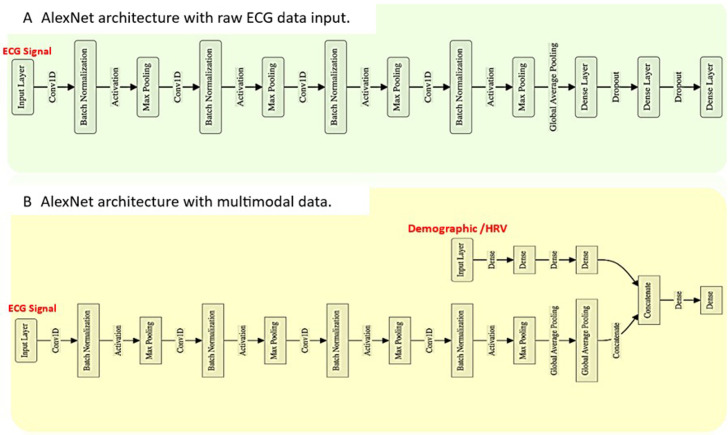
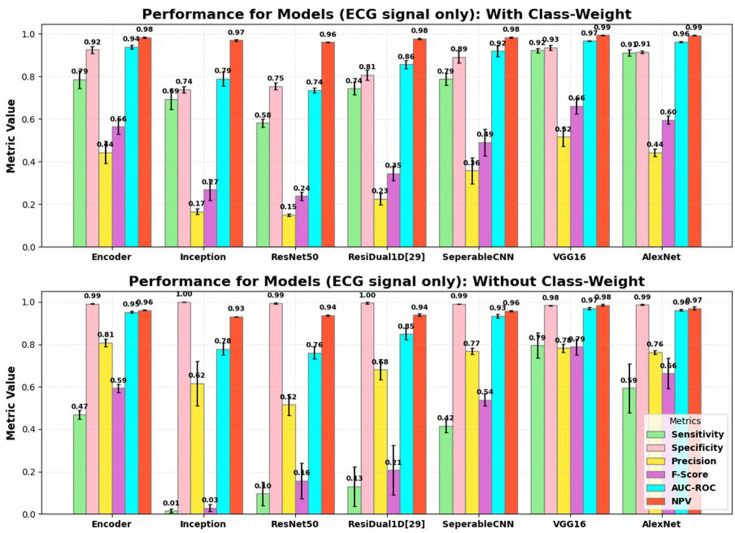
Methods: We analysed 35 634 12-lead ECG recordings from three public databases (China Physiological Signal Challenge-Extra, PTB-XL and Georgia), each with physician-validated AF labels. A range of convolutional neural network models, including AlexNet, VGG-16, ResNet and transformers, were tested for AF prediction, enriched with HRV and demographic data to explore the effectiveness of the multimodal approach. Each data modality (ECG, HRV and demographic) was assessed for its contribution to model performance using fivefold cross-validation. Performance improvements were evaluated across key metrics, and saliency maps were generated to provide further insights into model behaviour and identify critical features in AF detection.
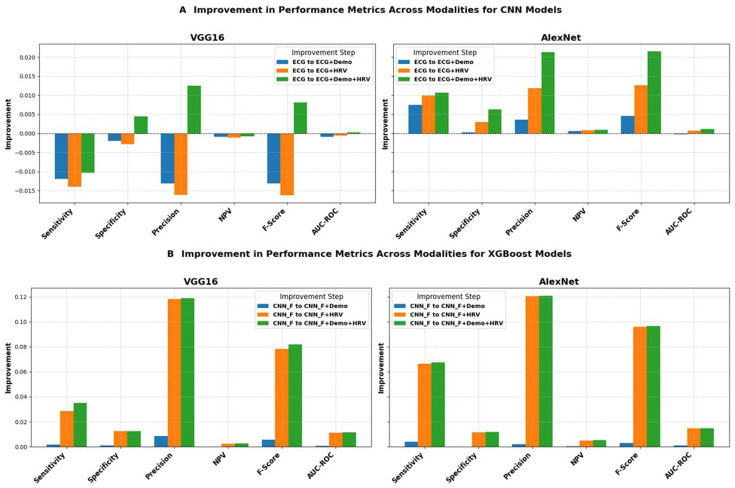
Results: Integrating HRV and demographic data with ECG substantially improved performance. AlexNet and VGG-16 outperformed more complex models, achieving AUROC of 0.9617 (95% CI 0.95 to 0.97) and 0.9668 (95% CI 0.96 to 0.97), respectively. Adding HRV data showed the most significant improvement in sensitivity, with AlexNet increasing from 0.9117 to 0.9225 and VGG-16 from 0.9216 to 0.9225. Combining both HRV and demographic data led to further improvements, with AlexNet achieving a sensitivity of 0.9225 (up from 0.9192 with HRV) and VGG-16 reaching 0.9113 (up from 0.9097 with HRV). The combination of HRV and demographic data resulted in the highest gains in sensitivity and area under the receiver operating characteristic curve. Saliency maps confirmed the models identified key AF features, such as the absence of the P-wave, validating the multimodal approach.
Conclusions: AlexNet and VGG-16 excelled in AF detection, with HRV data improving sensitivity, and demographic data providing additional benefits. These results highlight the potential of multimodal approaches, pending further clinical validation.
期刊介绍:
Open Heart is an online-only, open access cardiology journal that aims to be “open” in many ways: open access (free access for all readers), open peer review (unblinded peer review) and open data (data sharing is encouraged). The goal is to ensure maximum transparency and maximum impact on research progress and patient care. The journal is dedicated to publishing high quality, peer reviewed medical research in all disciplines and therapeutic areas of cardiovascular medicine. Research is published across all study phases and designs, from study protocols to phase I trials to meta-analyses, including small or specialist studies. Opinionated discussions on controversial topics are welcomed. Open Heart aims to operate a fast submission and review process with continuous publication online, to ensure timely, up-to-date research is available worldwide. The journal adheres to a rigorous and transparent peer review process, and all articles go through a statistical assessment to ensure robustness of the analyses. Open Heart is an official journal of the British Cardiovascular Society.





 京公网安备 11010802042870号
京ICP备2023020795号-1
京公网安备 11010802042870号
京ICP备2023020795号-1

 分享
分享
 求助内容:
求助内容: 应助结果提醒方式:
 扫码关注我们
