Katarina A. Ćeranić, Snežana D. Zarić and Dušan P. Malenov
{"title":"苯夹心化合物的阳离子识别--DFT视角","authors":"Katarina A. Ćeranić, Snežana D. Zarić and Dušan P. Malenov","doi":"10.1039/D5DT00395D","DOIUrl":null,"url":null,"abstract":"<p >Cation–π interactions between alkali, alkaline earth and ammonium cations and sandwich compounds of benzene and the cyclopentadienyl (Cp) anion were studied using quantum chemical CCSD(T)/CBS and DFT (B3LYP/def2-TZVP) calculations. The results show significantly stronger interactions of sandwich compounds with respect to (uncoordinated) benzene. Moreover, very strong cation–π interactions of Cp sandwich compounds are furthermore surpassed by cation–π interactions of benzene sandwich compounds, which are capable of reaching a remarkable interaction energy value of −196.8 kcal mol<small><sup>−1</sup></small> (Mg<small><sup>2+</sup></small>/W(benzene)<small><sub>2</sub></small>). While there are only small variations of interaction energy values for sandwich compounds of different transition metals (3d metals < 4d < 5d), cation–π interactions progressively become stronger in the following order: (uncoordinated) benzene < Cp sandwich < benzene sandwich. Aside from interaction energies, the cation–π interactions can be assessed by means of their influence on the geometries of sandwich compounds, which are found to strongly correlate with the strength of cation–π interactions. These results emphasize sandwich compounds, particularly those containing C<small><sub>6</sub></small> aromatic rings, as promising candidates for new receptors for common metal cations.</p>","PeriodicalId":71,"journal":{"name":"Dalton Transactions","volume":" 19","pages":" 7700-7706"},"PeriodicalIF":3.3000,"publicationDate":"2025-04-02","publicationTypes":"Journal Article","fieldsOfStudy":null,"isOpenAccess":false,"openAccessPdf":"","citationCount":"0","resultStr":"{\"title\":\"Cation recognition by benzene sandwich compounds – a DFT perspective†\",\"authors\":\"Katarina A. Ćeranić, Snežana D. Zarić and Dušan P. Malenov\",\"doi\":\"10.1039/D5DT00395D\",\"DOIUrl\":null,\"url\":null,\"abstract\":\"<p >Cation–π interactions between alkali, alkaline earth and ammonium cations and sandwich compounds of benzene and the cyclopentadienyl (Cp) anion were studied using quantum chemical CCSD(T)/CBS and DFT (B3LYP/def2-TZVP) calculations. The results show significantly stronger interactions of sandwich compounds with respect to (uncoordinated) benzene. Moreover, very strong cation–π interactions of Cp sandwich compounds are furthermore surpassed by cation–π interactions of benzene sandwich compounds, which are capable of reaching a remarkable interaction energy value of −196.8 kcal mol<small><sup>−1</sup></small> (Mg<small><sup>2+</sup></small>/W(benzene)<small><sub>2</sub></small>). While there are only small variations of interaction energy values for sandwich compounds of different transition metals (3d metals < 4d < 5d), cation–π interactions progressively become stronger in the following order: (uncoordinated) benzene < Cp sandwich < benzene sandwich. Aside from interaction energies, the cation–π interactions can be assessed by means of their influence on the geometries of sandwich compounds, which are found to strongly correlate with the strength of cation–π interactions. These results emphasize sandwich compounds, particularly those containing C<small><sub>6</sub></small> aromatic rings, as promising candidates for new receptors for common metal cations.</p>\",\"PeriodicalId\":71,\"journal\":{\"name\":\"Dalton Transactions\",\"volume\":\" 19\",\"pages\":\" 7700-7706\"},\"PeriodicalIF\":3.3000,\"publicationDate\":\"2025-04-02\",\"publicationTypes\":\"Journal Article\",\"fieldsOfStudy\":null,\"isOpenAccess\":false,\"openAccessPdf\":\"\",\"citationCount\":\"0\",\"resultStr\":null,\"platform\":\"Semanticscholar\",\"paperid\":null,\"PeriodicalName\":\"Dalton Transactions\",\"FirstCategoryId\":\"92\",\"ListUrlMain\":\"https://pubs.rsc.org/en/content/articlelanding/2025/dt/d5dt00395d\",\"RegionNum\":3,\"RegionCategory\":\"化学\",\"ArticlePicture\":[],\"TitleCN\":null,\"AbstractTextCN\":null,\"PMCID\":null,\"EPubDate\":\"\",\"PubModel\":\"\",\"JCR\":\"Q2\",\"JCRName\":\"CHEMISTRY, INORGANIC & NUCLEAR\",\"Score\":null,\"Total\":0}","platform":"Semanticscholar","paperid":null,"PeriodicalName":"Dalton Transactions","FirstCategoryId":"92","ListUrlMain":"https://pubs.rsc.org/en/content/articlelanding/2025/dt/d5dt00395d","RegionNum":3,"RegionCategory":"化学","ArticlePicture":[],"TitleCN":null,"AbstractTextCN":null,"PMCID":null,"EPubDate":"","PubModel":"","JCR":"Q2","JCRName":"CHEMISTRY, INORGANIC & NUCLEAR","Score":null,"Total":0}
引用次数: 0
摘要
采用量子化学CCSD(T)/CBS和DFT (B3LYP/def2-TZVP)计算方法研究了碱、碱土和铵离子阳离子与苯和环戊二烯阴离子夹心化合物之间的阳离子-π相互作用。结果表明,夹层化合物与(不配位)苯的相互作用明显增强。此外,环戊二烯夹层化合物的阳离子-π相互作用也被苯夹层化合物的阳离子-π相互作用所超越,其相互作用能达到-196.8 kcal/mol (Mg2+/W(苯)2)。而不同过渡金属(3d金属<;4 d & lt;5d),阳离子-π相互作用高度依赖于阳离子的大小和电荷(更小、更带电的阳离子形成更强的相互作用),它们按以下顺序逐渐变得更强:(不配位)苯<;Cp三明治<;苯三明治。除了相互作用能之外,阳离子-π相互作用还可以通过它们对夹层化合物几何形状的影响来评估,这些几何形状与阳离子-π相互作用的强度密切相关。这些结果强调夹层化合物,特别是那些含有C6芳香环的化合物,是常见金属阳离子的新受体的有希望的候选者。
Cation recognition by benzene sandwich compounds – a DFT perspective†
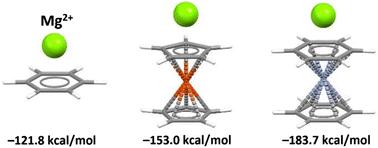
Cation–π interactions between alkali, alkaline earth and ammonium cations and sandwich compounds of benzene and the cyclopentadienyl (Cp) anion were studied using quantum chemical CCSD(T)/CBS and DFT (B3LYP/def2-TZVP) calculations. The results show significantly stronger interactions of sandwich compounds with respect to (uncoordinated) benzene. Moreover, very strong cation–π interactions of Cp sandwich compounds are furthermore surpassed by cation–π interactions of benzene sandwich compounds, which are capable of reaching a remarkable interaction energy value of −196.8 kcal mol−1 (Mg2+/W(benzene)2). While there are only small variations of interaction energy values for sandwich compounds of different transition metals (3d metals < 4d < 5d), cation–π interactions progressively become stronger in the following order: (uncoordinated) benzene < Cp sandwich < benzene sandwich. Aside from interaction energies, the cation–π interactions can be assessed by means of their influence on the geometries of sandwich compounds, which are found to strongly correlate with the strength of cation–π interactions. These results emphasize sandwich compounds, particularly those containing C6 aromatic rings, as promising candidates for new receptors for common metal cations.
期刊介绍:
Dalton Transactions is a journal for all areas of inorganic chemistry, which encompasses the organometallic, bioinorganic and materials chemistry of the elements, with applications including synthesis, catalysis, energy conversion/storage, electrical devices and medicine. Dalton Transactions welcomes high-quality, original submissions in all of these areas and more, where the advancement of knowledge in inorganic chemistry is significant.




 京公网安备 11010802042870号
京ICP备2023020795号-1
京公网安备 11010802042870号
京ICP备2023020795号-1

 分享
分享
 求助内容:
求助内容: 应助结果提醒方式:
 扫码关注我们
