Hussain Namvar Maroofy , Mohammad-Javad Hafezi , Hadi Veisi
{"title":"离子交联聚丙烯和未改性聚丙烯混合物的流变学和热学研究以及炭黑基电磁波屏蔽复合材料的制备","authors":"Hussain Namvar Maroofy , Mohammad-Javad Hafezi , Hadi Veisi","doi":"10.1016/j.polymer.2025.128342","DOIUrl":null,"url":null,"abstract":"<div><div>Initially, blends of ionically cross-linked PP (icPP) and unmodified PP were prepared. The miscibility and morphologies of the blends were studied with thermal and rheological analyses. It was confirmed that the blends were immiscible and formed co-continuous morphologies at icPP contents higher than 57.5 wt%. The formation of an inter-phase with synergistic properties was confirmed. Subsequently, CB incorporated to the blend composition with co-continuous morphology at 82.5 wt% icPP. Three strategies were implemented to hamper CB migration from unmodified PP to icPP phase during blending. A DC conductivity of 7.68 × 10⁻⁵ S cm<sup>−1</sup> was achieved at 2.625 wt% CB, which was close to the conductivity of unmodified PP with 12.5 wt% CB. The samples were tested for EMI shielding properties in the microwave frequency region. A minimum RL of −23.14 dB was obtained. SEM imaging confirmed the co-continuous morphology for the blended samples with CB and the localization of CB particles.</div></div>","PeriodicalId":405,"journal":{"name":"Polymer","volume":"326 ","pages":"Article 128342"},"PeriodicalIF":4.5000,"publicationDate":"2025-05-09","publicationTypes":"Journal Article","fieldsOfStudy":null,"isOpenAccess":false,"openAccessPdf":"","citationCount":"0","resultStr":"{\"title\":\"Rheological and thermal investigation of blends of ionically cross-linked and un-modified polypropylene and preparation of carbon black-based electromagnetic wave shielding composites\",\"authors\":\"Hussain Namvar Maroofy , Mohammad-Javad Hafezi , Hadi Veisi\",\"doi\":\"10.1016/j.polymer.2025.128342\",\"DOIUrl\":null,\"url\":null,\"abstract\":\"<div><div>Initially, blends of ionically cross-linked PP (icPP) and unmodified PP were prepared. The miscibility and morphologies of the blends were studied with thermal and rheological analyses. It was confirmed that the blends were immiscible and formed co-continuous morphologies at icPP contents higher than 57.5 wt%. The formation of an inter-phase with synergistic properties was confirmed. Subsequently, CB incorporated to the blend composition with co-continuous morphology at 82.5 wt% icPP. Three strategies were implemented to hamper CB migration from unmodified PP to icPP phase during blending. A DC conductivity of 7.68 × 10⁻⁵ S cm<sup>−1</sup> was achieved at 2.625 wt% CB, which was close to the conductivity of unmodified PP with 12.5 wt% CB. The samples were tested for EMI shielding properties in the microwave frequency region. A minimum RL of −23.14 dB was obtained. SEM imaging confirmed the co-continuous morphology for the blended samples with CB and the localization of CB particles.</div></div>\",\"PeriodicalId\":405,\"journal\":{\"name\":\"Polymer\",\"volume\":\"326 \",\"pages\":\"Article 128342\"},\"PeriodicalIF\":4.5000,\"publicationDate\":\"2025-05-09\",\"publicationTypes\":\"Journal Article\",\"fieldsOfStudy\":null,\"isOpenAccess\":false,\"openAccessPdf\":\"\",\"citationCount\":\"0\",\"resultStr\":null,\"platform\":\"Semanticscholar\",\"paperid\":null,\"PeriodicalName\":\"Polymer\",\"FirstCategoryId\":\"92\",\"ListUrlMain\":\"https://www.sciencedirect.com/science/article/pii/S0032386125003283\",\"RegionNum\":2,\"RegionCategory\":\"化学\",\"ArticlePicture\":[],\"TitleCN\":null,\"AbstractTextCN\":null,\"PMCID\":null,\"EPubDate\":\"2025/4/1 0:00:00\",\"PubModel\":\"Epub\",\"JCR\":\"Q2\",\"JCRName\":\"POLYMER SCIENCE\",\"Score\":null,\"Total\":0}","platform":"Semanticscholar","paperid":null,"PeriodicalName":"Polymer","FirstCategoryId":"92","ListUrlMain":"https://www.sciencedirect.com/science/article/pii/S0032386125003283","RegionNum":2,"RegionCategory":"化学","ArticlePicture":[],"TitleCN":null,"AbstractTextCN":null,"PMCID":null,"EPubDate":"2025/4/1 0:00:00","PubModel":"Epub","JCR":"Q2","JCRName":"POLYMER SCIENCE","Score":null,"Total":0}
Rheological and thermal investigation of blends of ionically cross-linked and un-modified polypropylene and preparation of carbon black-based electromagnetic wave shielding composites
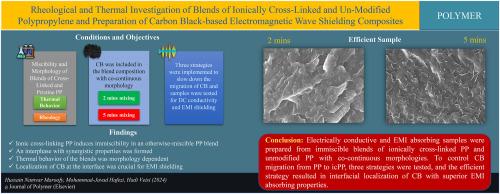
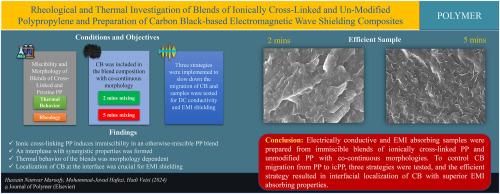
Initially, blends of ionically cross-linked PP (icPP) and unmodified PP were prepared. The miscibility and morphologies of the blends were studied with thermal and rheological analyses. It was confirmed that the blends were immiscible and formed co-continuous morphologies at icPP contents higher than 57.5 wt%. The formation of an inter-phase with synergistic properties was confirmed. Subsequently, CB incorporated to the blend composition with co-continuous morphology at 82.5 wt% icPP. Three strategies were implemented to hamper CB migration from unmodified PP to icPP phase during blending. A DC conductivity of 7.68 × 10⁻⁵ S cm−1 was achieved at 2.625 wt% CB, which was close to the conductivity of unmodified PP with 12.5 wt% CB. The samples were tested for EMI shielding properties in the microwave frequency region. A minimum RL of −23.14 dB was obtained. SEM imaging confirmed the co-continuous morphology for the blended samples with CB and the localization of CB particles.
期刊介绍:
Polymer is an interdisciplinary journal dedicated to publishing innovative and significant advances in Polymer Physics, Chemistry and Technology. We welcome submissions on polymer hybrids, nanocomposites, characterisation and self-assembly. Polymer also publishes work on the technological application of polymers in energy and optoelectronics.
The main scope is covered but not limited to the following core areas:
Polymer Materials
Nanocomposites and hybrid nanomaterials
Polymer blends, films, fibres, networks and porous materials
Physical Characterization
Characterisation, modelling and simulation* of molecular and materials properties in bulk, solution, and thin films
Polymer Engineering
Advanced multiscale processing methods
Polymer Synthesis, Modification and Self-assembly
Including designer polymer architectures, mechanisms and kinetics, and supramolecular polymerization
Technological Applications
Polymers for energy generation and storage
Polymer membranes for separation technology
Polymers for opto- and microelectronics.




 京公网安备 11010802042870号
京ICP备2023020795号-1
京公网安备 11010802042870号
京ICP备2023020795号-1

 分享
分享
 求助内容:
求助内容: 应助结果提醒方式:
 扫码关注我们
