Bai-He Chen , Hao-Ze Deng , Rui Han , Man Zhu , Rui-Wen Pan , Xue-Wei Zhang , Zhen-Liang Xu , Hong-Bo Li , Sun-Jie Xu
{"title":"用修饰结构重排法(mSRP)改进的薄膜复合膜用于水溶剂的快速分离","authors":"Bai-He Chen , Hao-Ze Deng , Rui Han , Man Zhu , Rui-Wen Pan , Xue-Wei Zhang , Zhen-Liang Xu , Hong-Bo Li , Sun-Jie Xu","doi":"10.1016/j.memsci.2025.124047","DOIUrl":null,"url":null,"abstract":"<div><div>This study aims to develop an advanced organic solvent nanofiltration (OSN) membrane by incorporating an adamantane-amide active layer through a modified structure rearrangement process (mSRP) combined with host-guest interactions. The membrane was fabricated by treating a commercial reverse osmosis (RO) membrane with solutions containing polysaccharides and adamantane monomers, obtaining significantly enhanced separation performance. The modified membrane exhibited a “mesh-like” morphology and increased surface roughness which contributed to substantially higher permeability and retention rates compared to those of pristine RO membrane. Specifically, the optimal membrane attained a permeability of 9.3 L m<sup>−2</sup> h<sup>−1</sup>·bar<sup>−1</sup>, representing an increase by 111.4 % relative to the pristine membrane, while maintaining a rejection rate of 94.0 % for the commonly used erythromycin antibiotic. The rearrangement behavior and mechanism of the host-guest interactions were investigated using density functional calculations. Long-term operational tests confirmed the stability of the membrane and its potential for industrial applications. This study introduced a novel approach for upgrading commercial RO membranes for efficient OSN applications, thereby contributing to the development of sustainable separation technologies in the biomedical sector.</div></div>","PeriodicalId":368,"journal":{"name":"Journal of Membrane Science","volume":"726 ","pages":"Article 124047"},"PeriodicalIF":9.0000,"publicationDate":"2025-05-01","publicationTypes":"Journal Article","fieldsOfStudy":null,"isOpenAccess":false,"openAccessPdf":"","citationCount":"0","resultStr":"{\"title\":\"Thin-film composite membrane improved by modified structure rearrangement process (mSRP) for rapidly aqueous and solvents separation\",\"authors\":\"Bai-He Chen , Hao-Ze Deng , Rui Han , Man Zhu , Rui-Wen Pan , Xue-Wei Zhang , Zhen-Liang Xu , Hong-Bo Li , Sun-Jie Xu\",\"doi\":\"10.1016/j.memsci.2025.124047\",\"DOIUrl\":null,\"url\":null,\"abstract\":\"<div><div>This study aims to develop an advanced organic solvent nanofiltration (OSN) membrane by incorporating an adamantane-amide active layer through a modified structure rearrangement process (mSRP) combined with host-guest interactions. The membrane was fabricated by treating a commercial reverse osmosis (RO) membrane with solutions containing polysaccharides and adamantane monomers, obtaining significantly enhanced separation performance. The modified membrane exhibited a “mesh-like” morphology and increased surface roughness which contributed to substantially higher permeability and retention rates compared to those of pristine RO membrane. Specifically, the optimal membrane attained a permeability of 9.3 L m<sup>−2</sup> h<sup>−1</sup>·bar<sup>−1</sup>, representing an increase by 111.4 % relative to the pristine membrane, while maintaining a rejection rate of 94.0 % for the commonly used erythromycin antibiotic. The rearrangement behavior and mechanism of the host-guest interactions were investigated using density functional calculations. Long-term operational tests confirmed the stability of the membrane and its potential for industrial applications. This study introduced a novel approach for upgrading commercial RO membranes for efficient OSN applications, thereby contributing to the development of sustainable separation technologies in the biomedical sector.</div></div>\",\"PeriodicalId\":368,\"journal\":{\"name\":\"Journal of Membrane Science\",\"volume\":\"726 \",\"pages\":\"Article 124047\"},\"PeriodicalIF\":9.0000,\"publicationDate\":\"2025-05-01\",\"publicationTypes\":\"Journal Article\",\"fieldsOfStudy\":null,\"isOpenAccess\":false,\"openAccessPdf\":\"\",\"citationCount\":\"0\",\"resultStr\":null,\"platform\":\"Semanticscholar\",\"paperid\":null,\"PeriodicalName\":\"Journal of Membrane Science\",\"FirstCategoryId\":\"5\",\"ListUrlMain\":\"https://www.sciencedirect.com/science/article/pii/S0376738825003606\",\"RegionNum\":1,\"RegionCategory\":\"工程技术\",\"ArticlePicture\":[],\"TitleCN\":null,\"AbstractTextCN\":null,\"PMCID\":null,\"EPubDate\":\"2025/3/26 0:00:00\",\"PubModel\":\"Epub\",\"JCR\":\"Q1\",\"JCRName\":\"ENGINEERING, CHEMICAL\",\"Score\":null,\"Total\":0}","platform":"Semanticscholar","paperid":null,"PeriodicalName":"Journal of Membrane Science","FirstCategoryId":"5","ListUrlMain":"https://www.sciencedirect.com/science/article/pii/S0376738825003606","RegionNum":1,"RegionCategory":"工程技术","ArticlePicture":[],"TitleCN":null,"AbstractTextCN":null,"PMCID":null,"EPubDate":"2025/3/26 0:00:00","PubModel":"Epub","JCR":"Q1","JCRName":"ENGINEERING, CHEMICAL","Score":null,"Total":0}
引用次数: 0
摘要
本研究旨在开发一种先进的有机溶剂纳滤膜(OSN),通过改性结构重排过程(mSRP)结合主客体相互作用,将金刚烷-酰胺活性层纳入其中。这种膜是用含有多糖和金刚烷单体的溶液处理商用反渗透膜后制成的,分离性能显著提高。改性膜呈现出 "网状 "形态,表面粗糙度增加,与原始反渗透膜相比,渗透率和截留率大幅提高。具体来说,最佳膜的渗透率达到了 9.3 L m-2 h-1-bar-1 ,与原始膜相比提高了 111.4%,同时对常用红霉素抗生素的截留率保持在 94.0%。利用密度泛函计算研究了主客体相互作用的重排行为和机制。长期运行测试证实了该膜的稳定性及其工业应用潜力。这项研究引入了一种新方法,用于升级商业反渗透膜,使其高效地应用于有机碳网,从而为生物医学领域可持续分离技术的发展做出了贡献。
Thin-film composite membrane improved by modified structure rearrangement process (mSRP) for rapidly aqueous and solvents separation
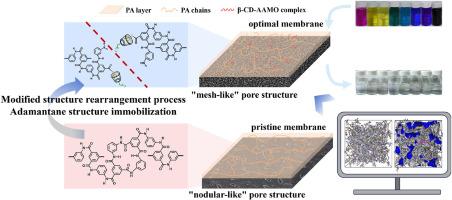
This study aims to develop an advanced organic solvent nanofiltration (OSN) membrane by incorporating an adamantane-amide active layer through a modified structure rearrangement process (mSRP) combined with host-guest interactions. The membrane was fabricated by treating a commercial reverse osmosis (RO) membrane with solutions containing polysaccharides and adamantane monomers, obtaining significantly enhanced separation performance. The modified membrane exhibited a “mesh-like” morphology and increased surface roughness which contributed to substantially higher permeability and retention rates compared to those of pristine RO membrane. Specifically, the optimal membrane attained a permeability of 9.3 L m−2 h−1·bar−1, representing an increase by 111.4 % relative to the pristine membrane, while maintaining a rejection rate of 94.0 % for the commonly used erythromycin antibiotic. The rearrangement behavior and mechanism of the host-guest interactions were investigated using density functional calculations. Long-term operational tests confirmed the stability of the membrane and its potential for industrial applications. This study introduced a novel approach for upgrading commercial RO membranes for efficient OSN applications, thereby contributing to the development of sustainable separation technologies in the biomedical sector.
期刊介绍:
The Journal of Membrane Science is a publication that focuses on membrane systems and is aimed at academic and industrial chemists, chemical engineers, materials scientists, and membranologists. It publishes original research and reviews on various aspects of membrane transport, membrane formation/structure, fouling, module/process design, and processes/applications. The journal primarily focuses on the structure, function, and performance of non-biological membranes but also includes papers that relate to biological membranes. The Journal of Membrane Science publishes Full Text Papers, State-of-the-Art Reviews, Letters to the Editor, and Perspectives.




 京公网安备 11010802042870号
京ICP备2023020795号-1
京公网安备 11010802042870号
京ICP备2023020795号-1

 分享
分享
 求助内容:
求助内容: 应助结果提醒方式:
 扫码关注我们
