Young Jae Kim , Byung Kwan Lee , Inho Park , Chaewon Youn , Myung-Seok Lee , Jung-Hyun Lee , Ho Bum Park
{"title":"多孔氧化石墨烯通过界面扩散控制提高反渗透膜性能","authors":"Young Jae Kim , Byung Kwan Lee , Inho Park , Chaewon Youn , Myung-Seok Lee , Jung-Hyun Lee , Ho Bum Park","doi":"10.1016/j.memsci.2025.124040","DOIUrl":null,"url":null,"abstract":"<div><div>The development of polyamide (PA) thin-film composite (TFC) membranes with enhanced water permeance and salt rejection is essential for energy-efficient desalination. This study introduces a reverse osmosis (RO) membrane that achieves rapid water transport and high salt rejection through precise control of interfacial polymerization (IP), enabled by porous graphene oxide (PGO) with optimally sized nanopores. These nanopores act as diffusion pathways for <em>m</em>-phenylenediamine (MPD) during IP in a confined space, reducing residual unreacted MPD and creating additional water transport channels. This process facilitates the formation of a highly crosslinked and permeable PA selective layer. The thin-film nanocomposite (TFN) membrane incorporating PGO etched for 3 h exhibited outstanding water permeance of 3.57 L m<sup>−2</sup> h<sup>−1</sup> bar<sup>−1</sup> and NaCl rejection of 98.7 %, surpassing state-of-the-art GO-modified RO membranes. Additionally, the membrane demonstrated superior antifouling performance and long-term operational stability. Structural and performance comparisons with TFN membranes incorporating PGO with varying nanopore sizes, controlled via etching time, elucidated the transport mechanism across the membrane. This work highlights a robust strategy for manufacturing high-performance TFC membranes by modulating interfacial diffusion during IP.</div></div>","PeriodicalId":368,"journal":{"name":"Journal of Membrane Science","volume":"726 ","pages":"Article 124040"},"PeriodicalIF":9.0000,"publicationDate":"2025-05-01","publicationTypes":"Journal Article","fieldsOfStudy":null,"isOpenAccess":false,"openAccessPdf":"","citationCount":"0","resultStr":"{\"title\":\"Enhancing reverse osmosis membrane performance via interfacial diffusion control using porous graphene oxide\",\"authors\":\"Young Jae Kim , Byung Kwan Lee , Inho Park , Chaewon Youn , Myung-Seok Lee , Jung-Hyun Lee , Ho Bum Park\",\"doi\":\"10.1016/j.memsci.2025.124040\",\"DOIUrl\":null,\"url\":null,\"abstract\":\"<div><div>The development of polyamide (PA) thin-film composite (TFC) membranes with enhanced water permeance and salt rejection is essential for energy-efficient desalination. This study introduces a reverse osmosis (RO) membrane that achieves rapid water transport and high salt rejection through precise control of interfacial polymerization (IP), enabled by porous graphene oxide (PGO) with optimally sized nanopores. These nanopores act as diffusion pathways for <em>m</em>-phenylenediamine (MPD) during IP in a confined space, reducing residual unreacted MPD and creating additional water transport channels. This process facilitates the formation of a highly crosslinked and permeable PA selective layer. The thin-film nanocomposite (TFN) membrane incorporating PGO etched for 3 h exhibited outstanding water permeance of 3.57 L m<sup>−2</sup> h<sup>−1</sup> bar<sup>−1</sup> and NaCl rejection of 98.7 %, surpassing state-of-the-art GO-modified RO membranes. Additionally, the membrane demonstrated superior antifouling performance and long-term operational stability. Structural and performance comparisons with TFN membranes incorporating PGO with varying nanopore sizes, controlled via etching time, elucidated the transport mechanism across the membrane. This work highlights a robust strategy for manufacturing high-performance TFC membranes by modulating interfacial diffusion during IP.</div></div>\",\"PeriodicalId\":368,\"journal\":{\"name\":\"Journal of Membrane Science\",\"volume\":\"726 \",\"pages\":\"Article 124040\"},\"PeriodicalIF\":9.0000,\"publicationDate\":\"2025-05-01\",\"publicationTypes\":\"Journal Article\",\"fieldsOfStudy\":null,\"isOpenAccess\":false,\"openAccessPdf\":\"\",\"citationCount\":\"0\",\"resultStr\":null,\"platform\":\"Semanticscholar\",\"paperid\":null,\"PeriodicalName\":\"Journal of Membrane Science\",\"FirstCategoryId\":\"5\",\"ListUrlMain\":\"https://www.sciencedirect.com/science/article/pii/S0376738825003539\",\"RegionNum\":1,\"RegionCategory\":\"工程技术\",\"ArticlePicture\":[],\"TitleCN\":null,\"AbstractTextCN\":null,\"PMCID\":null,\"EPubDate\":\"2025/3/27 0:00:00\",\"PubModel\":\"Epub\",\"JCR\":\"Q1\",\"JCRName\":\"ENGINEERING, CHEMICAL\",\"Score\":null,\"Total\":0}","platform":"Semanticscholar","paperid":null,"PeriodicalName":"Journal of Membrane Science","FirstCategoryId":"5","ListUrlMain":"https://www.sciencedirect.com/science/article/pii/S0376738825003539","RegionNum":1,"RegionCategory":"工程技术","ArticlePicture":[],"TitleCN":null,"AbstractTextCN":null,"PMCID":null,"EPubDate":"2025/3/27 0:00:00","PubModel":"Epub","JCR":"Q1","JCRName":"ENGINEERING, CHEMICAL","Score":null,"Total":0}
引用次数: 0
摘要
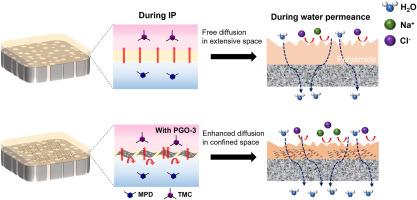
聚酰胺(PA)薄膜复合材料(TFC)膜具有较强的透水性和排盐性能,是高效节能海水淡化的必要条件。本研究介绍了一种反渗透(RO)膜,该膜通过精确控制界面聚合(IP)来实现快速的水输送和高盐抑制,该膜由具有最佳尺寸纳米孔的多孔氧化石墨烯(PGO)实现。这些纳米孔作为间苯二胺(MPD)在密闭空间内的扩散通道,减少了残留的未反应MPD,并创造了额外的水输送通道。该工艺有利于形成高度交联和可渗透的PA选择层。经PGO蚀刻3 h的薄膜纳米复合材料(TFN)膜的透水性为3.57 L m−2 h−1 bar−1,NaCl去除率为98.7%,超过了目前最先进的go修饰的RO膜。此外,该膜具有优异的防污性能和长期运行稳定性。通过蚀刻时间控制不同纳米孔大小的PGO与TFN膜的结构和性能比较,阐明了跨膜的传输机制。这项工作强调了通过在IP过程中调节界面扩散来制造高性能TFC膜的稳健策略。
Enhancing reverse osmosis membrane performance via interfacial diffusion control using porous graphene oxide
The development of polyamide (PA) thin-film composite (TFC) membranes with enhanced water permeance and salt rejection is essential for energy-efficient desalination. This study introduces a reverse osmosis (RO) membrane that achieves rapid water transport and high salt rejection through precise control of interfacial polymerization (IP), enabled by porous graphene oxide (PGO) with optimally sized nanopores. These nanopores act as diffusion pathways for m-phenylenediamine (MPD) during IP in a confined space, reducing residual unreacted MPD and creating additional water transport channels. This process facilitates the formation of a highly crosslinked and permeable PA selective layer. The thin-film nanocomposite (TFN) membrane incorporating PGO etched for 3 h exhibited outstanding water permeance of 3.57 L m−2 h−1 bar−1 and NaCl rejection of 98.7 %, surpassing state-of-the-art GO-modified RO membranes. Additionally, the membrane demonstrated superior antifouling performance and long-term operational stability. Structural and performance comparisons with TFN membranes incorporating PGO with varying nanopore sizes, controlled via etching time, elucidated the transport mechanism across the membrane. This work highlights a robust strategy for manufacturing high-performance TFC membranes by modulating interfacial diffusion during IP.
期刊介绍:
The Journal of Membrane Science is a publication that focuses on membrane systems and is aimed at academic and industrial chemists, chemical engineers, materials scientists, and membranologists. It publishes original research and reviews on various aspects of membrane transport, membrane formation/structure, fouling, module/process design, and processes/applications. The journal primarily focuses on the structure, function, and performance of non-biological membranes but also includes papers that relate to biological membranes. The Journal of Membrane Science publishes Full Text Papers, State-of-the-Art Reviews, Letters to the Editor, and Perspectives.




 京公网安备 11010802042870号
京ICP备2023020795号-1
京公网安备 11010802042870号
京ICP备2023020795号-1

 分享
分享
 求助内容:
求助内容: 应助结果提醒方式:
 扫码关注我们
