Yingming Kong, Yanghao Tai, Bin Chen, Chunzheng Li, Hao Chen, Liang Shi
{"title":"美国成人血清钾水平与血清神经丝轻链相关:2013-2014年全国健康与营养调查的横断面分析","authors":"Yingming Kong, Yanghao Tai, Bin Chen, Chunzheng Li, Hao Chen, Liang Shi","doi":"10.3389/fnagi.2025.1511881","DOIUrl":null,"url":null,"abstract":"<p><strong>Objective: </strong>Serum neurofilament light chain (sNfL) is one of the most sensitive diagnostic biomarkers for a variety of neurodegenerative pathologies. Potassium, an essential electrolyte, plays a critical role in maintaining neuronal health and the proper functioning of the central nervous system (CNS). The aim of our research was to investigate the association between serum potassium level and sNfL levels.</p><p><strong>Methods: </strong>Based on the National Health and Nutrition Examination Survey (NHANES) database, we analyzed data from the 2013 to 2014 NHANES. Serum potassium concentrations were measured via ion-selective electrode (ISE) technology. The levels of sNfL were measured using a sensitive immunoassay developed by Siemens Healthineers. Our researcher analyzed the association between potassium level in serum and sNfL in American persons using multivariate logistic regression analysis and smoothed curve fitting. The consistency of these results was examined in various population subgroups.</p><p><strong>Results: </strong>A total of 1,670 participants were involved in our research, including 872 women (50.5%) and 798 men (49.5%). The median serum potassium concentration was 4.0 mmol/L and the median sNfL was 12.3 pg/ml. After adjusting for potential confounders in the full model, individuals with higher serum potassium concentrations had higher sNfL levels (Q3 vs. Q1, β = 2.86, 95% CI: 0.33-5.39, <i>P</i> = 0.027). There was a non-linear positive dose-response association between higher serum potassium concentrations and sNfL levels (<i>P</i> for non-linearity = 0.028). Based on the results of stratified analysis, the relationship was stronger in the low- and middle-income group, non-drinking and non-physical activity participants, and participants with hypertension and diabetes.</p><p><strong>Interpretation: </strong>In the cohort of American adults, a greater serum potassium concentration was linked to a higher sNfL. However, causality still needs to be further verified.</p>","PeriodicalId":12450,"journal":{"name":"Frontiers in Aging Neuroscience","volume":"17 ","pages":"1511881"},"PeriodicalIF":4.5000,"publicationDate":"2025-03-18","publicationTypes":"Journal Article","fieldsOfStudy":null,"isOpenAccess":false,"openAccessPdf":"https://www.ncbi.nlm.nih.gov/pmc/articles/PMC11959064/pdf/","citationCount":"0","resultStr":"{\"title\":\"Serum potassium level is associated with serum neurofilament light chain in American adult population: a cross-sectional analysis of the 2013-2014 National Health and Nutrition Examination Survey.\",\"authors\":\"Yingming Kong, Yanghao Tai, Bin Chen, Chunzheng Li, Hao Chen, Liang Shi\",\"doi\":\"10.3389/fnagi.2025.1511881\",\"DOIUrl\":null,\"url\":null,\"abstract\":\"<p><strong>Objective: </strong>Serum neurofilament light chain (sNfL) is one of the most sensitive diagnostic biomarkers for a variety of neurodegenerative pathologies. Potassium, an essential electrolyte, plays a critical role in maintaining neuronal health and the proper functioning of the central nervous system (CNS). The aim of our research was to investigate the association between serum potassium level and sNfL levels.</p><p><strong>Methods: </strong>Based on the National Health and Nutrition Examination Survey (NHANES) database, we analyzed data from the 2013 to 2014 NHANES. Serum potassium concentrations were measured via ion-selective electrode (ISE) technology. The levels of sNfL were measured using a sensitive immunoassay developed by Siemens Healthineers. Our researcher analyzed the association between potassium level in serum and sNfL in American persons using multivariate logistic regression analysis and smoothed curve fitting. The consistency of these results was examined in various population subgroups.</p><p><strong>Results: </strong>A total of 1,670 participants were involved in our research, including 872 women (50.5%) and 798 men (49.5%). The median serum potassium concentration was 4.0 mmol/L and the median sNfL was 12.3 pg/ml. After adjusting for potential confounders in the full model, individuals with higher serum potassium concentrations had higher sNfL levels (Q3 vs. Q1, β = 2.86, 95% CI: 0.33-5.39, <i>P</i> = 0.027). There was a non-linear positive dose-response association between higher serum potassium concentrations and sNfL levels (<i>P</i> for non-linearity = 0.028). Based on the results of stratified analysis, the relationship was stronger in the low- and middle-income group, non-drinking and non-physical activity participants, and participants with hypertension and diabetes.</p><p><strong>Interpretation: </strong>In the cohort of American adults, a greater serum potassium concentration was linked to a higher sNfL. However, causality still needs to be further verified.</p>\",\"PeriodicalId\":12450,\"journal\":{\"name\":\"Frontiers in Aging Neuroscience\",\"volume\":\"17 \",\"pages\":\"1511881\"},\"PeriodicalIF\":4.5000,\"publicationDate\":\"2025-03-18\",\"publicationTypes\":\"Journal Article\",\"fieldsOfStudy\":null,\"isOpenAccess\":false,\"openAccessPdf\":\"https://www.ncbi.nlm.nih.gov/pmc/articles/PMC11959064/pdf/\",\"citationCount\":\"0\",\"resultStr\":null,\"platform\":\"Semanticscholar\",\"paperid\":null,\"PeriodicalName\":\"Frontiers in Aging Neuroscience\",\"FirstCategoryId\":\"3\",\"ListUrlMain\":\"https://doi.org/10.3389/fnagi.2025.1511881\",\"RegionNum\":2,\"RegionCategory\":\"医学\",\"ArticlePicture\":[],\"TitleCN\":null,\"AbstractTextCN\":null,\"PMCID\":null,\"EPubDate\":\"2025/1/1 0:00:00\",\"PubModel\":\"eCollection\",\"JCR\":\"Q2\",\"JCRName\":\"GERIATRICS & GERONTOLOGY\",\"Score\":null,\"Total\":0}","platform":"Semanticscholar","paperid":null,"PeriodicalName":"Frontiers in Aging Neuroscience","FirstCategoryId":"3","ListUrlMain":"https://doi.org/10.3389/fnagi.2025.1511881","RegionNum":2,"RegionCategory":"医学","ArticlePicture":[],"TitleCN":null,"AbstractTextCN":null,"PMCID":null,"EPubDate":"2025/1/1 0:00:00","PubModel":"eCollection","JCR":"Q2","JCRName":"GERIATRICS & GERONTOLOGY","Score":null,"Total":0}
引用次数: 0
摘要
目的:血清神经丝轻链(sNfL)是多种神经退行性病理最敏感的诊断生物标志物之一。钾是一种重要的电解质,在维持神经元健康和中枢神经系统的正常功能中起着至关重要的作用。我们的研究目的是探讨血清钾水平和sNfL水平之间的关系。方法:基于美国国家健康与营养检查调查(NHANES)数据库,对2013 - 2014年NHANES数据进行分析。采用离子选择电极(ISE)技术测定血清钾浓度。sNfL的水平是用西门子Healthineers开发的一种灵敏的免疫分析法来测量的。我们的研究人员使用多变量logistic回归分析和平滑曲线拟合分析了美国人血清钾水平与sNfL之间的关系。这些结果的一致性在不同的人群亚群中进行了检验。结果:共纳入受试者1670人,其中女性872人(50.5%),男性798人(49.5%)。中位血钾浓度为4.0 mmol/L,中位sNfL为12.3 pg/ml。在整个模型中调整了潜在的混杂因素后,血清钾浓度较高的个体sNfL水平较高(Q3 vs. Q1, β = 2.86, 95% CI: 0.33-5.39, P = 0.027)。高血钾浓度与sNfL水平呈非线性正剂量反应关系(非线性P = 0.028)。根据分层分析的结果,这种关系在低收入和中等收入群体、不饮酒和不运动的参与者以及高血压和糖尿病参与者中更强。解释:在美国成人队列中,较高的血清钾浓度与较高的sNfL有关。然而,因果关系仍有待进一步验证。
Serum potassium level is associated with serum neurofilament light chain in American adult population: a cross-sectional analysis of the 2013-2014 National Health and Nutrition Examination Survey.
Objective: Serum neurofilament light chain (sNfL) is one of the most sensitive diagnostic biomarkers for a variety of neurodegenerative pathologies. Potassium, an essential electrolyte, plays a critical role in maintaining neuronal health and the proper functioning of the central nervous system (CNS). The aim of our research was to investigate the association between serum potassium level and sNfL levels.
Methods: Based on the National Health and Nutrition Examination Survey (NHANES) database, we analyzed data from the 2013 to 2014 NHANES. Serum potassium concentrations were measured via ion-selective electrode (ISE) technology. The levels of sNfL were measured using a sensitive immunoassay developed by Siemens Healthineers. Our researcher analyzed the association between potassium level in serum and sNfL in American persons using multivariate logistic regression analysis and smoothed curve fitting. The consistency of these results was examined in various population subgroups.
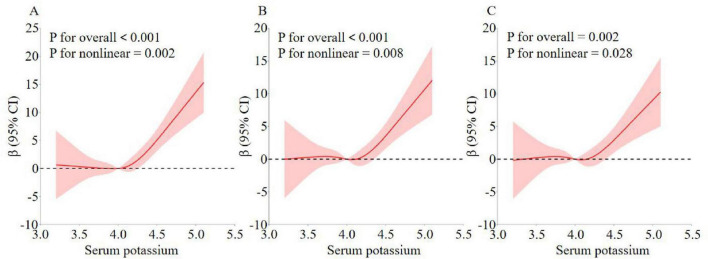
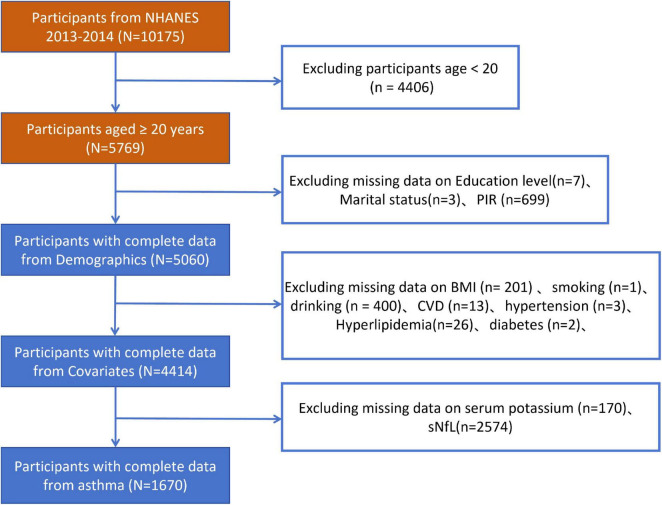
Results: A total of 1,670 participants were involved in our research, including 872 women (50.5%) and 798 men (49.5%). The median serum potassium concentration was 4.0 mmol/L and the median sNfL was 12.3 pg/ml. After adjusting for potential confounders in the full model, individuals with higher serum potassium concentrations had higher sNfL levels (Q3 vs. Q1, β = 2.86, 95% CI: 0.33-5.39, P = 0.027). There was a non-linear positive dose-response association between higher serum potassium concentrations and sNfL levels (P for non-linearity = 0.028). Based on the results of stratified analysis, the relationship was stronger in the low- and middle-income group, non-drinking and non-physical activity participants, and participants with hypertension and diabetes.
Interpretation: In the cohort of American adults, a greater serum potassium concentration was linked to a higher sNfL. However, causality still needs to be further verified.
期刊介绍:
Frontiers in Aging Neuroscience is a leading journal in its field, publishing rigorously peer-reviewed research that advances our understanding of the mechanisms of Central Nervous System aging and age-related neural diseases. Specialty Chief Editor Thomas Wisniewski at the New York University School of Medicine is supported by an outstanding Editorial Board of international researchers. This multidisciplinary open-access journal is at the forefront of disseminating and communicating scientific knowledge and impactful discoveries to researchers, academics, clinicians and the public worldwide.




 京公网安备 11010802042870号
京ICP备2023020795号-1
京公网安备 11010802042870号
京ICP备2023020795号-1

 分享
分享
 求助内容:
求助内容: 应助结果提醒方式:
 扫码关注我们
