Min Sun, Kim Geok Soh, Shudian Cao, Azhar Bin Yaacob, Shuzhen Ma, Cong Ding
{"title":"速度,敏捷性和快速训练对运动表现的影响:系统回顾和荟萃分析。","authors":"Min Sun, Kim Geok Soh, Shudian Cao, Azhar Bin Yaacob, Shuzhen Ma, Cong Ding","doi":"10.1186/s13102-025-01101-w","DOIUrl":null,"url":null,"abstract":"<p><strong>Background: </strong>Previous studies have demonstrated the effects of SAQ training on sprint, change-of-direction, and jump performance in soccer players. However, further research is needed to assess its broader impact on different athletic populations and performance metrics. This study aims to expand the existing evidence by incorporating a wider range of outcomes and providing a more comprehensive analysis of SAQ training effects.</p><p><strong>Methods: </strong>A thorough search of databases, including Web of Science Core, SPORTDiscus, PubMed, and SCOPUS, was conducted, with data up to July 2024. The PEDro scale assessed study quality and RevMan 5.3 evaluated bias risk. Effect sizes (ES) were calculated from means and standard deviations, with heterogeneity assessed using the I² statistic. Publication bias was evaluated using an extended Egger test.</p><p><strong>Results: </strong>Eleven RCTs involving 499 healthy athletes from sports such as soccer, basketball, tennis, and handball met the inclusion criteria. The SAQ interventions lasted between 4 and 12 weeks, with a frequency of two to three sessions per week. The analysis revealed significant improvements in 5-meter sprint (ES = 0.63, p < 0.01), 20-meter sprint (ES = 0.49, p < 0.01), 30-meter sprint (ES = 0.55, p = 0.015), change of direction (COD) performance (ES = 0.39, p < 0.01), reaction time (ES = 0.52, p = 0.01), lower limb power (ES = 0.96, p < 0.01), and flexibility (ES = 0.57, p < 0.01), with effect sizes ranging from small to moderate. Subgroup analysis indicated that only session duration had a near-significant effect on COD performance (≤ 60 min: ES = 0.58; >60 min: ES = 0.24; p = 0.059).</p><p><strong>Conclusions: </strong>SAQ training effectively enhances sprint performance, COD ability, reaction time, lower limb strength, and flexibility, with effect sizes ranging from small to moderate. The findings suggest that shorter training durations (≤ 60 min) may be more beneficial for improving COD performance, although this effect did not reach statistical significance. Further trials are recommended to determine the optimal training dosage, along with high-quality studies covering a broader range of sports, particularly in athletes aged 14 to 18.</p>","PeriodicalId":48585,"journal":{"name":"BMC Sports Science Medicine and Rehabilitation","volume":"17 1","pages":"66"},"PeriodicalIF":3.4000,"publicationDate":"2025-04-02","publicationTypes":"Journal Article","fieldsOfStudy":null,"isOpenAccess":false,"openAccessPdf":"https://www.ncbi.nlm.nih.gov/pmc/articles/PMC11963327/pdf/","citationCount":"0","resultStr":"{\"title\":\"Effects of speed, agility, and quickness training on athletic performance: a systematic review and meta-analysis.\",\"authors\":\"Min Sun, Kim Geok Soh, Shudian Cao, Azhar Bin Yaacob, Shuzhen Ma, Cong Ding\",\"doi\":\"10.1186/s13102-025-01101-w\",\"DOIUrl\":null,\"url\":null,\"abstract\":\"<p><strong>Background: </strong>Previous studies have demonstrated the effects of SAQ training on sprint, change-of-direction, and jump performance in soccer players. However, further research is needed to assess its broader impact on different athletic populations and performance metrics. This study aims to expand the existing evidence by incorporating a wider range of outcomes and providing a more comprehensive analysis of SAQ training effects.</p><p><strong>Methods: </strong>A thorough search of databases, including Web of Science Core, SPORTDiscus, PubMed, and SCOPUS, was conducted, with data up to July 2024. The PEDro scale assessed study quality and RevMan 5.3 evaluated bias risk. Effect sizes (ES) were calculated from means and standard deviations, with heterogeneity assessed using the I² statistic. Publication bias was evaluated using an extended Egger test.</p><p><strong>Results: </strong>Eleven RCTs involving 499 healthy athletes from sports such as soccer, basketball, tennis, and handball met the inclusion criteria. The SAQ interventions lasted between 4 and 12 weeks, with a frequency of two to three sessions per week. The analysis revealed significant improvements in 5-meter sprint (ES = 0.63, p < 0.01), 20-meter sprint (ES = 0.49, p < 0.01), 30-meter sprint (ES = 0.55, p = 0.015), change of direction (COD) performance (ES = 0.39, p < 0.01), reaction time (ES = 0.52, p = 0.01), lower limb power (ES = 0.96, p < 0.01), and flexibility (ES = 0.57, p < 0.01), with effect sizes ranging from small to moderate. Subgroup analysis indicated that only session duration had a near-significant effect on COD performance (≤ 60 min: ES = 0.58; >60 min: ES = 0.24; p = 0.059).</p><p><strong>Conclusions: </strong>SAQ training effectively enhances sprint performance, COD ability, reaction time, lower limb strength, and flexibility, with effect sizes ranging from small to moderate. The findings suggest that shorter training durations (≤ 60 min) may be more beneficial for improving COD performance, although this effect did not reach statistical significance. Further trials are recommended to determine the optimal training dosage, along with high-quality studies covering a broader range of sports, particularly in athletes aged 14 to 18.</p>\",\"PeriodicalId\":48585,\"journal\":{\"name\":\"BMC Sports Science Medicine and Rehabilitation\",\"volume\":\"17 1\",\"pages\":\"66\"},\"PeriodicalIF\":3.4000,\"publicationDate\":\"2025-04-02\",\"publicationTypes\":\"Journal Article\",\"fieldsOfStudy\":null,\"isOpenAccess\":false,\"openAccessPdf\":\"https://www.ncbi.nlm.nih.gov/pmc/articles/PMC11963327/pdf/\",\"citationCount\":\"0\",\"resultStr\":null,\"platform\":\"Semanticscholar\",\"paperid\":null,\"PeriodicalName\":\"BMC Sports Science Medicine and Rehabilitation\",\"FirstCategoryId\":\"3\",\"ListUrlMain\":\"https://doi.org/10.1186/s13102-025-01101-w\",\"RegionNum\":3,\"RegionCategory\":\"医学\",\"ArticlePicture\":[],\"TitleCN\":null,\"AbstractTextCN\":null,\"PMCID\":null,\"EPubDate\":\"\",\"PubModel\":\"\",\"JCR\":\"Q1\",\"JCRName\":\"REHABILITATION\",\"Score\":null,\"Total\":0}","platform":"Semanticscholar","paperid":null,"PeriodicalName":"BMC Sports Science Medicine and Rehabilitation","FirstCategoryId":"3","ListUrlMain":"https://doi.org/10.1186/s13102-025-01101-w","RegionNum":3,"RegionCategory":"医学","ArticlePicture":[],"TitleCN":null,"AbstractTextCN":null,"PMCID":null,"EPubDate":"","PubModel":"","JCR":"Q1","JCRName":"REHABILITATION","Score":null,"Total":0}
引用次数: 0
摘要
背景:先前的研究已经证明了SAQ训练对足球运动员短跑、方向改变和跳跃表现的影响。然而,需要进一步的研究来评估它对不同运动员群体和表现指标的更广泛影响。本研究旨在通过纳入更广泛的结果来扩展现有证据,并对SAQ训练效果进行更全面的分析。方法:对Web of Science Core、SPORTDiscus、PubMed、SCOPUS等数据库进行全面检索,数据截止到2024年7月。PEDro量表评估研究质量,RevMan 5.3评估偏倚风险。效应量(ES)由均值和标准差计算,异质性采用I²统计量评估。采用扩展Egger检验评价发表偏倚。结果:11项随机对照试验共纳入499名来自足球、篮球、网球和手球等运动项目的健康运动员。SAQ干预持续4至12周,频率为每周2至3次。分析显示,5米短跑(ES = 0.63, p 60分钟:ES = 0.24;p = 0.059)。结论:SAQ训练能有效提高短跑成绩、COD能力、反应时间、下肢力量和柔韧性,效应量从小到中等。研究结果表明,较短的训练时间(≤60 min)可能更有利于提高COD性能,尽管这种影响没有达到统计学意义。建议进行进一步的试验,以确定最佳的训练剂量,同时进行高质量的研究,涵盖更广泛的运动,特别是14至18岁的运动员。
Effects of speed, agility, and quickness training on athletic performance: a systematic review and meta-analysis.
Background: Previous studies have demonstrated the effects of SAQ training on sprint, change-of-direction, and jump performance in soccer players. However, further research is needed to assess its broader impact on different athletic populations and performance metrics. This study aims to expand the existing evidence by incorporating a wider range of outcomes and providing a more comprehensive analysis of SAQ training effects.
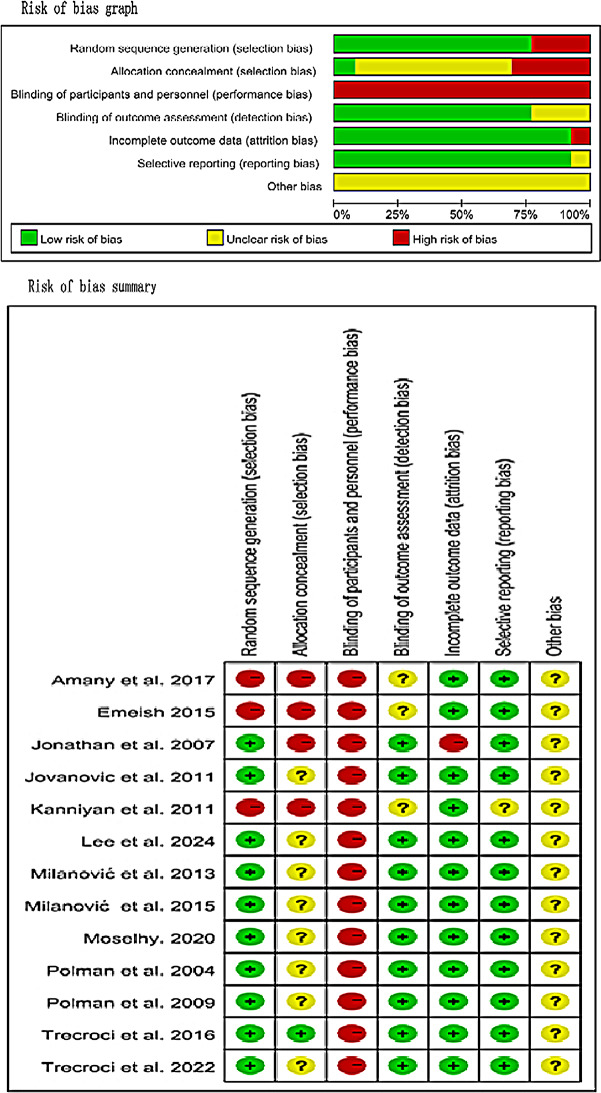
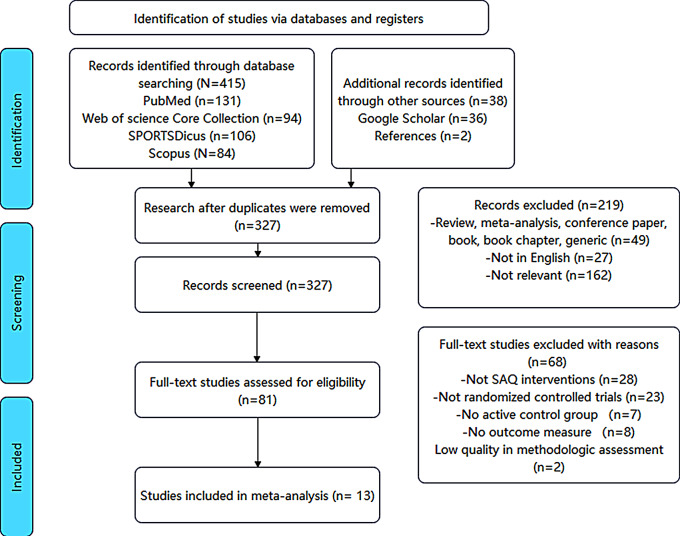
Methods: A thorough search of databases, including Web of Science Core, SPORTDiscus, PubMed, and SCOPUS, was conducted, with data up to July 2024. The PEDro scale assessed study quality and RevMan 5.3 evaluated bias risk. Effect sizes (ES) were calculated from means and standard deviations, with heterogeneity assessed using the I² statistic. Publication bias was evaluated using an extended Egger test.
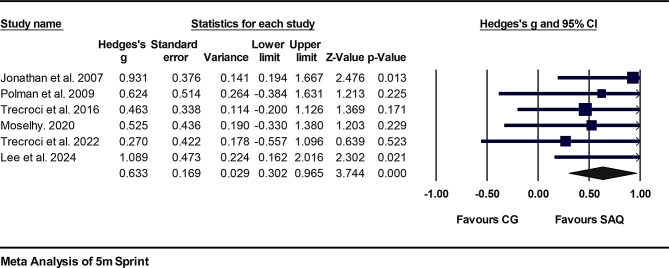
Results: Eleven RCTs involving 499 healthy athletes from sports such as soccer, basketball, tennis, and handball met the inclusion criteria. The SAQ interventions lasted between 4 and 12 weeks, with a frequency of two to three sessions per week. The analysis revealed significant improvements in 5-meter sprint (ES = 0.63, p < 0.01), 20-meter sprint (ES = 0.49, p < 0.01), 30-meter sprint (ES = 0.55, p = 0.015), change of direction (COD) performance (ES = 0.39, p < 0.01), reaction time (ES = 0.52, p = 0.01), lower limb power (ES = 0.96, p < 0.01), and flexibility (ES = 0.57, p < 0.01), with effect sizes ranging from small to moderate. Subgroup analysis indicated that only session duration had a near-significant effect on COD performance (≤ 60 min: ES = 0.58; >60 min: ES = 0.24; p = 0.059).
Conclusions: SAQ training effectively enhances sprint performance, COD ability, reaction time, lower limb strength, and flexibility, with effect sizes ranging from small to moderate. The findings suggest that shorter training durations (≤ 60 min) may be more beneficial for improving COD performance, although this effect did not reach statistical significance. Further trials are recommended to determine the optimal training dosage, along with high-quality studies covering a broader range of sports, particularly in athletes aged 14 to 18.
期刊介绍:
BMC Sports Science, Medicine and Rehabilitation is an open access, peer reviewed journal that considers articles on all aspects of sports medicine and the exercise sciences, including rehabilitation, traumatology, cardiology, physiology, and nutrition.




 京公网安备 11010802042870号
京ICP备2023020795号-1
京公网安备 11010802042870号
京ICP备2023020795号-1

 分享
分享
 求助内容:
求助内容: 应助结果提醒方式:
 扫码关注我们
