{"title":"具有弹性回弹性、裂纹耐受性和两栖自粘性的仿皮肤软应变传感器","authors":"Yunna Hao, Wei Ren, Qun Zhou, Bin Wang, Hongfang Liu, Peihua Zhang, Ranran Wang, Xiaohong Qin, Liming Wang, Yin Cheng","doi":"10.1021/acssensors.5c00555","DOIUrl":null,"url":null,"abstract":"The intrinsic elastic resilience, fatigue resistance, and self-adhesion of human skin are highly desired merits. However, they are challenging to combine into a single mechanoreceptive electronic skin for healthcare monitoring and humanoid soft robots. We introduce an elastically resilient, crack-tolerant, amphibiously adhesive, and strain-sensitive electronic skin (ERCAS-skin) featuring a hierarchical and gradient design. ERCAS-skin has a skin-like binary structure of a carbon nanotube-coated thermoplastic polyurethane nanofibrous scaffold embedded in a gradient cross-linking polydimethylsiloxane (PDMS) matrix. The binary structure endows ERCAS-skin with mechanical compliance (Young’s modulus of 2.4 MPa) and crack tolerance (fatigue threshold of 1285 J m<sup>–2</sup>) through a matrix-to-scaffold stress transfer. The gradient cross-linking PDMS ensures not only high elastic resilience (recovery of 95%) but also strong wet adhesion (0.76 N cm<sup>–1</sup>) through a synergistic hydrophobic chain mobility effect. The crack generation mechanism of the embedded carbon nanotube polyurethane enables high sensitivity and a wide strain-sensing range. Owing to its excellent strain-sensing capability, ERCAS-skin was utilized as a self-adhesive strain sensor for hand gesture recognition both in the air and under water and as a fatigue-free motion sensor for robotic fish monitoring.","PeriodicalId":24,"journal":{"name":"ACS Sensors","volume":"15 1","pages":""},"PeriodicalIF":10.9000,"publicationDate":"2025-04-03","publicationTypes":"Journal Article","fieldsOfStudy":null,"isOpenAccess":false,"openAccessPdf":"","citationCount":"0","resultStr":"{\"title\":\"Skin-Mimicking Soft Strain Sensor with Elastic Resilience, Crack Tolerance, and Amphibious Self-Adhesion\",\"authors\":\"Yunna Hao, Wei Ren, Qun Zhou, Bin Wang, Hongfang Liu, Peihua Zhang, Ranran Wang, Xiaohong Qin, Liming Wang, Yin Cheng\",\"doi\":\"10.1021/acssensors.5c00555\",\"DOIUrl\":null,\"url\":null,\"abstract\":\"The intrinsic elastic resilience, fatigue resistance, and self-adhesion of human skin are highly desired merits. However, they are challenging to combine into a single mechanoreceptive electronic skin for healthcare monitoring and humanoid soft robots. We introduce an elastically resilient, crack-tolerant, amphibiously adhesive, and strain-sensitive electronic skin (ERCAS-skin) featuring a hierarchical and gradient design. ERCAS-skin has a skin-like binary structure of a carbon nanotube-coated thermoplastic polyurethane nanofibrous scaffold embedded in a gradient cross-linking polydimethylsiloxane (PDMS) matrix. The binary structure endows ERCAS-skin with mechanical compliance (Young’s modulus of 2.4 MPa) and crack tolerance (fatigue threshold of 1285 J m<sup>–2</sup>) through a matrix-to-scaffold stress transfer. The gradient cross-linking PDMS ensures not only high elastic resilience (recovery of 95%) but also strong wet adhesion (0.76 N cm<sup>–1</sup>) through a synergistic hydrophobic chain mobility effect. The crack generation mechanism of the embedded carbon nanotube polyurethane enables high sensitivity and a wide strain-sensing range. Owing to its excellent strain-sensing capability, ERCAS-skin was utilized as a self-adhesive strain sensor for hand gesture recognition both in the air and under water and as a fatigue-free motion sensor for robotic fish monitoring.\",\"PeriodicalId\":24,\"journal\":{\"name\":\"ACS Sensors\",\"volume\":\"15 1\",\"pages\":\"\"},\"PeriodicalIF\":10.9000,\"publicationDate\":\"2025-04-03\",\"publicationTypes\":\"Journal Article\",\"fieldsOfStudy\":null,\"isOpenAccess\":false,\"openAccessPdf\":\"\",\"citationCount\":\"0\",\"resultStr\":null,\"platform\":\"Semanticscholar\",\"paperid\":null,\"PeriodicalName\":\"ACS Sensors\",\"FirstCategoryId\":\"92\",\"ListUrlMain\":\"https://doi.org/10.1021/acssensors.5c00555\",\"RegionNum\":1,\"RegionCategory\":\"化学\",\"ArticlePicture\":[],\"TitleCN\":null,\"AbstractTextCN\":null,\"PMCID\":null,\"EPubDate\":\"\",\"PubModel\":\"\",\"JCR\":\"Q1\",\"JCRName\":\"CHEMISTRY, ANALYTICAL\",\"Score\":null,\"Total\":0}","platform":"Semanticscholar","paperid":null,"PeriodicalName":"ACS Sensors","FirstCategoryId":"92","ListUrlMain":"https://doi.org/10.1021/acssensors.5c00555","RegionNum":1,"RegionCategory":"化学","ArticlePicture":[],"TitleCN":null,"AbstractTextCN":null,"PMCID":null,"EPubDate":"","PubModel":"","JCR":"Q1","JCRName":"CHEMISTRY, ANALYTICAL","Score":null,"Total":0}
引用次数: 0
摘要
人体皮肤具有固有的弹性、抗疲劳性和自粘附性等优点。然而,将它们结合成一个单一的机械感受电子皮肤用于医疗监测和类人软机器人是具有挑战性的。我们介绍了一种弹性弹性,耐裂纹,两栖胶粘剂,应变敏感电子皮肤(ercas -皮肤)具有分层和梯度设计。ERCAS-skin具有类似皮肤的二元结构,由碳纳米管涂层的热塑性聚氨酯纳米纤维支架嵌入梯度交联聚二甲基硅氧烷(PDMS)基质中。二元结构通过基质到支架的应力传递,使ERCAS-skin具有力学顺应性(杨氏模量为2.4 MPa)和裂纹容限(疲劳阈值为1285 J - m-2)。梯度交联PDMS不仅保证了高弹性回弹性(恢复95%),而且通过协同疏水链迁移效应具有强的湿附着力(0.76 N cm-1)。碳纳米管聚氨酯的裂纹产生机制使其具有高灵敏度和宽应变传感范围。由于其优异的应变传感能力,ERCAS-skin被用作自粘应变传感器,用于空中和水下的手势识别,以及用于机器鱼监测的无疲劳运动传感器。
Skin-Mimicking Soft Strain Sensor with Elastic Resilience, Crack Tolerance, and Amphibious Self-Adhesion
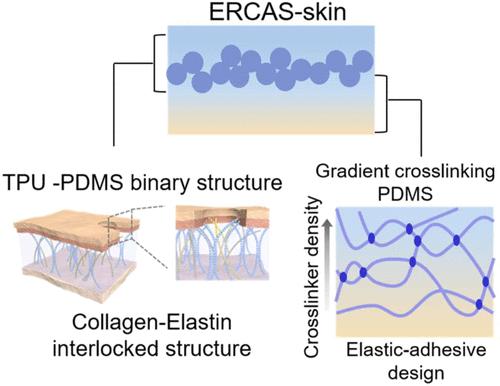
The intrinsic elastic resilience, fatigue resistance, and self-adhesion of human skin are highly desired merits. However, they are challenging to combine into a single mechanoreceptive electronic skin for healthcare monitoring and humanoid soft robots. We introduce an elastically resilient, crack-tolerant, amphibiously adhesive, and strain-sensitive electronic skin (ERCAS-skin) featuring a hierarchical and gradient design. ERCAS-skin has a skin-like binary structure of a carbon nanotube-coated thermoplastic polyurethane nanofibrous scaffold embedded in a gradient cross-linking polydimethylsiloxane (PDMS) matrix. The binary structure endows ERCAS-skin with mechanical compliance (Young’s modulus of 2.4 MPa) and crack tolerance (fatigue threshold of 1285 J m–2) through a matrix-to-scaffold stress transfer. The gradient cross-linking PDMS ensures not only high elastic resilience (recovery of 95%) but also strong wet adhesion (0.76 N cm–1) through a synergistic hydrophobic chain mobility effect. The crack generation mechanism of the embedded carbon nanotube polyurethane enables high sensitivity and a wide strain-sensing range. Owing to its excellent strain-sensing capability, ERCAS-skin was utilized as a self-adhesive strain sensor for hand gesture recognition both in the air and under water and as a fatigue-free motion sensor for robotic fish monitoring.
期刊介绍:
ACS Sensors is a peer-reviewed research journal that focuses on the dissemination of new and original knowledge in the field of sensor science, particularly those that selectively sense chemical or biological species or processes. The journal covers a broad range of topics, including but not limited to biosensors, chemical sensors, gas sensors, intracellular sensors, single molecule sensors, cell chips, and microfluidic devices. It aims to publish articles that address conceptual advances in sensing technology applicable to various types of analytes or application papers that report on the use of existing sensing concepts in new ways or for new analytes.




 京公网安备 11010802042870号
京ICP备2023020795号-1
京公网安备 11010802042870号
京ICP备2023020795号-1

 分享
分享
 求助内容:
求助内容: 应助结果提醒方式:
 扫码关注我们
