Guodong Kong , Penglong Li , Xiaolei Cui , Zixi Kang , Hailing Guo , Svetlana Mintova
{"title":"纳米二氧化硅渗透掺杂TFN膜的制备及其增强渗透纳滤性能","authors":"Guodong Kong , Penglong Li , Xiaolei Cui , Zixi Kang , Hailing Guo , Svetlana Mintova","doi":"10.1016/j.memsci.2025.124059","DOIUrl":null,"url":null,"abstract":"<div><div>Constructing high-performance nanofiltration membranes requires maximizing water permeance while maintaining desirable rejection. Here, a thin-film nanocomposite (TFN) membrane with a filler penetrant-doped structure was designed for efficient desalination. Unlike conventional TFN membranes, the filler silica nanoparticles are exposed on the top of the polyamide layer, which further enhances the hydrophilicity and thus allows water to wet the membrane surface quickly. At the same time, the partially embedded silica nanoparticles create transportation channels for water molecules between silica and polyamide (PA) matrix. This stems from the moderate cross-linking between hydroxyl groups and chlorides on the silica surface, which builds water channels while avoiding large interfacial defects. As a result of the special doping, the NF membrane has a high water permeance, reaching an impressive value of 19.7 L m<sup>-2</sup>h<sup>-1</sup> bar<sup>-1</sup>, which is 95% higher than that of the conventional TFN membrane. Additionally, the membranes exhibited a Na<sub>2</sub>SO<sub>4</sub> rejection exceeding 95%. In conclusion, this penetrant doping synthesis method provides a promising solution for the construction of high-permeance nanofiltration membranes.</div></div>","PeriodicalId":368,"journal":{"name":"Journal of Membrane Science","volume":"726 ","pages":"Article 124059"},"PeriodicalIF":9.0000,"publicationDate":"2025-04-01","publicationTypes":"Journal Article","fieldsOfStudy":null,"isOpenAccess":false,"openAccessPdf":"","citationCount":"0","resultStr":"{\"title\":\"Construction of Silica Nanoparticle Penetrant-doped TFN membranes for Enhanced Permeance Nanofiltration\",\"authors\":\"Guodong Kong , Penglong Li , Xiaolei Cui , Zixi Kang , Hailing Guo , Svetlana Mintova\",\"doi\":\"10.1016/j.memsci.2025.124059\",\"DOIUrl\":null,\"url\":null,\"abstract\":\"<div><div>Constructing high-performance nanofiltration membranes requires maximizing water permeance while maintaining desirable rejection. Here, a thin-film nanocomposite (TFN) membrane with a filler penetrant-doped structure was designed for efficient desalination. Unlike conventional TFN membranes, the filler silica nanoparticles are exposed on the top of the polyamide layer, which further enhances the hydrophilicity and thus allows water to wet the membrane surface quickly. At the same time, the partially embedded silica nanoparticles create transportation channels for water molecules between silica and polyamide (PA) matrix. This stems from the moderate cross-linking between hydroxyl groups and chlorides on the silica surface, which builds water channels while avoiding large interfacial defects. As a result of the special doping, the NF membrane has a high water permeance, reaching an impressive value of 19.7 L m<sup>-2</sup>h<sup>-1</sup> bar<sup>-1</sup>, which is 95% higher than that of the conventional TFN membrane. Additionally, the membranes exhibited a Na<sub>2</sub>SO<sub>4</sub> rejection exceeding 95%. In conclusion, this penetrant doping synthesis method provides a promising solution for the construction of high-permeance nanofiltration membranes.</div></div>\",\"PeriodicalId\":368,\"journal\":{\"name\":\"Journal of Membrane Science\",\"volume\":\"726 \",\"pages\":\"Article 124059\"},\"PeriodicalIF\":9.0000,\"publicationDate\":\"2025-04-01\",\"publicationTypes\":\"Journal Article\",\"fieldsOfStudy\":null,\"isOpenAccess\":false,\"openAccessPdf\":\"\",\"citationCount\":\"0\",\"resultStr\":null,\"platform\":\"Semanticscholar\",\"paperid\":null,\"PeriodicalName\":\"Journal of Membrane Science\",\"FirstCategoryId\":\"5\",\"ListUrlMain\":\"https://www.sciencedirect.com/science/article/pii/S0376738825003722\",\"RegionNum\":1,\"RegionCategory\":\"工程技术\",\"ArticlePicture\":[],\"TitleCN\":null,\"AbstractTextCN\":null,\"PMCID\":null,\"EPubDate\":\"\",\"PubModel\":\"\",\"JCR\":\"Q1\",\"JCRName\":\"ENGINEERING, CHEMICAL\",\"Score\":null,\"Total\":0}","platform":"Semanticscholar","paperid":null,"PeriodicalName":"Journal of Membrane Science","FirstCategoryId":"5","ListUrlMain":"https://www.sciencedirect.com/science/article/pii/S0376738825003722","RegionNum":1,"RegionCategory":"工程技术","ArticlePicture":[],"TitleCN":null,"AbstractTextCN":null,"PMCID":null,"EPubDate":"","PubModel":"","JCR":"Q1","JCRName":"ENGINEERING, CHEMICAL","Score":null,"Total":0}
引用次数: 0
摘要
构建高性能纳滤膜需要最大限度地提高透水性,同时保持理想的截留率。本文设计了一种具有填料渗透掺杂结构的薄膜纳米复合材料(TFN)膜,用于高效脱盐。与传统的TFN膜不同,填充二氧化硅纳米颗粒暴露在聚酰胺层的顶部,这进一步增强了亲水性,从而使水能够快速润湿膜表面。同时,部分嵌入的二氧化硅纳米颗粒为二氧化硅和聚酰胺(PA)基质之间的水分子创造了运输通道。这源于二氧化硅表面羟基和氯化物之间适度的交联,在避免大的界面缺陷的同时建立了水通道。由于特殊掺杂,纳滤膜具有很高的水透性,达到19.7 L m-2h-1 bar-1,比传统的TFN膜高95%。此外,膜对Na2SO4的去除率超过95%。总之,这种渗透掺杂合成方法为构建高渗透纳滤膜提供了一种很有前途的解决方案。
Construction of Silica Nanoparticle Penetrant-doped TFN membranes for Enhanced Permeance Nanofiltration
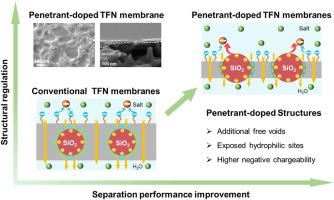
Constructing high-performance nanofiltration membranes requires maximizing water permeance while maintaining desirable rejection. Here, a thin-film nanocomposite (TFN) membrane with a filler penetrant-doped structure was designed for efficient desalination. Unlike conventional TFN membranes, the filler silica nanoparticles are exposed on the top of the polyamide layer, which further enhances the hydrophilicity and thus allows water to wet the membrane surface quickly. At the same time, the partially embedded silica nanoparticles create transportation channels for water molecules between silica and polyamide (PA) matrix. This stems from the moderate cross-linking between hydroxyl groups and chlorides on the silica surface, which builds water channels while avoiding large interfacial defects. As a result of the special doping, the NF membrane has a high water permeance, reaching an impressive value of 19.7 L m-2h-1 bar-1, which is 95% higher than that of the conventional TFN membrane. Additionally, the membranes exhibited a Na2SO4 rejection exceeding 95%. In conclusion, this penetrant doping synthesis method provides a promising solution for the construction of high-permeance nanofiltration membranes.
期刊介绍:
The Journal of Membrane Science is a publication that focuses on membrane systems and is aimed at academic and industrial chemists, chemical engineers, materials scientists, and membranologists. It publishes original research and reviews on various aspects of membrane transport, membrane formation/structure, fouling, module/process design, and processes/applications. The journal primarily focuses on the structure, function, and performance of non-biological membranes but also includes papers that relate to biological membranes. The Journal of Membrane Science publishes Full Text Papers, State-of-the-Art Reviews, Letters to the Editor, and Perspectives.



 京公网安备 11010802042870号
京ICP备2023020795号-1
京公网安备 11010802042870号
京ICP备2023020795号-1

 分享
分享
 求助内容:
求助内容: 应助结果提醒方式:
 扫码关注我们
