Haixian Guo , Hongliang Fu , Yue Lian , Jing Zhao , Huaihao Zhang
{"title":"具有多级孔结构的B、n共掺杂碳骨架用于超级电容器和电容去离子","authors":"Haixian Guo , Hongliang Fu , Yue Lian , Jing Zhao , Huaihao Zhang","doi":"10.1016/j.desal.2025.118862","DOIUrl":null,"url":null,"abstract":"<div><div>Due to the advantages of simple structure regulation, low cost and easy availability, asphalt-based carbon material has become a promising electrode material in supercapacitive research field. In this work, a boron-nitrogen co-doped multistage porous carbon material (BNMPC) was successfully prepared by various ways to regulate the nano-structure of asphalt-derived carbon material. From the synergistic activation of ammonium borate and potassium bicarbonate, the advanced pore structures were constructed, effectively ensuring full utilization of high specific surface area. At the same time, B and N atoms were successfully doped into the carbon lattice, which significantly improved the material's wettability and pseudocapacitance contribution. Ammonium borate (as doping and activation dual functional agent) secure the doping uniformity and stability of material properties. In addition, the B-N valence bond from B and N doping can improve the material's conductivity and ion transport kinetics, providing a strong guarantee for good supercapacitive properties. In supercapacitors (SC), BNMPC//BNMPC devices demonstrate superior performance, affording energy densities and power densities up to 8.3 Wh kg<sup>−1</sup> and 2.5 kW kg<sup>−1</sup>, respectively. As for capacitor deionization (CDI) device, its salt adsorption capacity can reach 14.8 mg g<sup>−1</sup>. In summary, the carbon materials prepared in this study show desirable capacitive properties.</div></div>","PeriodicalId":299,"journal":{"name":"Desalination","volume":"609 ","pages":"Article 118862"},"PeriodicalIF":9.8000,"publicationDate":"2025-04-02","publicationTypes":"Journal Article","fieldsOfStudy":null,"isOpenAccess":false,"openAccessPdf":"","citationCount":"0","resultStr":"{\"title\":\"B, N-codoped carbon skeletons with multistage pore structure for supercapacitor and capacitive deionization\",\"authors\":\"Haixian Guo , Hongliang Fu , Yue Lian , Jing Zhao , Huaihao Zhang\",\"doi\":\"10.1016/j.desal.2025.118862\",\"DOIUrl\":null,\"url\":null,\"abstract\":\"<div><div>Due to the advantages of simple structure regulation, low cost and easy availability, asphalt-based carbon material has become a promising electrode material in supercapacitive research field. In this work, a boron-nitrogen co-doped multistage porous carbon material (BNMPC) was successfully prepared by various ways to regulate the nano-structure of asphalt-derived carbon material. From the synergistic activation of ammonium borate and potassium bicarbonate, the advanced pore structures were constructed, effectively ensuring full utilization of high specific surface area. At the same time, B and N atoms were successfully doped into the carbon lattice, which significantly improved the material's wettability and pseudocapacitance contribution. Ammonium borate (as doping and activation dual functional agent) secure the doping uniformity and stability of material properties. In addition, the B-N valence bond from B and N doping can improve the material's conductivity and ion transport kinetics, providing a strong guarantee for good supercapacitive properties. In supercapacitors (SC), BNMPC//BNMPC devices demonstrate superior performance, affording energy densities and power densities up to 8.3 Wh kg<sup>−1</sup> and 2.5 kW kg<sup>−1</sup>, respectively. As for capacitor deionization (CDI) device, its salt adsorption capacity can reach 14.8 mg g<sup>−1</sup>. In summary, the carbon materials prepared in this study show desirable capacitive properties.</div></div>\",\"PeriodicalId\":299,\"journal\":{\"name\":\"Desalination\",\"volume\":\"609 \",\"pages\":\"Article 118862\"},\"PeriodicalIF\":9.8000,\"publicationDate\":\"2025-04-02\",\"publicationTypes\":\"Journal Article\",\"fieldsOfStudy\":null,\"isOpenAccess\":false,\"openAccessPdf\":\"\",\"citationCount\":\"0\",\"resultStr\":null,\"platform\":\"Semanticscholar\",\"paperid\":null,\"PeriodicalName\":\"Desalination\",\"FirstCategoryId\":\"5\",\"ListUrlMain\":\"https://www.sciencedirect.com/science/article/pii/S0011916425003376\",\"RegionNum\":1,\"RegionCategory\":\"工程技术\",\"ArticlePicture\":[],\"TitleCN\":null,\"AbstractTextCN\":null,\"PMCID\":null,\"EPubDate\":\"\",\"PubModel\":\"\",\"JCR\":\"Q1\",\"JCRName\":\"ENGINEERING, CHEMICAL\",\"Score\":null,\"Total\":0}","platform":"Semanticscholar","paperid":null,"PeriodicalName":"Desalination","FirstCategoryId":"5","ListUrlMain":"https://www.sciencedirect.com/science/article/pii/S0011916425003376","RegionNum":1,"RegionCategory":"工程技术","ArticlePicture":[],"TitleCN":null,"AbstractTextCN":null,"PMCID":null,"EPubDate":"","PubModel":"","JCR":"Q1","JCRName":"ENGINEERING, CHEMICAL","Score":null,"Total":0}
引用次数: 0
摘要
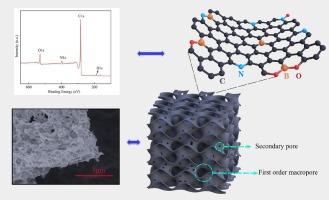
沥青基碳材料具有结构调控简单、成本低廉、易于获得等优点,已成为超级电容研究领域一种前景广阔的电极材料。本研究采用多种方法调节沥青基碳材料的纳米结构,成功制备了硼氮共掺杂多级多孔碳材料(BNMPC)。通过硼酸铵和碳酸氢钾的协同活化,构建了先进的孔隙结构,有效保证了高比表面积的充分利用。同时,硼酸铵和碳酸氢钾还成功地在碳晶格中掺入了硼原子和氮原子,从而显著提高了材料的润湿性和伪电容贡献。硼酸铵(作为掺杂和活化双功能剂)确保了掺杂的均匀性和材料性能的稳定性。此外,掺杂 B 和 N 所产生的 B-N 价键还能改善材料的导电性和离子传输动力学,为实现良好的超级电容器性能提供了有力保障。在超级电容器(SC)中,BNMPC//BNMPC 器件表现出卓越的性能,能量密度和功率密度分别高达 8.3 Wh kg-1 和 2.5 kW kg-1。至于电容器去离子(CDI)装置,其盐吸附能力可达 14.8 mg g-1。总之,本研究制备的碳材料具有理想的电容特性。
B, N-codoped carbon skeletons with multistage pore structure for supercapacitor and capacitive deionization
Due to the advantages of simple structure regulation, low cost and easy availability, asphalt-based carbon material has become a promising electrode material in supercapacitive research field. In this work, a boron-nitrogen co-doped multistage porous carbon material (BNMPC) was successfully prepared by various ways to regulate the nano-structure of asphalt-derived carbon material. From the synergistic activation of ammonium borate and potassium bicarbonate, the advanced pore structures were constructed, effectively ensuring full utilization of high specific surface area. At the same time, B and N atoms were successfully doped into the carbon lattice, which significantly improved the material's wettability and pseudocapacitance contribution. Ammonium borate (as doping and activation dual functional agent) secure the doping uniformity and stability of material properties. In addition, the B-N valence bond from B and N doping can improve the material's conductivity and ion transport kinetics, providing a strong guarantee for good supercapacitive properties. In supercapacitors (SC), BNMPC//BNMPC devices demonstrate superior performance, affording energy densities and power densities up to 8.3 Wh kg−1 and 2.5 kW kg−1, respectively. As for capacitor deionization (CDI) device, its salt adsorption capacity can reach 14.8 mg g−1. In summary, the carbon materials prepared in this study show desirable capacitive properties.
期刊介绍:
Desalination is a scholarly journal that focuses on the field of desalination materials, processes, and associated technologies. It encompasses a wide range of disciplines and aims to publish exceptional papers in this area.
The journal invites submissions that explicitly revolve around water desalting and its applications to various sources such as seawater, groundwater, and wastewater. It particularly encourages research on diverse desalination methods including thermal, membrane, sorption, and hybrid processes.
By providing a platform for innovative studies, Desalination aims to advance the understanding and development of desalination technologies, promoting sustainable solutions for water scarcity challenges.




 京公网安备 11010802042870号
京ICP备2023020795号-1
京公网安备 11010802042870号
京ICP备2023020795号-1

 分享
分享
 求助内容:
求助内容: 应助结果提醒方式:
 扫码关注我们
