Moreah Zisquit, Alon Shoa, Ramon Oliva, Stav Perry, Bernhard Spanlang, Anat Brunstein Klomek, Mel Slater, Doron Friedman
{"title":"人工智能增强的虚拟现实心理咨询自言自语:形成性质的研究。","authors":"Moreah Zisquit, Alon Shoa, Ramon Oliva, Stav Perry, Bernhard Spanlang, Anat Brunstein Klomek, Mel Slater, Doron Friedman","doi":"10.2196/67782","DOIUrl":null,"url":null,"abstract":"<p><strong>Background: </strong>Access to mental health services continues to pose a global challenge, with current services often unable to meet the growing demand. This has sparked interest in conversational artificial intelligence (AI) agents as potential solutions. Despite this, the development of a reliable virtual therapist remains challenging, and the feasibility of AI fulfilling this sensitive role is still uncertain. One promising approach involves using AI agents for psychological self-talk, particularly within virtual reality (VR) environments. Self-talk in VR allows externalizing self-conversation by enabling individuals to embody avatars representing themselves as both patient and counselor, thus enhancing cognitive flexibility and problem-solving abilities. However, participants sometimes experience difficulties progressing in sessions, which is where AI could offer guidance and support.</p><p><strong>Objective: </strong>This formative study aims to assess the challenges and advantages of integrating an AI agent into self-talk in VR for psychological counseling, focusing on user experience and the potential role of AI in supporting self-reflection, problem-solving, and positive behavioral change.</p><p><strong>Methods: </strong>We carried out an iterative design and development of a system and protocol integrating large language models (LLMs) within VR self-talk during the first two and a half years. The design process addressed user interface, speech-to-text functionalities, fine-tuning the LLMs, and prompt engineering. Upon completion of the design process, we conducted a 3-month long exploratory qualitative study in which 11 healthy participants completed a session that included identifying a problem they wanted to address, attempting to address this problem using self-talk in VR, and then continuing self-talk in VR but this time with the assistance of an LLM-based virtual human. The sessions were carried out with a trained clinical psychologist and followed by semistructured interviews. We used applied thematic analysis after the interviews to code and develop key themes for the participants that addressed our research objective.</p><p><strong>Results: </strong>In total, 4 themes were identified regarding the quality of advice, the potential advantages of human-AI collaboration in self-help, the believability of the virtual human, and user preferences for avatars in the scenario. The participants rated their desire to engage in additional such sessions at 8.3 out of 10, and more than half of the respondents indicated that they preferred using VR self-talk with AI rather than without it. On average, the usefulness of the session was rated 6.9 (SD 0.54), and the degree to which it helped solve their problem was rated 6.1 (SD 1.58). Participants specifically noted that human-AI collaboration led to improved outcomes and facilitated more positive thought processes, thereby enhancing self-reflection and problem-solving abilities.</p><p><strong>Conclusions: </strong>This exploratory study suggests that the VR self-talk paradigm can be enhanced by LLM-based agents and presents the ways to achieve this, potential pitfalls, and additional insights.</p>","PeriodicalId":14841,"journal":{"name":"JMIR Formative Research","volume":"9 ","pages":"e67782"},"PeriodicalIF":2.4000,"publicationDate":"2025-04-02","publicationTypes":"Journal Article","fieldsOfStudy":null,"isOpenAccess":false,"openAccessPdf":"https://www.ncbi.nlm.nih.gov/pmc/articles/PMC12004015/pdf/","citationCount":"0","resultStr":"{\"title\":\"AI-Enhanced Virtual Reality Self-Talk for Psychological Counseling: Formative Qualitative Study.\",\"authors\":\"Moreah Zisquit, Alon Shoa, Ramon Oliva, Stav Perry, Bernhard Spanlang, Anat Brunstein Klomek, Mel Slater, Doron Friedman\",\"doi\":\"10.2196/67782\",\"DOIUrl\":null,\"url\":null,\"abstract\":\"<p><strong>Background: </strong>Access to mental health services continues to pose a global challenge, with current services often unable to meet the growing demand. This has sparked interest in conversational artificial intelligence (AI) agents as potential solutions. Despite this, the development of a reliable virtual therapist remains challenging, and the feasibility of AI fulfilling this sensitive role is still uncertain. One promising approach involves using AI agents for psychological self-talk, particularly within virtual reality (VR) environments. Self-talk in VR allows externalizing self-conversation by enabling individuals to embody avatars representing themselves as both patient and counselor, thus enhancing cognitive flexibility and problem-solving abilities. However, participants sometimes experience difficulties progressing in sessions, which is where AI could offer guidance and support.</p><p><strong>Objective: </strong>This formative study aims to assess the challenges and advantages of integrating an AI agent into self-talk in VR for psychological counseling, focusing on user experience and the potential role of AI in supporting self-reflection, problem-solving, and positive behavioral change.</p><p><strong>Methods: </strong>We carried out an iterative design and development of a system and protocol integrating large language models (LLMs) within VR self-talk during the first two and a half years. The design process addressed user interface, speech-to-text functionalities, fine-tuning the LLMs, and prompt engineering. Upon completion of the design process, we conducted a 3-month long exploratory qualitative study in which 11 healthy participants completed a session that included identifying a problem they wanted to address, attempting to address this problem using self-talk in VR, and then continuing self-talk in VR but this time with the assistance of an LLM-based virtual human. The sessions were carried out with a trained clinical psychologist and followed by semistructured interviews. We used applied thematic analysis after the interviews to code and develop key themes for the participants that addressed our research objective.</p><p><strong>Results: </strong>In total, 4 themes were identified regarding the quality of advice, the potential advantages of human-AI collaboration in self-help, the believability of the virtual human, and user preferences for avatars in the scenario. The participants rated their desire to engage in additional such sessions at 8.3 out of 10, and more than half of the respondents indicated that they preferred using VR self-talk with AI rather than without it. On average, the usefulness of the session was rated 6.9 (SD 0.54), and the degree to which it helped solve their problem was rated 6.1 (SD 1.58). Participants specifically noted that human-AI collaboration led to improved outcomes and facilitated more positive thought processes, thereby enhancing self-reflection and problem-solving abilities.</p><p><strong>Conclusions: </strong>This exploratory study suggests that the VR self-talk paradigm can be enhanced by LLM-based agents and presents the ways to achieve this, potential pitfalls, and additional insights.</p>\",\"PeriodicalId\":14841,\"journal\":{\"name\":\"JMIR Formative Research\",\"volume\":\"9 \",\"pages\":\"e67782\"},\"PeriodicalIF\":2.4000,\"publicationDate\":\"2025-04-02\",\"publicationTypes\":\"Journal Article\",\"fieldsOfStudy\":null,\"isOpenAccess\":false,\"openAccessPdf\":\"https://www.ncbi.nlm.nih.gov/pmc/articles/PMC12004015/pdf/\",\"citationCount\":\"0\",\"resultStr\":null,\"platform\":\"Semanticscholar\",\"paperid\":null,\"PeriodicalName\":\"JMIR Formative Research\",\"FirstCategoryId\":\"1085\",\"ListUrlMain\":\"https://doi.org/10.2196/67782\",\"RegionNum\":0,\"RegionCategory\":null,\"ArticlePicture\":[],\"TitleCN\":null,\"AbstractTextCN\":null,\"PMCID\":null,\"EPubDate\":\"\",\"PubModel\":\"\",\"JCR\":\"Q3\",\"JCRName\":\"HEALTH CARE SCIENCES & SERVICES\",\"Score\":null,\"Total\":0}","platform":"Semanticscholar","paperid":null,"PeriodicalName":"JMIR Formative Research","FirstCategoryId":"1085","ListUrlMain":"https://doi.org/10.2196/67782","RegionNum":0,"RegionCategory":null,"ArticlePicture":[],"TitleCN":null,"AbstractTextCN":null,"PMCID":null,"EPubDate":"","PubModel":"","JCR":"Q3","JCRName":"HEALTH CARE SCIENCES & SERVICES","Score":null,"Total":0}
AI-Enhanced Virtual Reality Self-Talk for Psychological Counseling: Formative Qualitative Study.
Background: Access to mental health services continues to pose a global challenge, with current services often unable to meet the growing demand. This has sparked interest in conversational artificial intelligence (AI) agents as potential solutions. Despite this, the development of a reliable virtual therapist remains challenging, and the feasibility of AI fulfilling this sensitive role is still uncertain. One promising approach involves using AI agents for psychological self-talk, particularly within virtual reality (VR) environments. Self-talk in VR allows externalizing self-conversation by enabling individuals to embody avatars representing themselves as both patient and counselor, thus enhancing cognitive flexibility and problem-solving abilities. However, participants sometimes experience difficulties progressing in sessions, which is where AI could offer guidance and support.
Objective: This formative study aims to assess the challenges and advantages of integrating an AI agent into self-talk in VR for psychological counseling, focusing on user experience and the potential role of AI in supporting self-reflection, problem-solving, and positive behavioral change.
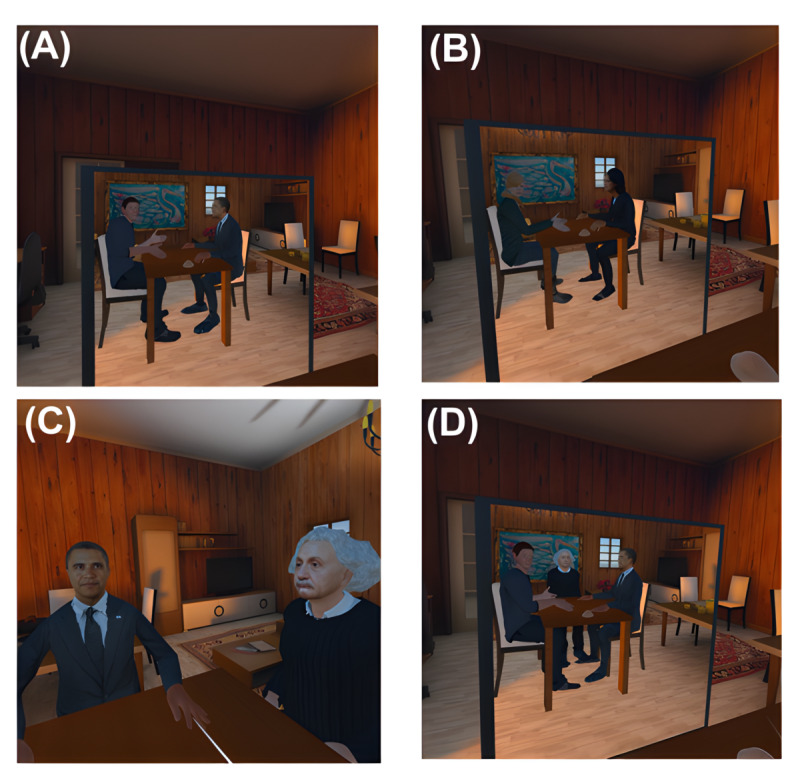
Methods: We carried out an iterative design and development of a system and protocol integrating large language models (LLMs) within VR self-talk during the first two and a half years. The design process addressed user interface, speech-to-text functionalities, fine-tuning the LLMs, and prompt engineering. Upon completion of the design process, we conducted a 3-month long exploratory qualitative study in which 11 healthy participants completed a session that included identifying a problem they wanted to address, attempting to address this problem using self-talk in VR, and then continuing self-talk in VR but this time with the assistance of an LLM-based virtual human. The sessions were carried out with a trained clinical psychologist and followed by semistructured interviews. We used applied thematic analysis after the interviews to code and develop key themes for the participants that addressed our research objective.
Results: In total, 4 themes were identified regarding the quality of advice, the potential advantages of human-AI collaboration in self-help, the believability of the virtual human, and user preferences for avatars in the scenario. The participants rated their desire to engage in additional such sessions at 8.3 out of 10, and more than half of the respondents indicated that they preferred using VR self-talk with AI rather than without it. On average, the usefulness of the session was rated 6.9 (SD 0.54), and the degree to which it helped solve their problem was rated 6.1 (SD 1.58). Participants specifically noted that human-AI collaboration led to improved outcomes and facilitated more positive thought processes, thereby enhancing self-reflection and problem-solving abilities.
Conclusions: This exploratory study suggests that the VR self-talk paradigm can be enhanced by LLM-based agents and presents the ways to achieve this, potential pitfalls, and additional insights.






 京公网安备 11010802042870号
京ICP备2023020795号-1
京公网安备 11010802042870号
京ICP备2023020795号-1

 分享
分享
 求助内容:
求助内容: 应助结果提醒方式:
 扫码关注我们
