Songtao Mei , Kai Wang , Heike Schmitt , Nynke Hofstra
{"title":"模拟大肠杆菌浓度:45.6%至78.1%的中国河流显示微生物水质较差","authors":"Songtao Mei , Kai Wang , Heike Schmitt , Nynke Hofstra","doi":"10.1016/j.envpol.2025.126184","DOIUrl":null,"url":null,"abstract":"<div><div>Water quality is under threat due to the presence of pathogenic and antibiotic-resistant bacteria. <em>Escherichia coli</em> (<em>E. coli</em>) serves as an indicator of faecal contamination and the potential presence of other harmful pathogens. Understanding <em>E. coli</em> concentrations helps in assessing the overall health risks associated with waterborne diseases and developing effective water management strategies. Therefore, we developed the first large-scale model, GloWPa-Ecoli C1 to simulate <em>E. coli</em> loads and concentrations in rivers and apply this model to China. The model provides the first comprehensive overview of microbial water quality across China's rivers. The model simulates <em>E. coli</em> concentrations in 2020 to range from 10<sup>−1.2</sup> to 10<sup>6.3</sup> CFU/L, with 45.6 %–78.1 % of rivers exhibiting poor microbial water quality. Major hotspots of <em>E. coli</em> pollution are Haihe, Huaihe and Pearl River Basins. Direct discharge of human faecal waste contributes 80.2 % of the total <em>E. coli</em> load, while directly discharged livestock waste accounts for 13.1 %. To mitigate <em>E. coli</em> pollution in rivers in China, we recommend increasing human faecal waste collection rates, expanding wastewater treatment plant (WWTP) coverage, phasing out primary treatment WWTPs and eliminating direct livestock faecal waste discharge, particularly from smallholder farms. The study underscores the urgent need to improve microbial water quality in China's rivers. The findings provide actionable insights to inform policy development aimed at safeguarding water quality and public health. Furthermore, the modelling approach is applicable to other regions and microorganisms, offering a foundation for developing models to address antibiotic-resistant bacteria and other emerging water quality challenges.</div></div>","PeriodicalId":311,"journal":{"name":"Environmental Pollution","volume":"374 ","pages":"Article 126184"},"PeriodicalIF":7.2000,"publicationDate":"2025-06-01","publicationTypes":"Journal Article","fieldsOfStudy":null,"isOpenAccess":false,"openAccessPdf":"","citationCount":"0","resultStr":"{\"title\":\"Modelling Escherichia coli concentrations: 45.6 %–78.1 % of China's rivers show poor microbial water quality\",\"authors\":\"Songtao Mei , Kai Wang , Heike Schmitt , Nynke Hofstra\",\"doi\":\"10.1016/j.envpol.2025.126184\",\"DOIUrl\":null,\"url\":null,\"abstract\":\"<div><div>Water quality is under threat due to the presence of pathogenic and antibiotic-resistant bacteria. <em>Escherichia coli</em> (<em>E. coli</em>) serves as an indicator of faecal contamination and the potential presence of other harmful pathogens. Understanding <em>E. coli</em> concentrations helps in assessing the overall health risks associated with waterborne diseases and developing effective water management strategies. Therefore, we developed the first large-scale model, GloWPa-Ecoli C1 to simulate <em>E. coli</em> loads and concentrations in rivers and apply this model to China. The model provides the first comprehensive overview of microbial water quality across China's rivers. The model simulates <em>E. coli</em> concentrations in 2020 to range from 10<sup>−1.2</sup> to 10<sup>6.3</sup> CFU/L, with 45.6 %–78.1 % of rivers exhibiting poor microbial water quality. Major hotspots of <em>E. coli</em> pollution are Haihe, Huaihe and Pearl River Basins. Direct discharge of human faecal waste contributes 80.2 % of the total <em>E. coli</em> load, while directly discharged livestock waste accounts for 13.1 %. To mitigate <em>E. coli</em> pollution in rivers in China, we recommend increasing human faecal waste collection rates, expanding wastewater treatment plant (WWTP) coverage, phasing out primary treatment WWTPs and eliminating direct livestock faecal waste discharge, particularly from smallholder farms. The study underscores the urgent need to improve microbial water quality in China's rivers. The findings provide actionable insights to inform policy development aimed at safeguarding water quality and public health. Furthermore, the modelling approach is applicable to other regions and microorganisms, offering a foundation for developing models to address antibiotic-resistant bacteria and other emerging water quality challenges.</div></div>\",\"PeriodicalId\":311,\"journal\":{\"name\":\"Environmental Pollution\",\"volume\":\"374 \",\"pages\":\"Article 126184\"},\"PeriodicalIF\":7.2000,\"publicationDate\":\"2025-06-01\",\"publicationTypes\":\"Journal Article\",\"fieldsOfStudy\":null,\"isOpenAccess\":false,\"openAccessPdf\":\"\",\"citationCount\":\"0\",\"resultStr\":null,\"platform\":\"Semanticscholar\",\"paperid\":null,\"PeriodicalName\":\"Environmental Pollution\",\"FirstCategoryId\":\"93\",\"ListUrlMain\":\"https://www.sciencedirect.com/science/article/pii/S0269749125005573\",\"RegionNum\":2,\"RegionCategory\":\"环境科学与生态学\",\"ArticlePicture\":[],\"TitleCN\":null,\"AbstractTextCN\":null,\"PMCID\":null,\"EPubDate\":\"2025/4/3 0:00:00\",\"PubModel\":\"Epub\",\"JCR\":\"Q1\",\"JCRName\":\"ENVIRONMENTAL SCIENCES\",\"Score\":null,\"Total\":0}","platform":"Semanticscholar","paperid":null,"PeriodicalName":"Environmental Pollution","FirstCategoryId":"93","ListUrlMain":"https://www.sciencedirect.com/science/article/pii/S0269749125005573","RegionNum":2,"RegionCategory":"环境科学与生态学","ArticlePicture":[],"TitleCN":null,"AbstractTextCN":null,"PMCID":null,"EPubDate":"2025/4/3 0:00:00","PubModel":"Epub","JCR":"Q1","JCRName":"ENVIRONMENTAL SCIENCES","Score":null,"Total":0}
Modelling Escherichia coli concentrations: 45.6 %–78.1 % of China's rivers show poor microbial water quality
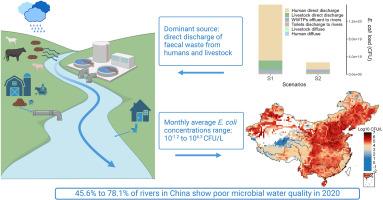
Water quality is under threat due to the presence of pathogenic and antibiotic-resistant bacteria. Escherichia coli (E. coli) serves as an indicator of faecal contamination and the potential presence of other harmful pathogens. Understanding E. coli concentrations helps in assessing the overall health risks associated with waterborne diseases and developing effective water management strategies. Therefore, we developed the first large-scale model, GloWPa-Ecoli C1 to simulate E. coli loads and concentrations in rivers and apply this model to China. The model provides the first comprehensive overview of microbial water quality across China's rivers. The model simulates E. coli concentrations in 2020 to range from 10−1.2 to 106.3 CFU/L, with 45.6 %–78.1 % of rivers exhibiting poor microbial water quality. Major hotspots of E. coli pollution are Haihe, Huaihe and Pearl River Basins. Direct discharge of human faecal waste contributes 80.2 % of the total E. coli load, while directly discharged livestock waste accounts for 13.1 %. To mitigate E. coli pollution in rivers in China, we recommend increasing human faecal waste collection rates, expanding wastewater treatment plant (WWTP) coverage, phasing out primary treatment WWTPs and eliminating direct livestock faecal waste discharge, particularly from smallholder farms. The study underscores the urgent need to improve microbial water quality in China's rivers. The findings provide actionable insights to inform policy development aimed at safeguarding water quality and public health. Furthermore, the modelling approach is applicable to other regions and microorganisms, offering a foundation for developing models to address antibiotic-resistant bacteria and other emerging water quality challenges.
期刊介绍:
Environmental Pollution is an international peer-reviewed journal that publishes high-quality research papers and review articles covering all aspects of environmental pollution and its impacts on ecosystems and human health.
Subject areas include, but are not limited to:
• Sources and occurrences of pollutants that are clearly defined and measured in environmental compartments, food and food-related items, and human bodies;
• Interlinks between contaminant exposure and biological, ecological, and human health effects, including those of climate change;
• Contaminants of emerging concerns (including but not limited to antibiotic resistant microorganisms or genes, microplastics/nanoplastics, electronic wastes, light, and noise) and/or their biological, ecological, or human health effects;
• Laboratory and field studies on the remediation/mitigation of environmental pollution via new techniques and with clear links to biological, ecological, or human health effects;
• Modeling of pollution processes, patterns, or trends that is of clear environmental and/or human health interest;
• New techniques that measure and examine environmental occurrences, transport, behavior, and effects of pollutants within the environment or the laboratory, provided that they can be clearly used to address problems within regional or global environmental compartments.





 京公网安备 11010802042870号
京ICP备2023020795号-1
京公网安备 11010802042870号
京ICP备2023020795号-1

 分享
分享
 求助内容:
求助内容: 应助结果提醒方式:
 扫码关注我们
