Giulia Baroncini, Francesco Campa, Priscilla Castellani Tarabini, Alberto Sala, Lorenzo Boldrini, Stefano Mazzoni, Antonio Paoli
{"title":"基于人体测量学的预测方程在追踪精英女足运动员一个赛季的脂肪量方面的准确性:一项验证研究。","authors":"Giulia Baroncini, Francesco Campa, Priscilla Castellani Tarabini, Alberto Sala, Lorenzo Boldrini, Stefano Mazzoni, Antonio Paoli","doi":"10.1186/s13102-025-01115-4","DOIUrl":null,"url":null,"abstract":"<p><strong>Background and aims: </strong>Body fat is a key body composition parameter monitored in soccer. Identifying reliable alternatives to laboratory techniques for assessing body fat during the competitive period is essential. This study aimed to evaluate the cross-sectional and longitudinal validity of anthropometric prediction equations in elite female soccer players.</p><p><strong>Methods: </strong>Eighteen female soccer players (age: 26.6 [3.8] years; height: 168 [6.3] cm; body mass: 64.1 [7.4] kg; body mass index: 22.7 [1.9] kg/m²) from an Italian Serie A team were assessed at four time points during a competitive season. Fat mass was estimated using anthropometric equations by Evans and Warner and compared to dual-energy X-ray absorptiometry (DXA), which served as the reference method.</p><p><strong>Results: </strong>Cross-sectional agreement analysis revealed a bias of -4.5% with Warner's equation, while Evans's equation showed no bias compared to DXA, with coefficient of determination (R²) values of 0.69 and 0.70, respectively. Both methods showed a negative association (Evans: r = -0.53, Warner: r = -0.63) when the difference between the values and the mean with DXA were correlated. Longitudinal agreement analysis showed no significant differences in fat mass changes between the anthropometric equations and DXA, with R² values ranging from 0.68 to 0.83. The 95% limits of agreement between the methods for individual changes in fat mass ranged from - 3.3 to 3.2%. Furthermore, no significant changes (p > 0.05) in fat mass were observed over the season with any method.</p><p><strong>Conclusions: </strong>At the group level, Evans's equation provides valid estimates of fat mass, whereas it may overestimate values in players with low body fat and underestimate them in those with high fat mass. The Warner equation showed the same trend as Evans at the individual level, also resulting in poor accuracy at the group level. Despite this, both anthropometric equations are valid alternatives to DXA for monitoring fat mass changes during the season, with Evans's equation showing superior overall performance.</p>","PeriodicalId":48585,"journal":{"name":"BMC Sports Science Medicine and Rehabilitation","volume":"17 1","pages":"68"},"PeriodicalIF":2.8000,"publicationDate":"2025-04-03","publicationTypes":"Journal Article","fieldsOfStudy":null,"isOpenAccess":false,"openAccessPdf":"https://www.ncbi.nlm.nih.gov/pmc/articles/PMC11967043/pdf/","citationCount":"0","resultStr":"{\"title\":\"Accuracy of anthropometric-based predictive equations for tracking fat mass over a competitive season in elite female soccer players: a validation study.\",\"authors\":\"Giulia Baroncini, Francesco Campa, Priscilla Castellani Tarabini, Alberto Sala, Lorenzo Boldrini, Stefano Mazzoni, Antonio Paoli\",\"doi\":\"10.1186/s13102-025-01115-4\",\"DOIUrl\":null,\"url\":null,\"abstract\":\"<p><strong>Background and aims: </strong>Body fat is a key body composition parameter monitored in soccer. Identifying reliable alternatives to laboratory techniques for assessing body fat during the competitive period is essential. This study aimed to evaluate the cross-sectional and longitudinal validity of anthropometric prediction equations in elite female soccer players.</p><p><strong>Methods: </strong>Eighteen female soccer players (age: 26.6 [3.8] years; height: 168 [6.3] cm; body mass: 64.1 [7.4] kg; body mass index: 22.7 [1.9] kg/m²) from an Italian Serie A team were assessed at four time points during a competitive season. Fat mass was estimated using anthropometric equations by Evans and Warner and compared to dual-energy X-ray absorptiometry (DXA), which served as the reference method.</p><p><strong>Results: </strong>Cross-sectional agreement analysis revealed a bias of -4.5% with Warner's equation, while Evans's equation showed no bias compared to DXA, with coefficient of determination (R²) values of 0.69 and 0.70, respectively. Both methods showed a negative association (Evans: r = -0.53, Warner: r = -0.63) when the difference between the values and the mean with DXA were correlated. Longitudinal agreement analysis showed no significant differences in fat mass changes between the anthropometric equations and DXA, with R² values ranging from 0.68 to 0.83. The 95% limits of agreement between the methods for individual changes in fat mass ranged from - 3.3 to 3.2%. Furthermore, no significant changes (p > 0.05) in fat mass were observed over the season with any method.</p><p><strong>Conclusions: </strong>At the group level, Evans's equation provides valid estimates of fat mass, whereas it may overestimate values in players with low body fat and underestimate them in those with high fat mass. The Warner equation showed the same trend as Evans at the individual level, also resulting in poor accuracy at the group level. Despite this, both anthropometric equations are valid alternatives to DXA for monitoring fat mass changes during the season, with Evans's equation showing superior overall performance.</p>\",\"PeriodicalId\":48585,\"journal\":{\"name\":\"BMC Sports Science Medicine and Rehabilitation\",\"volume\":\"17 1\",\"pages\":\"68\"},\"PeriodicalIF\":2.8000,\"publicationDate\":\"2025-04-03\",\"publicationTypes\":\"Journal Article\",\"fieldsOfStudy\":null,\"isOpenAccess\":false,\"openAccessPdf\":\"https://www.ncbi.nlm.nih.gov/pmc/articles/PMC11967043/pdf/\",\"citationCount\":\"0\",\"resultStr\":null,\"platform\":\"Semanticscholar\",\"paperid\":null,\"PeriodicalName\":\"BMC Sports Science Medicine and Rehabilitation\",\"FirstCategoryId\":\"3\",\"ListUrlMain\":\"https://doi.org/10.1186/s13102-025-01115-4\",\"RegionNum\":3,\"RegionCategory\":\"医学\",\"ArticlePicture\":[],\"TitleCN\":null,\"AbstractTextCN\":null,\"PMCID\":null,\"EPubDate\":\"\",\"PubModel\":\"\",\"JCR\":\"Q1\",\"JCRName\":\"REHABILITATION\",\"Score\":null,\"Total\":0}","platform":"Semanticscholar","paperid":null,"PeriodicalName":"BMC Sports Science Medicine and Rehabilitation","FirstCategoryId":"3","ListUrlMain":"https://doi.org/10.1186/s13102-025-01115-4","RegionNum":3,"RegionCategory":"医学","ArticlePicture":[],"TitleCN":null,"AbstractTextCN":null,"PMCID":null,"EPubDate":"","PubModel":"","JCR":"Q1","JCRName":"REHABILITATION","Score":null,"Total":0}
引用次数: 0
摘要
背景与目的:体脂是足球运动员监测的一项重要身体成分参数。在比赛期间,确定可靠的替代实验室技术来评估身体脂肪是至关重要的。本研究旨在评估优秀女子足球运动员人体测量预测方程的横截面和纵向有效性。方法:18名女子足球运动员(年龄:26.6[3.8]岁;高度:168 [6.3]cm;体重:64.1 [7.4]kg;身体质量指数:22.7 [1.9]kg/m²),来自意大利甲级球队,在比赛赛季的四个时间点进行评估。Evans和Warner使用人体测量方程估算脂肪量,并与作为参考方法的双能x射线吸收测定法(DXA)进行比较。结果:横断面一致性分析显示Warner的方程偏差为-4.5%,而Evans的方程与DXA相比无偏差,决定系数(R²)分别为0.69和0.70。当与DXA的值与平均值的差值相关时,两种方法均显示为负相关(Evans: r = -0.53, Warner: r = -0.63)。纵向一致性分析显示,人体测量方程和DXA之间的脂肪质量变化无显著差异,R²值在0.68至0.83之间。不同方法对个体脂肪量变化的95%一致限范围为- 3.3 ~ 3.2%。此外,用任何方法观察到的脂肪量在不同季节没有显著变化(p > 0.05)。结论:在群体水平上,Evans的方程提供了有效的脂肪量估计,然而它可能高估了低体脂球员的值,而低估了高体脂球员的值。在个体水平上,华纳方程与埃文斯的趋势相同,同样导致了在群体水平上的准确性较差。尽管如此,这两种人体测量方程都是监测季节脂肪量变化的有效替代DXA, Evans的方程显示出更好的整体性能。
Accuracy of anthropometric-based predictive equations for tracking fat mass over a competitive season in elite female soccer players: a validation study.
Background and aims: Body fat is a key body composition parameter monitored in soccer. Identifying reliable alternatives to laboratory techniques for assessing body fat during the competitive period is essential. This study aimed to evaluate the cross-sectional and longitudinal validity of anthropometric prediction equations in elite female soccer players.
Methods: Eighteen female soccer players (age: 26.6 [3.8] years; height: 168 [6.3] cm; body mass: 64.1 [7.4] kg; body mass index: 22.7 [1.9] kg/m²) from an Italian Serie A team were assessed at four time points during a competitive season. Fat mass was estimated using anthropometric equations by Evans and Warner and compared to dual-energy X-ray absorptiometry (DXA), which served as the reference method.
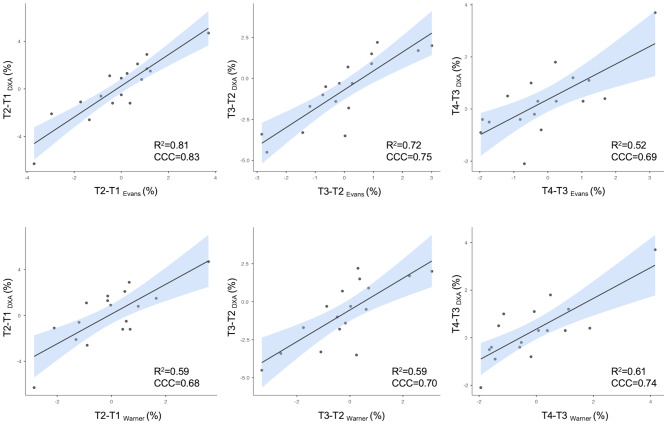
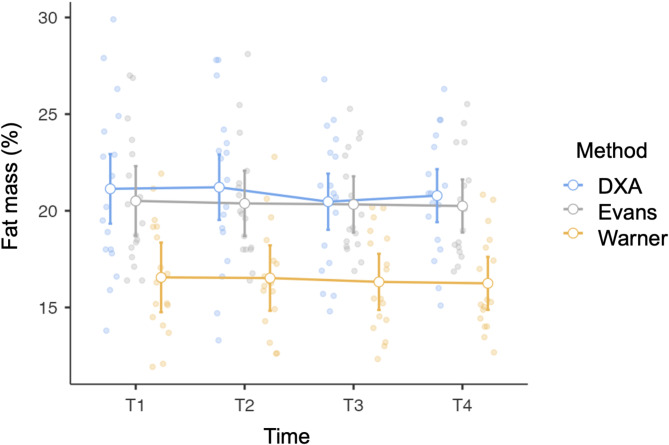
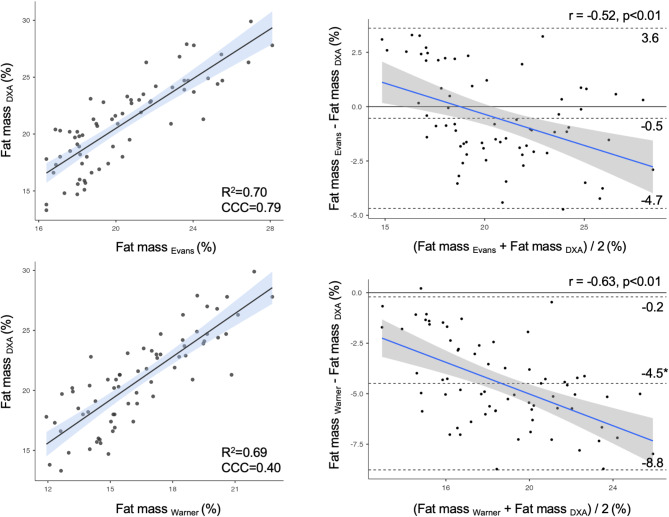
Results: Cross-sectional agreement analysis revealed a bias of -4.5% with Warner's equation, while Evans's equation showed no bias compared to DXA, with coefficient of determination (R²) values of 0.69 and 0.70, respectively. Both methods showed a negative association (Evans: r = -0.53, Warner: r = -0.63) when the difference between the values and the mean with DXA were correlated. Longitudinal agreement analysis showed no significant differences in fat mass changes between the anthropometric equations and DXA, with R² values ranging from 0.68 to 0.83. The 95% limits of agreement between the methods for individual changes in fat mass ranged from - 3.3 to 3.2%. Furthermore, no significant changes (p > 0.05) in fat mass were observed over the season with any method.
Conclusions: At the group level, Evans's equation provides valid estimates of fat mass, whereas it may overestimate values in players with low body fat and underestimate them in those with high fat mass. The Warner equation showed the same trend as Evans at the individual level, also resulting in poor accuracy at the group level. Despite this, both anthropometric equations are valid alternatives to DXA for monitoring fat mass changes during the season, with Evans's equation showing superior overall performance.
期刊介绍:
BMC Sports Science, Medicine and Rehabilitation is an open access, peer reviewed journal that considers articles on all aspects of sports medicine and the exercise sciences, including rehabilitation, traumatology, cardiology, physiology, and nutrition.




 京公网安备 11010802042870号
京ICP备2023020795号-1
京公网安备 11010802042870号
京ICP备2023020795号-1

 分享
分享
 求助内容:
求助内容: 应助结果提醒方式:
 扫码关注我们
