Maximilian A. Wollenweber , Jonas Werner , Carl F. Kusche , Chunhua Tian , Pei-Ling Sun , Jannik Gerlach , Talal Al-Samman , Sandra Korte-Kerzel
{"title":"MnS的高温塑性及其对损伤流行率的影响","authors":"Maximilian A. Wollenweber , Jonas Werner , Carl F. Kusche , Chunhua Tian , Pei-Ling Sun , Jannik Gerlach , Talal Al-Samman , Sandra Korte-Kerzel","doi":"10.1016/j.actamat.2025.120987","DOIUrl":null,"url":null,"abstract":"<div><div>Forming-induced damage strongly influences the service life and mechanical properties of components made from 16MnCrS5 steel. This damage is initiated in the vicinity of MnS inclusions, which fracture or delaminate at their interfaces due to the mechanical contrast to the steel matrix. Forming processes are often conducted at elevated temperatures; however, the plasticity of MnS at these temperatures in correlation with crystallographic orientation have not been fully explored. In this study, we aim to uncover the high-temperature properties of MnS using micropillar compression and TEM analysis. We then relate them to damage prevalence observed in steel at elevated temperatures with high resolution SEM imaging in combination with AI-assisted damage analysis. We demonstrate that the mechanical contrast of MnS and steel influences the damage prevalence significantly showing a minimum at 400<!--> <!-->°C. We additionally determine the CRSS for the primary <span><math><mrow><mo>{</mo><mn>1</mn><mspace></mspace><mn>1</mn><mspace></mspace><mn>0</mn><mo>}</mo></mrow></math></span> <span><math><mrow><mo>〈</mo><mn>1</mn><mspace></mspace><mover><mrow><mn>1</mn></mrow><mo>¯</mo></mover><mspace></mspace><mn>0</mn><mo>〉</mo></mrow></math></span> slip system in the temperature range from 20<!--> <!-->°C to 600<!--> <!-->°C and the CRSS for the secondary <span><math><mrow><mo>{</mo><mn>1</mn><mspace></mspace><mn>1</mn><mspace></mspace><mn>1</mn><mo>}</mo></mrow></math></span> <span><math><mrow><mo>〈</mo><mn>1</mn><mspace></mspace><mover><mrow><mn>1</mn></mrow><mo>¯</mo></mover><mspace></mspace><mn>0</mn><mo>〉</mo></mrow></math></span> slip system at temperatures of 400<!--> <!-->°C and 600<!--> <!-->°C. We show that MnS exhibits a yield strength anomaly at 400<!--> <!-->°C in specific orientations and at slow loading rates that is accompanied by a change of the active slip system. We relate this yield strength anomaly to thermally activated cross-slip and increased impurity mobility at elevated temperatures.</div></div>","PeriodicalId":238,"journal":{"name":"Acta Materialia","volume":"291 ","pages":"Article 120987"},"PeriodicalIF":9.3000,"publicationDate":"2025-06-01","publicationTypes":"Journal Article","fieldsOfStudy":null,"isOpenAccess":false,"openAccessPdf":"","citationCount":"0","resultStr":"{\"title\":\"On the plasticity of MnS at elevated temperatures and its influence on damage prevalence\",\"authors\":\"Maximilian A. Wollenweber , Jonas Werner , Carl F. Kusche , Chunhua Tian , Pei-Ling Sun , Jannik Gerlach , Talal Al-Samman , Sandra Korte-Kerzel\",\"doi\":\"10.1016/j.actamat.2025.120987\",\"DOIUrl\":null,\"url\":null,\"abstract\":\"<div><div>Forming-induced damage strongly influences the service life and mechanical properties of components made from 16MnCrS5 steel. This damage is initiated in the vicinity of MnS inclusions, which fracture or delaminate at their interfaces due to the mechanical contrast to the steel matrix. Forming processes are often conducted at elevated temperatures; however, the plasticity of MnS at these temperatures in correlation with crystallographic orientation have not been fully explored. In this study, we aim to uncover the high-temperature properties of MnS using micropillar compression and TEM analysis. We then relate them to damage prevalence observed in steel at elevated temperatures with high resolution SEM imaging in combination with AI-assisted damage analysis. We demonstrate that the mechanical contrast of MnS and steel influences the damage prevalence significantly showing a minimum at 400<!--> <!-->°C. We additionally determine the CRSS for the primary <span><math><mrow><mo>{</mo><mn>1</mn><mspace></mspace><mn>1</mn><mspace></mspace><mn>0</mn><mo>}</mo></mrow></math></span> <span><math><mrow><mo>〈</mo><mn>1</mn><mspace></mspace><mover><mrow><mn>1</mn></mrow><mo>¯</mo></mover><mspace></mspace><mn>0</mn><mo>〉</mo></mrow></math></span> slip system in the temperature range from 20<!--> <!-->°C to 600<!--> <!-->°C and the CRSS for the secondary <span><math><mrow><mo>{</mo><mn>1</mn><mspace></mspace><mn>1</mn><mspace></mspace><mn>1</mn><mo>}</mo></mrow></math></span> <span><math><mrow><mo>〈</mo><mn>1</mn><mspace></mspace><mover><mrow><mn>1</mn></mrow><mo>¯</mo></mover><mspace></mspace><mn>0</mn><mo>〉</mo></mrow></math></span> slip system at temperatures of 400<!--> <!-->°C and 600<!--> <!-->°C. We show that MnS exhibits a yield strength anomaly at 400<!--> <!-->°C in specific orientations and at slow loading rates that is accompanied by a change of the active slip system. We relate this yield strength anomaly to thermally activated cross-slip and increased impurity mobility at elevated temperatures.</div></div>\",\"PeriodicalId\":238,\"journal\":{\"name\":\"Acta Materialia\",\"volume\":\"291 \",\"pages\":\"Article 120987\"},\"PeriodicalIF\":9.3000,\"publicationDate\":\"2025-06-01\",\"publicationTypes\":\"Journal Article\",\"fieldsOfStudy\":null,\"isOpenAccess\":false,\"openAccessPdf\":\"\",\"citationCount\":\"0\",\"resultStr\":null,\"platform\":\"Semanticscholar\",\"paperid\":null,\"PeriodicalName\":\"Acta Materialia\",\"FirstCategoryId\":\"88\",\"ListUrlMain\":\"https://www.sciencedirect.com/science/article/pii/S1359645425002782\",\"RegionNum\":1,\"RegionCategory\":\"材料科学\",\"ArticlePicture\":[],\"TitleCN\":null,\"AbstractTextCN\":null,\"PMCID\":null,\"EPubDate\":\"2025/4/4 0:00:00\",\"PubModel\":\"Epub\",\"JCR\":\"Q1\",\"JCRName\":\"MATERIALS SCIENCE, MULTIDISCIPLINARY\",\"Score\":null,\"Total\":0}","platform":"Semanticscholar","paperid":null,"PeriodicalName":"Acta Materialia","FirstCategoryId":"88","ListUrlMain":"https://www.sciencedirect.com/science/article/pii/S1359645425002782","RegionNum":1,"RegionCategory":"材料科学","ArticlePicture":[],"TitleCN":null,"AbstractTextCN":null,"PMCID":null,"EPubDate":"2025/4/4 0:00:00","PubModel":"Epub","JCR":"Q1","JCRName":"MATERIALS SCIENCE, MULTIDISCIPLINARY","Score":null,"Total":0}
On the plasticity of MnS at elevated temperatures and its influence on damage prevalence
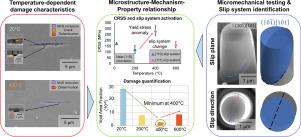
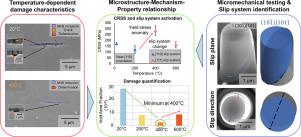
Forming-induced damage strongly influences the service life and mechanical properties of components made from 16MnCrS5 steel. This damage is initiated in the vicinity of MnS inclusions, which fracture or delaminate at their interfaces due to the mechanical contrast to the steel matrix. Forming processes are often conducted at elevated temperatures; however, the plasticity of MnS at these temperatures in correlation with crystallographic orientation have not been fully explored. In this study, we aim to uncover the high-temperature properties of MnS using micropillar compression and TEM analysis. We then relate them to damage prevalence observed in steel at elevated temperatures with high resolution SEM imaging in combination with AI-assisted damage analysis. We demonstrate that the mechanical contrast of MnS and steel influences the damage prevalence significantly showing a minimum at 400 °C. We additionally determine the CRSS for the primary slip system in the temperature range from 20 °C to 600 °C and the CRSS for the secondary slip system at temperatures of 400 °C and 600 °C. We show that MnS exhibits a yield strength anomaly at 400 °C in specific orientations and at slow loading rates that is accompanied by a change of the active slip system. We relate this yield strength anomaly to thermally activated cross-slip and increased impurity mobility at elevated temperatures.
期刊介绍:
Acta Materialia serves as a platform for publishing full-length, original papers and commissioned overviews that contribute to a profound understanding of the correlation between the processing, structure, and properties of inorganic materials. The journal seeks papers with high impact potential or those that significantly propel the field forward. The scope includes the atomic and molecular arrangements, chemical and electronic structures, and microstructure of materials, focusing on their mechanical or functional behavior across all length scales, including nanostructures.




 京公网安备 11010802042870号
京ICP备2023020795号-1
京公网安备 11010802042870号
京ICP备2023020795号-1

 分享
分享
 求助内容:
求助内容: 应助结果提醒方式:
 扫码关注我们
