Zhi Zhang, Lifeng Ma, Longhao Li, Chengyuan He, Chunxiao Li
{"title":"机器学习驱动的TPV加工与力学性能构建关系——一种堆叠模型的观点","authors":"Zhi Zhang, Lifeng Ma, Longhao Li, Chengyuan He, Chunxiao Li","doi":"10.1016/j.polymer.2025.128359","DOIUrl":null,"url":null,"abstract":"<div><div>Thermoplastic vulcanizate (TPV) exhibit excellent processability and mechanical properties, making them widely applicable in industrial fields. Their mechanical properties, including tensile strength, fracture toughness, and hardness, play a crucial role in determining their suitability for various applications. However, due to the numerous factors influencing the mechanical properties of TPV, the traditional trial-and-error experimental approach not only would consume significant resources but also fail to provide a comprehensive and quantitative understanding of the relationship between the processing parameters and its mechanical performance. To address this challenge, this study has developed one novel stacking model to achieve one high-precision prediction for tensile strength, elongation at break, and Shore hardness for TPV, thereby accelerating the experimental and development process of TPV. Additionally, SHapley Additive exPlanations (SHAP) feature analysis has been employed to interpret the black-box characteristics of the stacking model, revealing how different features influence the overall mechanical performance of TPV. Finally, bivariate dependence plots have been generated to establish the specific mechanisms governing the relationship between TPV processing parameters and mechanical properties. This study would provide an effective approach for guiding TPV experimentation while offering a more efficient method for optimizing TPV performance.</div></div>","PeriodicalId":405,"journal":{"name":"Polymer","volume":"326 ","pages":"Article 128359"},"PeriodicalIF":5.1000,"publicationDate":"2025-05-09","publicationTypes":"Journal Article","fieldsOfStudy":null,"isOpenAccess":false,"openAccessPdf":"","citationCount":"0","resultStr":"{\"title\":\"Machine learning-driven constructing relationship between processing and mechanical properties of TPV: A view of one stacking model\",\"authors\":\"Zhi Zhang, Lifeng Ma, Longhao Li, Chengyuan He, Chunxiao Li\",\"doi\":\"10.1016/j.polymer.2025.128359\",\"DOIUrl\":null,\"url\":null,\"abstract\":\"<div><div>Thermoplastic vulcanizate (TPV) exhibit excellent processability and mechanical properties, making them widely applicable in industrial fields. Their mechanical properties, including tensile strength, fracture toughness, and hardness, play a crucial role in determining their suitability for various applications. However, due to the numerous factors influencing the mechanical properties of TPV, the traditional trial-and-error experimental approach not only would consume significant resources but also fail to provide a comprehensive and quantitative understanding of the relationship between the processing parameters and its mechanical performance. To address this challenge, this study has developed one novel stacking model to achieve one high-precision prediction for tensile strength, elongation at break, and Shore hardness for TPV, thereby accelerating the experimental and development process of TPV. Additionally, SHapley Additive exPlanations (SHAP) feature analysis has been employed to interpret the black-box characteristics of the stacking model, revealing how different features influence the overall mechanical performance of TPV. Finally, bivariate dependence plots have been generated to establish the specific mechanisms governing the relationship between TPV processing parameters and mechanical properties. This study would provide an effective approach for guiding TPV experimentation while offering a more efficient method for optimizing TPV performance.</div></div>\",\"PeriodicalId\":405,\"journal\":{\"name\":\"Polymer\",\"volume\":\"326 \",\"pages\":\"Article 128359\"},\"PeriodicalIF\":5.1000,\"publicationDate\":\"2025-05-09\",\"publicationTypes\":\"Journal Article\",\"fieldsOfStudy\":null,\"isOpenAccess\":false,\"openAccessPdf\":\"\",\"citationCount\":\"0\",\"resultStr\":null,\"platform\":\"Semanticscholar\",\"paperid\":null,\"PeriodicalName\":\"Polymer\",\"FirstCategoryId\":\"92\",\"ListUrlMain\":\"https://www.sciencedirect.com/science/article/pii/S0032386125003453\",\"RegionNum\":2,\"RegionCategory\":\"化学\",\"ArticlePicture\":[],\"TitleCN\":null,\"AbstractTextCN\":null,\"PMCID\":null,\"EPubDate\":\"2025/4/5 0:00:00\",\"PubModel\":\"Epub\",\"JCR\":\"Q2\",\"JCRName\":\"POLYMER SCIENCE\",\"Score\":null,\"Total\":0}","platform":"Semanticscholar","paperid":null,"PeriodicalName":"Polymer","FirstCategoryId":"92","ListUrlMain":"https://www.sciencedirect.com/science/article/pii/S0032386125003453","RegionNum":2,"RegionCategory":"化学","ArticlePicture":[],"TitleCN":null,"AbstractTextCN":null,"PMCID":null,"EPubDate":"2025/4/5 0:00:00","PubModel":"Epub","JCR":"Q2","JCRName":"POLYMER SCIENCE","Score":null,"Total":0}
Machine learning-driven constructing relationship between processing and mechanical properties of TPV: A view of one stacking model
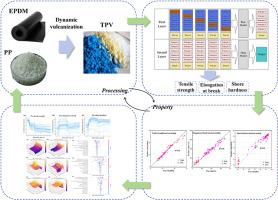
Thermoplastic vulcanizate (TPV) exhibit excellent processability and mechanical properties, making them widely applicable in industrial fields. Their mechanical properties, including tensile strength, fracture toughness, and hardness, play a crucial role in determining their suitability for various applications. However, due to the numerous factors influencing the mechanical properties of TPV, the traditional trial-and-error experimental approach not only would consume significant resources but also fail to provide a comprehensive and quantitative understanding of the relationship between the processing parameters and its mechanical performance. To address this challenge, this study has developed one novel stacking model to achieve one high-precision prediction for tensile strength, elongation at break, and Shore hardness for TPV, thereby accelerating the experimental and development process of TPV. Additionally, SHapley Additive exPlanations (SHAP) feature analysis has been employed to interpret the black-box characteristics of the stacking model, revealing how different features influence the overall mechanical performance of TPV. Finally, bivariate dependence plots have been generated to establish the specific mechanisms governing the relationship between TPV processing parameters and mechanical properties. This study would provide an effective approach for guiding TPV experimentation while offering a more efficient method for optimizing TPV performance.
期刊介绍:
Polymer is an interdisciplinary journal dedicated to publishing innovative and significant advances in Polymer Physics, Chemistry and Technology. We welcome submissions on polymer hybrids, nanocomposites, characterisation and self-assembly. Polymer also publishes work on the technological application of polymers in energy and optoelectronics.
The main scope is covered but not limited to the following core areas:
Polymer Materials
Nanocomposites and hybrid nanomaterials
Polymer blends, films, fibres, networks and porous materials
Physical Characterization
Characterisation, modelling and simulation* of molecular and materials properties in bulk, solution, and thin films
Polymer Engineering
Advanced multiscale processing methods
Polymer Synthesis, Modification and Self-assembly
Including designer polymer architectures, mechanisms and kinetics, and supramolecular polymerization
Technological Applications
Polymers for energy generation and storage
Polymer membranes for separation technology
Polymers for opto- and microelectronics.





 京公网安备 11010802042870号
京ICP备2023020795号-1
京公网安备 11010802042870号
京ICP备2023020795号-1

 分享
分享
 求助内容:
求助内容: 应助结果提醒方式:
 扫码关注我们
