Xiaoxi Guo , Zhuoyan Liu , Jiajia Lan , Hongyang Wu , Yi-Fan Han
{"title":"Co-Cu-Al-Ox降解氯霉素:Cu掺入对CoOx配位和电子环境的影响","authors":"Xiaoxi Guo , Zhuoyan Liu , Jiajia Lan , Hongyang Wu , Yi-Fan Han","doi":"10.1016/j.apsusc.2025.163130","DOIUrl":null,"url":null,"abstract":"<div><div>In heterogeneous Fenton catalysis, the modification of electronic structures at active sites is crucial for enhancing degradation efficiency. This strategy enhances the activation of H<sub>2</sub>O<sub>2</sub> and the subsequent generation of hydroxyl radicals (·OH). However, the effectiveness of these processes is often limited by suboptimal coordination environments at the active sites. In this study, we synthesized a series of MAl<sub>2</sub>O<sub>4</sub> (M=Co and/or Cu) catalysts with spinel structures, specifically tailored for the efficient degradation of chloramphenicol (CAP). We modulated the electronic structure at the active sites by strategically incorporating Cu atoms, controlling the doping concentration to boost the surface enrichment of Cu-embedded CoO<sub>6</sub> on CoAl<sub>2</sub>O<sub>4</sub>, thus optimizing catalyst performance. This alteration promotes Cu–O-Co interactions within the MO<sub>6</sub> environment, enhancing the reducibility of Cu atoms and boosting electron donation and transfer during reactions. This improvement leads to more effective adsorption of H<sub>2</sub>O<sub>2</sub> and enhanced desorption of hydroxyl radicals, coupled with improved regeneration of active sites. The optimized Co<sub>7.5</sub>Cu<sub>2.5</sub>/Al<sub>2</sub>O<sub>3</sub> catalyst achieved a remarkable 95.5 % conversion rate of chloramphenicol, demonstrating its potential as an effective solution for treating persistent organic pollutants.</div></div>","PeriodicalId":247,"journal":{"name":"Applied Surface Science","volume":"699 ","pages":"Article 163130"},"PeriodicalIF":6.9000,"publicationDate":"2025-04-06","publicationTypes":"Journal Article","fieldsOfStudy":null,"isOpenAccess":false,"openAccessPdf":"","citationCount":"0","resultStr":"{\"title\":\"Co-Cu-Al-Ox for chloramphenicol degradation: Modification of CoOx coordination and electronic environment by Cu incorporation\",\"authors\":\"Xiaoxi Guo , Zhuoyan Liu , Jiajia Lan , Hongyang Wu , Yi-Fan Han\",\"doi\":\"10.1016/j.apsusc.2025.163130\",\"DOIUrl\":null,\"url\":null,\"abstract\":\"<div><div>In heterogeneous Fenton catalysis, the modification of electronic structures at active sites is crucial for enhancing degradation efficiency. This strategy enhances the activation of H<sub>2</sub>O<sub>2</sub> and the subsequent generation of hydroxyl radicals (·OH). However, the effectiveness of these processes is often limited by suboptimal coordination environments at the active sites. In this study, we synthesized a series of MAl<sub>2</sub>O<sub>4</sub> (M=Co and/or Cu) catalysts with spinel structures, specifically tailored for the efficient degradation of chloramphenicol (CAP). We modulated the electronic structure at the active sites by strategically incorporating Cu atoms, controlling the doping concentration to boost the surface enrichment of Cu-embedded CoO<sub>6</sub> on CoAl<sub>2</sub>O<sub>4</sub>, thus optimizing catalyst performance. This alteration promotes Cu–O-Co interactions within the MO<sub>6</sub> environment, enhancing the reducibility of Cu atoms and boosting electron donation and transfer during reactions. This improvement leads to more effective adsorption of H<sub>2</sub>O<sub>2</sub> and enhanced desorption of hydroxyl radicals, coupled with improved regeneration of active sites. The optimized Co<sub>7.5</sub>Cu<sub>2.5</sub>/Al<sub>2</sub>O<sub>3</sub> catalyst achieved a remarkable 95.5 % conversion rate of chloramphenicol, demonstrating its potential as an effective solution for treating persistent organic pollutants.</div></div>\",\"PeriodicalId\":247,\"journal\":{\"name\":\"Applied Surface Science\",\"volume\":\"699 \",\"pages\":\"Article 163130\"},\"PeriodicalIF\":6.9000,\"publicationDate\":\"2025-04-06\",\"publicationTypes\":\"Journal Article\",\"fieldsOfStudy\":null,\"isOpenAccess\":false,\"openAccessPdf\":\"\",\"citationCount\":\"0\",\"resultStr\":null,\"platform\":\"Semanticscholar\",\"paperid\":null,\"PeriodicalName\":\"Applied Surface Science\",\"FirstCategoryId\":\"88\",\"ListUrlMain\":\"https://www.sciencedirect.com/science/article/pii/S016943322500844X\",\"RegionNum\":2,\"RegionCategory\":\"材料科学\",\"ArticlePicture\":[],\"TitleCN\":null,\"AbstractTextCN\":null,\"PMCID\":null,\"EPubDate\":\"\",\"PubModel\":\"\",\"JCR\":\"Q2\",\"JCRName\":\"CHEMISTRY, PHYSICAL\",\"Score\":null,\"Total\":0}","platform":"Semanticscholar","paperid":null,"PeriodicalName":"Applied Surface Science","FirstCategoryId":"88","ListUrlMain":"https://www.sciencedirect.com/science/article/pii/S016943322500844X","RegionNum":2,"RegionCategory":"材料科学","ArticlePicture":[],"TitleCN":null,"AbstractTextCN":null,"PMCID":null,"EPubDate":"","PubModel":"","JCR":"Q2","JCRName":"CHEMISTRY, PHYSICAL","Score":null,"Total":0}
引用次数: 0
摘要
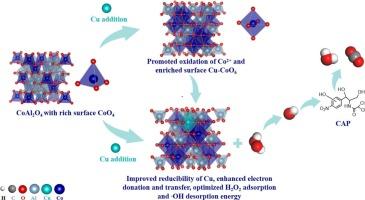
在非均相Fenton催化中,活性位点的电子结构修饰是提高降解效率的关键。这种策略增强了H2O2的活化和随后产生的羟基自由基(·OH)。然而,这些过程的有效性常常受到活性位点的次优协调环境的限制。在这项研究中,我们合成了一系列尖晶石结构的MAl2O4 (M=Co和/或Cu)催化剂,专门用于高效降解氯霉素(CAP)。我们通过战略性地掺入Cu原子来调节活性位点的电子结构,控制掺杂浓度,从而提高Cu包埋的CoO6在CoAl2O4上的表面富集,从而优化催化剂的性能。这种改变促进了Cu - o - co在MO6环境中的相互作用,增强了Cu原子的还原性,促进了反应过程中的电子给能和转移。这种改进导致H2O2的更有效吸附和羟基自由基的解吸增强,同时活性位点的再生也得到了改善。优化后的Co7.5Cu2.5/Al2O3催化剂对氯霉素的转化率达到了95.5 %,显示了其作为处理持久性有机污染物的有效溶液的潜力。
Co-Cu-Al-Ox for chloramphenicol degradation: Modification of CoOx coordination and electronic environment by Cu incorporation
In heterogeneous Fenton catalysis, the modification of electronic structures at active sites is crucial for enhancing degradation efficiency. This strategy enhances the activation of H2O2 and the subsequent generation of hydroxyl radicals (·OH). However, the effectiveness of these processes is often limited by suboptimal coordination environments at the active sites. In this study, we synthesized a series of MAl2O4 (M=Co and/or Cu) catalysts with spinel structures, specifically tailored for the efficient degradation of chloramphenicol (CAP). We modulated the electronic structure at the active sites by strategically incorporating Cu atoms, controlling the doping concentration to boost the surface enrichment of Cu-embedded CoO6 on CoAl2O4, thus optimizing catalyst performance. This alteration promotes Cu–O-Co interactions within the MO6 environment, enhancing the reducibility of Cu atoms and boosting electron donation and transfer during reactions. This improvement leads to more effective adsorption of H2O2 and enhanced desorption of hydroxyl radicals, coupled with improved regeneration of active sites. The optimized Co7.5Cu2.5/Al2O3 catalyst achieved a remarkable 95.5 % conversion rate of chloramphenicol, demonstrating its potential as an effective solution for treating persistent organic pollutants.
期刊介绍:
Applied Surface Science covers topics contributing to a better understanding of surfaces, interfaces, nanostructures and their applications. The journal is concerned with scientific research on the atomic and molecular level of material properties determined with specific surface analytical techniques and/or computational methods, as well as the processing of such structures.




 京公网安备 11010802042870号
京ICP备2023020795号-1
京公网安备 11010802042870号
京ICP备2023020795号-1

 分享
分享
 求助内容:
求助内容: 应助结果提醒方式:
 扫码关注我们
