Tenzin Thinley , Prabagar Jijoe Samuel , Divya Vinod , Nazim Nasir , Shadma Wahab , Mohammad Khalid , Harikaranahalli Puttaiah Shivaraju
{"title":"柠檬酸盐-氧化溶胶-凝胶合成Sr3Ni2WO9三重钙钛矿光催化修复新兴污染物","authors":"Tenzin Thinley , Prabagar Jijoe Samuel , Divya Vinod , Nazim Nasir , Shadma Wahab , Mohammad Khalid , Harikaranahalli Puttaiah Shivaraju","doi":"10.1016/j.inoche.2025.114468","DOIUrl":null,"url":null,"abstract":"<div><div>The complex perovskite materials are of great interest due to the coexistence of ferri/ferromagnetic which provides unique optoelectrical and physical properties. The semiconducting nature of these materials allows them for multiple applications in catalysis and electronics. Here, the modified citrate sol–gel approach has been effectively used to synthesize the nanoscale crystalline triple perovskite Sr<sub>3</sub>Ni<sub>2</sub>WO<sub>9</sub> (SNWO), with an average crystallite size of 250 Å. X-ray diffraction was primarily used to examine the structure of the SNWO triple perovskite, and the Rietveld analysis was then used to analyze it. With a cell volume of 330.15 Å<sup>3</sup>, the phase pure perovskite compound crystallizes in the P12/m1(10) space-group at room temperature, displaying a monoclinic structure with crystal parameters of a = 7.84 Å, b = 5.56 Å, and c = 7.57 Å. Upon photocatalytic study, the material showed efficient degradation of organic complexes with 99 % and 82 % degradation efficiency for dye mixture and antibiotic mixture which are contaminants of emerging concerns within 90 min of illumination with LED light (30 W) indicating the photocatalytic prowess of the material.</div></div>","PeriodicalId":13609,"journal":{"name":"Inorganic Chemistry Communications","volume":"178 ","pages":"Article 114468"},"PeriodicalIF":5.4000,"publicationDate":"2025-08-01","publicationTypes":"Journal Article","fieldsOfStudy":null,"isOpenAccess":false,"openAccessPdf":"","citationCount":"0","resultStr":"{\"title\":\"Citrate-oxidative sol–gel synthesis Sr3Ni2WO9 triple perovskite for photocatalytic remediation of emerging contaminants\",\"authors\":\"Tenzin Thinley , Prabagar Jijoe Samuel , Divya Vinod , Nazim Nasir , Shadma Wahab , Mohammad Khalid , Harikaranahalli Puttaiah Shivaraju\",\"doi\":\"10.1016/j.inoche.2025.114468\",\"DOIUrl\":null,\"url\":null,\"abstract\":\"<div><div>The complex perovskite materials are of great interest due to the coexistence of ferri/ferromagnetic which provides unique optoelectrical and physical properties. The semiconducting nature of these materials allows them for multiple applications in catalysis and electronics. Here, the modified citrate sol–gel approach has been effectively used to synthesize the nanoscale crystalline triple perovskite Sr<sub>3</sub>Ni<sub>2</sub>WO<sub>9</sub> (SNWO), with an average crystallite size of 250 Å. X-ray diffraction was primarily used to examine the structure of the SNWO triple perovskite, and the Rietveld analysis was then used to analyze it. With a cell volume of 330.15 Å<sup>3</sup>, the phase pure perovskite compound crystallizes in the P12/m1(10) space-group at room temperature, displaying a monoclinic structure with crystal parameters of a = 7.84 Å, b = 5.56 Å, and c = 7.57 Å. Upon photocatalytic study, the material showed efficient degradation of organic complexes with 99 % and 82 % degradation efficiency for dye mixture and antibiotic mixture which are contaminants of emerging concerns within 90 min of illumination with LED light (30 W) indicating the photocatalytic prowess of the material.</div></div>\",\"PeriodicalId\":13609,\"journal\":{\"name\":\"Inorganic Chemistry Communications\",\"volume\":\"178 \",\"pages\":\"Article 114468\"},\"PeriodicalIF\":5.4000,\"publicationDate\":\"2025-08-01\",\"publicationTypes\":\"Journal Article\",\"fieldsOfStudy\":null,\"isOpenAccess\":false,\"openAccessPdf\":\"\",\"citationCount\":\"0\",\"resultStr\":null,\"platform\":\"Semanticscholar\",\"paperid\":null,\"PeriodicalName\":\"Inorganic Chemistry Communications\",\"FirstCategoryId\":\"92\",\"ListUrlMain\":\"https://www.sciencedirect.com/science/article/pii/S1387700325005842\",\"RegionNum\":3,\"RegionCategory\":\"化学\",\"ArticlePicture\":[],\"TitleCN\":null,\"AbstractTextCN\":null,\"PMCID\":null,\"EPubDate\":\"2025/4/2 0:00:00\",\"PubModel\":\"Epub\",\"JCR\":\"Q1\",\"JCRName\":\"CHEMISTRY, INORGANIC & NUCLEAR\",\"Score\":null,\"Total\":0}","platform":"Semanticscholar","paperid":null,"PeriodicalName":"Inorganic Chemistry Communications","FirstCategoryId":"92","ListUrlMain":"https://www.sciencedirect.com/science/article/pii/S1387700325005842","RegionNum":3,"RegionCategory":"化学","ArticlePicture":[],"TitleCN":null,"AbstractTextCN":null,"PMCID":null,"EPubDate":"2025/4/2 0:00:00","PubModel":"Epub","JCR":"Q1","JCRName":"CHEMISTRY, INORGANIC & NUCLEAR","Score":null,"Total":0}
引用次数: 0
摘要
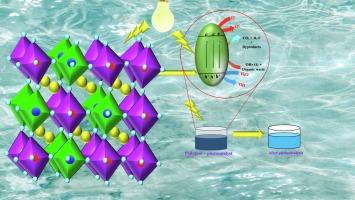
复合钙钛矿材料由于铁/铁磁性共存而具有独特的光电和物理性能而备受关注。这些材料的半导体性质使它们在催化和电子领域有多种应用。本文利用改性柠檬酸盐溶胶-凝胶法制备了平均晶粒尺寸为250 Å的纳米级三重钙钛矿Sr3Ni2WO9 (SNWO)。x射线衍射主要用于检测SNWO三重钙钛矿的结构,然后使用Rietveld分析对其进行分析。当晶胞体积为330.15 Å3时,纯钙钛矿化合物在室温下在P12/m1(10)空间群中结晶,晶体参数为a = 7.84 Å, b = 5.56 Å, c = 7.57 Å,呈单斜晶结构。在光催化研究中,该材料在LED灯(30 W)照射90分钟内,对染料混合物和抗生素混合物的有机配合物的降解效率分别为99%和82%,表明该材料的光催化能力。
Citrate-oxidative sol–gel synthesis Sr3Ni2WO9 triple perovskite for photocatalytic remediation of emerging contaminants
The complex perovskite materials are of great interest due to the coexistence of ferri/ferromagnetic which provides unique optoelectrical and physical properties. The semiconducting nature of these materials allows them for multiple applications in catalysis and electronics. Here, the modified citrate sol–gel approach has been effectively used to synthesize the nanoscale crystalline triple perovskite Sr3Ni2WO9 (SNWO), with an average crystallite size of 250 Å. X-ray diffraction was primarily used to examine the structure of the SNWO triple perovskite, and the Rietveld analysis was then used to analyze it. With a cell volume of 330.15 Å3, the phase pure perovskite compound crystallizes in the P12/m1(10) space-group at room temperature, displaying a monoclinic structure with crystal parameters of a = 7.84 Å, b = 5.56 Å, and c = 7.57 Å. Upon photocatalytic study, the material showed efficient degradation of organic complexes with 99 % and 82 % degradation efficiency for dye mixture and antibiotic mixture which are contaminants of emerging concerns within 90 min of illumination with LED light (30 W) indicating the photocatalytic prowess of the material.
期刊介绍:
Launched in January 1998, Inorganic Chemistry Communications is an international journal dedicated to the rapid publication of short communications in the major areas of inorganic, organometallic and supramolecular chemistry. Topics include synthetic and reaction chemistry, kinetics and mechanisms of reactions, bioinorganic chemistry, photochemistry and the use of metal and organometallic compounds in stoichiometric and catalytic synthesis or organic compounds.



 京公网安备 11010802042870号
京ICP备2023020795号-1
京公网安备 11010802042870号
京ICP备2023020795号-1

 分享
分享
 求助内容:
求助内容: 应助结果提醒方式:
 扫码关注我们
