Jinhuai Hua , Rui Yao , Haonan Xu , Wenbin Zhao , Yuping Zhou , Hua Jin , Yanshuo Li
{"title":"一种新型的高填充密度板框膜模块集成了ZIF-8/PMPS混合基质膜,用于从稀溶液中高效回收丁醇","authors":"Jinhuai Hua , Rui Yao , Haonan Xu , Wenbin Zhao , Yuping Zhou , Hua Jin , Yanshuo Li","doi":"10.1016/j.memsci.2025.124068","DOIUrl":null,"url":null,"abstract":"<div><div>This study addresses the challenges of bio-butanol recovery by synergizing innovative module design with advanced mixed matrix membranes (MMMs) for enhanced pervaporation (PV) efficiency. ZIF-8 nanoparticles (14–120 nm) were integrated into a polymethylphenylsiloxane (PMPS) matrix to fabricate ZIF-8/PMPS MMMs on flat-sheet Al<sub>2</sub>O<sub>3</sub> supports, for efficient n-butanol separation via pervaporation. The optimized 14 nm-ZIF-8/PMPS MMMs (13.0 wt% loading) exhibited optimal performance, achieving a total flux of 925.86 g m<sup>−2</sup> h<sup>−1</sup> and a separation factor of 37.65 for 1 wt% n-butanol/water mixtures at 40 °C, enabling stable operation over 600 h. Key factors included the improved hydrophobicity, reduced interfacial voids, and enhanced surface roughness. A novel plate-and-frame module was engineered to address scalability challenges, increasing packing density from 5 to 55 m<sup>2</sup>/m<sup>3</sup> while mitigating concentration polarization and enhancing mass transfer under dynamic flow conditions. The module's compact design, combined with the mechanical robustness of Al<sub>2</sub>O<sub>3</sub> supports and the compatibility of ZIF-8/PMPS membranes, demonstrates industrial viability.</div></div>","PeriodicalId":368,"journal":{"name":"Journal of Membrane Science","volume":"726 ","pages":"Article 124068"},"PeriodicalIF":9.0000,"publicationDate":"2025-05-01","publicationTypes":"Journal Article","fieldsOfStudy":null,"isOpenAccess":false,"openAccessPdf":"","citationCount":"0","resultStr":"{\"title\":\"A novel high-packing-density plate-and-frame membrane module integrated with ZIF-8/PMPS mixed matrix membranes for efficient butanol recovery from dilute solutions\",\"authors\":\"Jinhuai Hua , Rui Yao , Haonan Xu , Wenbin Zhao , Yuping Zhou , Hua Jin , Yanshuo Li\",\"doi\":\"10.1016/j.memsci.2025.124068\",\"DOIUrl\":null,\"url\":null,\"abstract\":\"<div><div>This study addresses the challenges of bio-butanol recovery by synergizing innovative module design with advanced mixed matrix membranes (MMMs) for enhanced pervaporation (PV) efficiency. ZIF-8 nanoparticles (14–120 nm) were integrated into a polymethylphenylsiloxane (PMPS) matrix to fabricate ZIF-8/PMPS MMMs on flat-sheet Al<sub>2</sub>O<sub>3</sub> supports, for efficient n-butanol separation via pervaporation. The optimized 14 nm-ZIF-8/PMPS MMMs (13.0 wt% loading) exhibited optimal performance, achieving a total flux of 925.86 g m<sup>−2</sup> h<sup>−1</sup> and a separation factor of 37.65 for 1 wt% n-butanol/water mixtures at 40 °C, enabling stable operation over 600 h. Key factors included the improved hydrophobicity, reduced interfacial voids, and enhanced surface roughness. A novel plate-and-frame module was engineered to address scalability challenges, increasing packing density from 5 to 55 m<sup>2</sup>/m<sup>3</sup> while mitigating concentration polarization and enhancing mass transfer under dynamic flow conditions. The module's compact design, combined with the mechanical robustness of Al<sub>2</sub>O<sub>3</sub> supports and the compatibility of ZIF-8/PMPS membranes, demonstrates industrial viability.</div></div>\",\"PeriodicalId\":368,\"journal\":{\"name\":\"Journal of Membrane Science\",\"volume\":\"726 \",\"pages\":\"Article 124068\"},\"PeriodicalIF\":9.0000,\"publicationDate\":\"2025-05-01\",\"publicationTypes\":\"Journal Article\",\"fieldsOfStudy\":null,\"isOpenAccess\":false,\"openAccessPdf\":\"\",\"citationCount\":\"0\",\"resultStr\":null,\"platform\":\"Semanticscholar\",\"paperid\":null,\"PeriodicalName\":\"Journal of Membrane Science\",\"FirstCategoryId\":\"5\",\"ListUrlMain\":\"https://www.sciencedirect.com/science/article/pii/S0376738825003813\",\"RegionNum\":1,\"RegionCategory\":\"工程技术\",\"ArticlePicture\":[],\"TitleCN\":null,\"AbstractTextCN\":null,\"PMCID\":null,\"EPubDate\":\"2025/4/4 0:00:00\",\"PubModel\":\"Epub\",\"JCR\":\"Q1\",\"JCRName\":\"ENGINEERING, CHEMICAL\",\"Score\":null,\"Total\":0}","platform":"Semanticscholar","paperid":null,"PeriodicalName":"Journal of Membrane Science","FirstCategoryId":"5","ListUrlMain":"https://www.sciencedirect.com/science/article/pii/S0376738825003813","RegionNum":1,"RegionCategory":"工程技术","ArticlePicture":[],"TitleCN":null,"AbstractTextCN":null,"PMCID":null,"EPubDate":"2025/4/4 0:00:00","PubModel":"Epub","JCR":"Q1","JCRName":"ENGINEERING, CHEMICAL","Score":null,"Total":0}
A novel high-packing-density plate-and-frame membrane module integrated with ZIF-8/PMPS mixed matrix membranes for efficient butanol recovery from dilute solutions
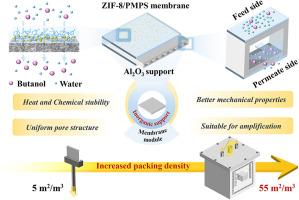
This study addresses the challenges of bio-butanol recovery by synergizing innovative module design with advanced mixed matrix membranes (MMMs) for enhanced pervaporation (PV) efficiency. ZIF-8 nanoparticles (14–120 nm) were integrated into a polymethylphenylsiloxane (PMPS) matrix to fabricate ZIF-8/PMPS MMMs on flat-sheet Al2O3 supports, for efficient n-butanol separation via pervaporation. The optimized 14 nm-ZIF-8/PMPS MMMs (13.0 wt% loading) exhibited optimal performance, achieving a total flux of 925.86 g m−2 h−1 and a separation factor of 37.65 for 1 wt% n-butanol/water mixtures at 40 °C, enabling stable operation over 600 h. Key factors included the improved hydrophobicity, reduced interfacial voids, and enhanced surface roughness. A novel plate-and-frame module was engineered to address scalability challenges, increasing packing density from 5 to 55 m2/m3 while mitigating concentration polarization and enhancing mass transfer under dynamic flow conditions. The module's compact design, combined with the mechanical robustness of Al2O3 supports and the compatibility of ZIF-8/PMPS membranes, demonstrates industrial viability.
期刊介绍:
The Journal of Membrane Science is a publication that focuses on membrane systems and is aimed at academic and industrial chemists, chemical engineers, materials scientists, and membranologists. It publishes original research and reviews on various aspects of membrane transport, membrane formation/structure, fouling, module/process design, and processes/applications. The journal primarily focuses on the structure, function, and performance of non-biological membranes but also includes papers that relate to biological membranes. The Journal of Membrane Science publishes Full Text Papers, State-of-the-Art Reviews, Letters to the Editor, and Perspectives.




 京公网安备 11010802042870号
京ICP备2023020795号-1
京公网安备 11010802042870号
京ICP备2023020795号-1

 分享
分享
 求助内容:
求助内容: 应助结果提醒方式:
 扫码关注我们
