Hage Sonia , Techi Boni , Nilamoni Chelleng , Nazim Uddin Afzal , Prasenjit Manna , Suman Koirala , Parimal Kar , Chandan Tamuly
{"title":"揭示小米酒的生物活性:体外降糖、抗脲酶活性和硅分子对接方法","authors":"Hage Sonia , Techi Boni , Nilamoni Chelleng , Nazim Uddin Afzal , Prasenjit Manna , Suman Koirala , Parimal Kar , Chandan Tamuly","doi":"10.1016/j.sajb.2025.03.058","DOIUrl":null,"url":null,"abstract":"<div><div>There is no comprehensive chemical analysis of hypoglycemic and anti-urease properties, as well as computational studies of finger millet wine (FMW). Therefore, the current study aims to investigate its hypoglycemic and anti-urease properties along with its glucose utilisation and GLUT4 transport behaviour in Rat L6 myoblast cell line and its molecular docking studies. Results revealed that FMW inhibited α-glucosidase and urease enzyme with an IC<sub>50</sub> value of 8.45 and 67.67 µg/mL, respectively. Seven phenolic compounds: <em>p</em>-coumaric, <em>trans-</em>ferulic, caffeic, protocatechuic, sinapic, vanillic, and <em>trans</em>-cinnamic acid were identified by HPLC. HS-SPME/LLE-GC–MS identified major compounds 2,3-Butanediol (24.80/0.08 %), Ethyl hydrogen succinate (24.46/11.04 %), Caffeine (14.84/5.81 %), and Methyl 4-<em>O</em>-methyl-d-arabinopyranoside (4.23/2.09 %). Glucose utilization and GLUT4 translocation showed significant (<em>p</em> < 0.05) improvement at the concentration of 40 µg/mL. Molecular docking (MD) simulation and Molecular Mechanics Poisson-Boltzmann Surface Area (MM-PBSA) studies revealed protocatechuic acid (-27.84 kcal/mol) had highest binding affinity. Additionally, we identified the hotspot residues Trp-376, Trp-481, Glu-521, Asp-404, Asp-649, and Asp-616. Thus, it can be summarised, finger millet-based wine shows potential hypoglycaemic activity backed up by glucose utilisation, docking studies have further supported the bioactive importance of this wine. This finding might open a scope for further optimization and further <em>in-vivo</em> research.</div></div>","PeriodicalId":21919,"journal":{"name":"South African Journal of Botany","volume":"180 ","pages":"Pages 820-836"},"PeriodicalIF":3.1000,"publicationDate":"2025-05-01","publicationTypes":"Journal Article","fieldsOfStudy":null,"isOpenAccess":false,"openAccessPdf":"","citationCount":"0","resultStr":"{\"title\":\"Unraveling the bioactive profile of finger millet wine: In-vitro hypoglycemic, anti-urease activities, and In-silico molecular docking approach\",\"authors\":\"Hage Sonia , Techi Boni , Nilamoni Chelleng , Nazim Uddin Afzal , Prasenjit Manna , Suman Koirala , Parimal Kar , Chandan Tamuly\",\"doi\":\"10.1016/j.sajb.2025.03.058\",\"DOIUrl\":null,\"url\":null,\"abstract\":\"<div><div>There is no comprehensive chemical analysis of hypoglycemic and anti-urease properties, as well as computational studies of finger millet wine (FMW). Therefore, the current study aims to investigate its hypoglycemic and anti-urease properties along with its glucose utilisation and GLUT4 transport behaviour in Rat L6 myoblast cell line and its molecular docking studies. Results revealed that FMW inhibited α-glucosidase and urease enzyme with an IC<sub>50</sub> value of 8.45 and 67.67 µg/mL, respectively. Seven phenolic compounds: <em>p</em>-coumaric, <em>trans-</em>ferulic, caffeic, protocatechuic, sinapic, vanillic, and <em>trans</em>-cinnamic acid were identified by HPLC. HS-SPME/LLE-GC–MS identified major compounds 2,3-Butanediol (24.80/0.08 %), Ethyl hydrogen succinate (24.46/11.04 %), Caffeine (14.84/5.81 %), and Methyl 4-<em>O</em>-methyl-d-arabinopyranoside (4.23/2.09 %). Glucose utilization and GLUT4 translocation showed significant (<em>p</em> < 0.05) improvement at the concentration of 40 µg/mL. Molecular docking (MD) simulation and Molecular Mechanics Poisson-Boltzmann Surface Area (MM-PBSA) studies revealed protocatechuic acid (-27.84 kcal/mol) had highest binding affinity. Additionally, we identified the hotspot residues Trp-376, Trp-481, Glu-521, Asp-404, Asp-649, and Asp-616. Thus, it can be summarised, finger millet-based wine shows potential hypoglycaemic activity backed up by glucose utilisation, docking studies have further supported the bioactive importance of this wine. This finding might open a scope for further optimization and further <em>in-vivo</em> research.</div></div>\",\"PeriodicalId\":21919,\"journal\":{\"name\":\"South African Journal of Botany\",\"volume\":\"180 \",\"pages\":\"Pages 820-836\"},\"PeriodicalIF\":3.1000,\"publicationDate\":\"2025-05-01\",\"publicationTypes\":\"Journal Article\",\"fieldsOfStudy\":null,\"isOpenAccess\":false,\"openAccessPdf\":\"\",\"citationCount\":\"0\",\"resultStr\":null,\"platform\":\"Semanticscholar\",\"paperid\":null,\"PeriodicalName\":\"South African Journal of Botany\",\"FirstCategoryId\":\"99\",\"ListUrlMain\":\"https://www.sciencedirect.com/science/article/pii/S0254629925001826\",\"RegionNum\":3,\"RegionCategory\":\"生物学\",\"ArticlePicture\":[],\"TitleCN\":null,\"AbstractTextCN\":null,\"PMCID\":null,\"EPubDate\":\"2025/4/7 0:00:00\",\"PubModel\":\"Epub\",\"JCR\":\"Q2\",\"JCRName\":\"PLANT SCIENCES\",\"Score\":null,\"Total\":0}","platform":"Semanticscholar","paperid":null,"PeriodicalName":"South African Journal of Botany","FirstCategoryId":"99","ListUrlMain":"https://www.sciencedirect.com/science/article/pii/S0254629925001826","RegionNum":3,"RegionCategory":"生物学","ArticlePicture":[],"TitleCN":null,"AbstractTextCN":null,"PMCID":null,"EPubDate":"2025/4/7 0:00:00","PubModel":"Epub","JCR":"Q2","JCRName":"PLANT SCIENCES","Score":null,"Total":0}
引用次数: 0
摘要
目前还没有对手指小米酒(FMW)的降糖和抗脲酶性能进行全面的化学分析,以及计算研究。因此,本研究旨在探讨其在大鼠L6成肌细胞系中的降糖和抗脲酶特性、葡萄糖利用和GLUT4转运行为及其分子对接研究。结果表明,FMW对α-葡萄糖苷酶和脲酶的抑制作用IC50值分别为8.45和67.67µg/mL。用高效液相色谱法鉴定了7种酚类化合物:对香豆酸、反式阿魏酸、咖啡酸、原儿茶酸、辛酸、香草酸和反式肉桂酸。HS-SPME/ le - gc - ms鉴定出主要化合物2,3-丁二醇(24.80/ 0.08%)、琥珀酸氢乙酯(24.46/ 11.04%)、咖啡因(14.84/ 5.81%)和甲基4- o -甲基-d-阿拉伯吡喃苷(4.23/ 2.09%)。葡萄糖利用和GLUT4易位差异有统计学意义(p <;浓度为40µg/mL时,改善率为0.05)。分子对接(MD)模拟和分子力学泊松-玻尔兹曼表面积(MM-PBSA)研究表明,原儿茶酸(-27.84 kcal/mol)具有最高的结合亲和力。此外,我们还鉴定出了热点残基tp -376、tp -481、gl -521、Asp-404、Asp-649和Asp-616。因此,可以总结,基于手指小米的葡萄酒显示出潜在的降糖活性,支持葡萄糖利用,对接研究进一步支持了这种葡萄酒的生物活性重要性。这一发现可能为进一步优化和进一步的体内研究开辟了空间。
Unraveling the bioactive profile of finger millet wine: In-vitro hypoglycemic, anti-urease activities, and In-silico molecular docking approach
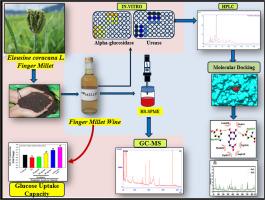
There is no comprehensive chemical analysis of hypoglycemic and anti-urease properties, as well as computational studies of finger millet wine (FMW). Therefore, the current study aims to investigate its hypoglycemic and anti-urease properties along with its glucose utilisation and GLUT4 transport behaviour in Rat L6 myoblast cell line and its molecular docking studies. Results revealed that FMW inhibited α-glucosidase and urease enzyme with an IC50 value of 8.45 and 67.67 µg/mL, respectively. Seven phenolic compounds: p-coumaric, trans-ferulic, caffeic, protocatechuic, sinapic, vanillic, and trans-cinnamic acid were identified by HPLC. HS-SPME/LLE-GC–MS identified major compounds 2,3-Butanediol (24.80/0.08 %), Ethyl hydrogen succinate (24.46/11.04 %), Caffeine (14.84/5.81 %), and Methyl 4-O-methyl-d-arabinopyranoside (4.23/2.09 %). Glucose utilization and GLUT4 translocation showed significant (p < 0.05) improvement at the concentration of 40 µg/mL. Molecular docking (MD) simulation and Molecular Mechanics Poisson-Boltzmann Surface Area (MM-PBSA) studies revealed protocatechuic acid (-27.84 kcal/mol) had highest binding affinity. Additionally, we identified the hotspot residues Trp-376, Trp-481, Glu-521, Asp-404, Asp-649, and Asp-616. Thus, it can be summarised, finger millet-based wine shows potential hypoglycaemic activity backed up by glucose utilisation, docking studies have further supported the bioactive importance of this wine. This finding might open a scope for further optimization and further in-vivo research.
期刊介绍:
The South African Journal of Botany publishes original papers that deal with the classification, biodiversity, morphology, physiology, molecular biology, ecology, biotechnology, ethnobotany and other botanically related aspects of species that are of importance to southern Africa. Manuscripts dealing with significant new findings on other species of the world and general botanical principles will also be considered and are encouraged.




 京公网安备 11010802042870号
京ICP备2023020795号-1
京公网安备 11010802042870号
京ICP备2023020795号-1

 分享
分享
 求助内容:
求助内容: 应助结果提醒方式:
 扫码关注我们
