George Athanasios Karpouzas, Miguel A Gonzalez-Gay, Alfonso Corrales, Elena Myasoedova, Solbritt Rantapää-Dahlqvist, Petros P Sfikakis, Patrick Dessein, Carol Hitchon, Virginia Pascual-Ramos, Irazú Contreras-Yáñez, Iris J Colunga-Pedraza, Dionicio Angel Galarza-Delgado, Jose Ramon Azpiri-Lopez, Anne Grete Semb, Piet Leonardus Cornelis Maria van Riel, Durga Prasanna Misra, Durez Patrick, Brian Bridal Logstrup, Ellen-Margrethe Hauge, George Kitas, Sarah R Ormseth
{"title":"身体质量指数对类风湿关节炎心血管风险的影响因抗瓜氨酸蛋白抗体状态和生物制剂使用而异。","authors":"George Athanasios Karpouzas, Miguel A Gonzalez-Gay, Alfonso Corrales, Elena Myasoedova, Solbritt Rantapää-Dahlqvist, Petros P Sfikakis, Patrick Dessein, Carol Hitchon, Virginia Pascual-Ramos, Irazú Contreras-Yáñez, Iris J Colunga-Pedraza, Dionicio Angel Galarza-Delgado, Jose Ramon Azpiri-Lopez, Anne Grete Semb, Piet Leonardus Cornelis Maria van Riel, Durga Prasanna Misra, Durez Patrick, Brian Bridal Logstrup, Ellen-Margrethe Hauge, George Kitas, Sarah R Ormseth","doi":"10.1136/rmdopen-2025-005464","DOIUrl":null,"url":null,"abstract":"<p><strong>Objectives: </strong>The impact of body mass index (BMI) on cardiovascular risk in rheumatoid arthritis (RA) is unclear. RA characteristics may influence the association between BMI and risk. Disease activity, which predicts cardiovascular risk, is associated with obesity only among anticitrullinated antibody (ACPA)-positive patients. Biologics alter body composition and mitigate cardiovascular risk in RA. We explored the association of BMI with cardiovascular risk and whether this varied across ACPA status and biologic use.</p><p><strong>Methods: </strong>We evaluated 3982 patients from an international observational cohort. Outcomes included (a) first major adverse cardiovascular event (MACE) encompassing myocardial infarction, stroke or cardiovascular death; and (b) all events comprising MACE, angina, revascularisation, transient ischaemic attack, peripheral arterial disease and heart failure. Multivariable Cox models stratified by centre risk evaluated the impact of BMI, ACPA, biologics and their two- and three-way interactions on outcomes.</p><p><strong>Results: </strong>We recorded 192 MACE and 319 total events. No main effects of BMI, ACPA or biologics were observed. A three-way interaction between them on MACE (p-interaction<0.001) and all events (p-interaction=0.028) was noted. Among ACPA negative patients, BMI was inversely associated with MACE (HR 0.38 (95% CI 0.25 to 0.57)) and all events (HR 0.67 (0.49 to 0.92)) in biologic users but not non-users (p-for-interaction <0.001 and 0.012). Among ACPA-positive patients, BMI was associated with MACE (HR 1.04 [1.01-1.07]) and all events (HR 1.03 (1.00 to 1.06)) independently of biologic use.</p><p><strong>Conclusions: </strong>BMI is inversely associated with cardiovascular risk only among ACPA-negative biologic users. In contrast, BMI is associated with cardiovascular risk in ACPA-positive patients independently of biologic use.</p>","PeriodicalId":21396,"journal":{"name":"RMD Open","volume":"11 2","pages":""},"PeriodicalIF":4.7000,"publicationDate":"2025-04-05","publicationTypes":"Journal Article","fieldsOfStudy":null,"isOpenAccess":false,"openAccessPdf":"https://www.ncbi.nlm.nih.gov/pmc/articles/PMC11973786/pdf/","citationCount":"0","resultStr":"{\"title\":\"Influence of body mass index on cardiovascular risk in rheumatoid arthritis varies across anti-citrullinated protein antibody status and biologic use.\",\"authors\":\"George Athanasios Karpouzas, Miguel A Gonzalez-Gay, Alfonso Corrales, Elena Myasoedova, Solbritt Rantapää-Dahlqvist, Petros P Sfikakis, Patrick Dessein, Carol Hitchon, Virginia Pascual-Ramos, Irazú Contreras-Yáñez, Iris J Colunga-Pedraza, Dionicio Angel Galarza-Delgado, Jose Ramon Azpiri-Lopez, Anne Grete Semb, Piet Leonardus Cornelis Maria van Riel, Durga Prasanna Misra, Durez Patrick, Brian Bridal Logstrup, Ellen-Margrethe Hauge, George Kitas, Sarah R Ormseth\",\"doi\":\"10.1136/rmdopen-2025-005464\",\"DOIUrl\":null,\"url\":null,\"abstract\":\"<p><strong>Objectives: </strong>The impact of body mass index (BMI) on cardiovascular risk in rheumatoid arthritis (RA) is unclear. RA characteristics may influence the association between BMI and risk. Disease activity, which predicts cardiovascular risk, is associated with obesity only among anticitrullinated antibody (ACPA)-positive patients. Biologics alter body composition and mitigate cardiovascular risk in RA. We explored the association of BMI with cardiovascular risk and whether this varied across ACPA status and biologic use.</p><p><strong>Methods: </strong>We evaluated 3982 patients from an international observational cohort. Outcomes included (a) first major adverse cardiovascular event (MACE) encompassing myocardial infarction, stroke or cardiovascular death; and (b) all events comprising MACE, angina, revascularisation, transient ischaemic attack, peripheral arterial disease and heart failure. Multivariable Cox models stratified by centre risk evaluated the impact of BMI, ACPA, biologics and their two- and three-way interactions on outcomes.</p><p><strong>Results: </strong>We recorded 192 MACE and 319 total events. No main effects of BMI, ACPA or biologics were observed. A three-way interaction between them on MACE (p-interaction<0.001) and all events (p-interaction=0.028) was noted. Among ACPA negative patients, BMI was inversely associated with MACE (HR 0.38 (95% CI 0.25 to 0.57)) and all events (HR 0.67 (0.49 to 0.92)) in biologic users but not non-users (p-for-interaction <0.001 and 0.012). Among ACPA-positive patients, BMI was associated with MACE (HR 1.04 [1.01-1.07]) and all events (HR 1.03 (1.00 to 1.06)) independently of biologic use.</p><p><strong>Conclusions: </strong>BMI is inversely associated with cardiovascular risk only among ACPA-negative biologic users. In contrast, BMI is associated with cardiovascular risk in ACPA-positive patients independently of biologic use.</p>\",\"PeriodicalId\":21396,\"journal\":{\"name\":\"RMD Open\",\"volume\":\"11 2\",\"pages\":\"\"},\"PeriodicalIF\":4.7000,\"publicationDate\":\"2025-04-05\",\"publicationTypes\":\"Journal Article\",\"fieldsOfStudy\":null,\"isOpenAccess\":false,\"openAccessPdf\":\"https://www.ncbi.nlm.nih.gov/pmc/articles/PMC11973786/pdf/\",\"citationCount\":\"0\",\"resultStr\":null,\"platform\":\"Semanticscholar\",\"paperid\":null,\"PeriodicalName\":\"RMD Open\",\"FirstCategoryId\":\"3\",\"ListUrlMain\":\"https://doi.org/10.1136/rmdopen-2025-005464\",\"RegionNum\":2,\"RegionCategory\":\"医学\",\"ArticlePicture\":[],\"TitleCN\":null,\"AbstractTextCN\":null,\"PMCID\":null,\"EPubDate\":\"\",\"PubModel\":\"\",\"JCR\":\"Q1\",\"JCRName\":\"RHEUMATOLOGY\",\"Score\":null,\"Total\":0}","platform":"Semanticscholar","paperid":null,"PeriodicalName":"RMD Open","FirstCategoryId":"3","ListUrlMain":"https://doi.org/10.1136/rmdopen-2025-005464","RegionNum":2,"RegionCategory":"医学","ArticlePicture":[],"TitleCN":null,"AbstractTextCN":null,"PMCID":null,"EPubDate":"","PubModel":"","JCR":"Q1","JCRName":"RHEUMATOLOGY","Score":null,"Total":0}
Influence of body mass index on cardiovascular risk in rheumatoid arthritis varies across anti-citrullinated protein antibody status and biologic use.
Objectives: The impact of body mass index (BMI) on cardiovascular risk in rheumatoid arthritis (RA) is unclear. RA characteristics may influence the association between BMI and risk. Disease activity, which predicts cardiovascular risk, is associated with obesity only among anticitrullinated antibody (ACPA)-positive patients. Biologics alter body composition and mitigate cardiovascular risk in RA. We explored the association of BMI with cardiovascular risk and whether this varied across ACPA status and biologic use.
Methods: We evaluated 3982 patients from an international observational cohort. Outcomes included (a) first major adverse cardiovascular event (MACE) encompassing myocardial infarction, stroke or cardiovascular death; and (b) all events comprising MACE, angina, revascularisation, transient ischaemic attack, peripheral arterial disease and heart failure. Multivariable Cox models stratified by centre risk evaluated the impact of BMI, ACPA, biologics and their two- and three-way interactions on outcomes.
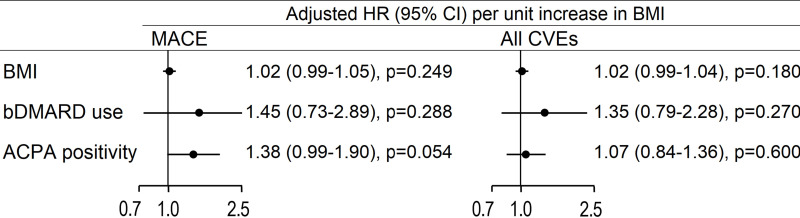
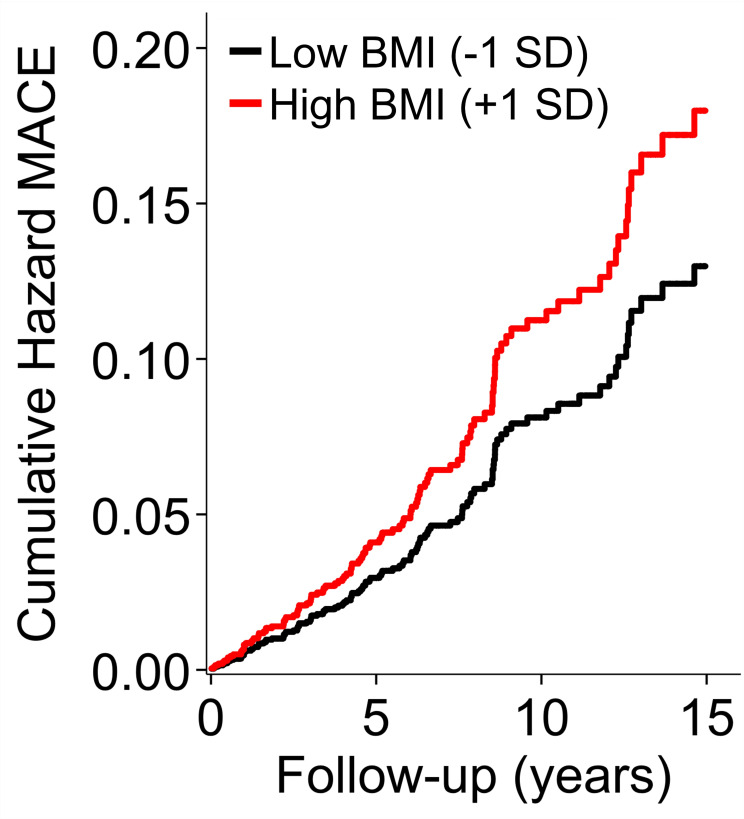
Results: We recorded 192 MACE and 319 total events. No main effects of BMI, ACPA or biologics were observed. A three-way interaction between them on MACE (p-interaction<0.001) and all events (p-interaction=0.028) was noted. Among ACPA negative patients, BMI was inversely associated with MACE (HR 0.38 (95% CI 0.25 to 0.57)) and all events (HR 0.67 (0.49 to 0.92)) in biologic users but not non-users (p-for-interaction <0.001 and 0.012). Among ACPA-positive patients, BMI was associated with MACE (HR 1.04 [1.01-1.07]) and all events (HR 1.03 (1.00 to 1.06)) independently of biologic use.
Conclusions: BMI is inversely associated with cardiovascular risk only among ACPA-negative biologic users. In contrast, BMI is associated with cardiovascular risk in ACPA-positive patients independently of biologic use.
期刊介绍:
RMD Open publishes high quality peer-reviewed original research covering the full spectrum of musculoskeletal disorders, rheumatism and connective tissue diseases, including osteoporosis, spine and rehabilitation. Clinical and epidemiological research, basic and translational medicine, interesting clinical cases, and smaller studies that add to the literature are all considered.





 京公网安备 11010802042870号
京ICP备2023020795号-1
京公网安备 11010802042870号
京ICP备2023020795号-1

 分享
分享
 求助内容:
求助内容: 应助结果提醒方式:
 扫码关注我们
