Jintai Deng, Wang Wan, Rui Sun, Qiuxuan Xia, Jing Yan, Jialu Sun, Xiaomeng Jia, Hao Jin, Xueqing Wang, Kun Guo, Man Li, Yu Liu
{"title":"耐酸和粘度敏感的蛋白质组聚集传感器可视化细胞聚集在活细胞和临床样品","authors":"Jintai Deng, Wang Wan, Rui Sun, Qiuxuan Xia, Jing Yan, Jialu Sun, Xiaomeng Jia, Hao Jin, Xueqing Wang, Kun Guo, Man Li, Yu Liu","doi":"10.1021/acssensors.4c03560","DOIUrl":null,"url":null,"abstract":"Aggrephagy in cells is defined as the degradation of intracellular aggregated proteins via the macroautophagy process. This process sequesters protein aggregates into autolysosomes, which bear characteristic viscous and acidic microenvironments. Limited protein aggregation sensors are environmentally compatible with the cellular aggrephagy process. Here, we report an acid-resistant and viscosity-sensitive proteome aggregation sensor to detect cellular aggrephagy in stressed cells and clinical samples. This sensor fluoresces upon selectively and ubiquitously binding to different aggregated proteins. Importantly, unlike other reported protein aggregation sensors, our probe offers unique acid-resistant fluorescence inside aggregated proteins, enabling its application in the acidic autolysosome microenvironment. In live cells under various stressed conditions, the optimal probe (A6) successfully detects aggregated proteome in autolysosomes, as validated by colocalization with a lysosomal tracker. Additionally, we demonstrate that the sensor can detect proteome aggregation in heat-stressed clinical tissue samples biopsied from cancer patients undergoing thermal perfusion treatment. Together, the reported acid-resistant and viscosity-sensitive protein aggregation sensor facilitates the detection of cellular aggrephagy by chemically matching its microenvironmental characteristics.","PeriodicalId":24,"journal":{"name":"ACS Sensors","volume":"18 1","pages":""},"PeriodicalIF":10.9000,"publicationDate":"2025-04-06","publicationTypes":"Journal Article","fieldsOfStudy":null,"isOpenAccess":false,"openAccessPdf":"","citationCount":"0","resultStr":"{\"title\":\"Acid-Resistant and Viscosity-Sensitive Proteome Aggregation Sensor To Visualize Cellular Aggrephagy in Live Cells and Clinical Samples\",\"authors\":\"Jintai Deng, Wang Wan, Rui Sun, Qiuxuan Xia, Jing Yan, Jialu Sun, Xiaomeng Jia, Hao Jin, Xueqing Wang, Kun Guo, Man Li, Yu Liu\",\"doi\":\"10.1021/acssensors.4c03560\",\"DOIUrl\":null,\"url\":null,\"abstract\":\"Aggrephagy in cells is defined as the degradation of intracellular aggregated proteins via the macroautophagy process. This process sequesters protein aggregates into autolysosomes, which bear characteristic viscous and acidic microenvironments. Limited protein aggregation sensors are environmentally compatible with the cellular aggrephagy process. Here, we report an acid-resistant and viscosity-sensitive proteome aggregation sensor to detect cellular aggrephagy in stressed cells and clinical samples. This sensor fluoresces upon selectively and ubiquitously binding to different aggregated proteins. Importantly, unlike other reported protein aggregation sensors, our probe offers unique acid-resistant fluorescence inside aggregated proteins, enabling its application in the acidic autolysosome microenvironment. In live cells under various stressed conditions, the optimal probe (A6) successfully detects aggregated proteome in autolysosomes, as validated by colocalization with a lysosomal tracker. Additionally, we demonstrate that the sensor can detect proteome aggregation in heat-stressed clinical tissue samples biopsied from cancer patients undergoing thermal perfusion treatment. Together, the reported acid-resistant and viscosity-sensitive protein aggregation sensor facilitates the detection of cellular aggrephagy by chemically matching its microenvironmental characteristics.\",\"PeriodicalId\":24,\"journal\":{\"name\":\"ACS Sensors\",\"volume\":\"18 1\",\"pages\":\"\"},\"PeriodicalIF\":10.9000,\"publicationDate\":\"2025-04-06\",\"publicationTypes\":\"Journal Article\",\"fieldsOfStudy\":null,\"isOpenAccess\":false,\"openAccessPdf\":\"\",\"citationCount\":\"0\",\"resultStr\":null,\"platform\":\"Semanticscholar\",\"paperid\":null,\"PeriodicalName\":\"ACS Sensors\",\"FirstCategoryId\":\"92\",\"ListUrlMain\":\"https://doi.org/10.1021/acssensors.4c03560\",\"RegionNum\":1,\"RegionCategory\":\"化学\",\"ArticlePicture\":[],\"TitleCN\":null,\"AbstractTextCN\":null,\"PMCID\":null,\"EPubDate\":\"\",\"PubModel\":\"\",\"JCR\":\"Q1\",\"JCRName\":\"CHEMISTRY, ANALYTICAL\",\"Score\":null,\"Total\":0}","platform":"Semanticscholar","paperid":null,"PeriodicalName":"ACS Sensors","FirstCategoryId":"92","ListUrlMain":"https://doi.org/10.1021/acssensors.4c03560","RegionNum":1,"RegionCategory":"化学","ArticlePicture":[],"TitleCN":null,"AbstractTextCN":null,"PMCID":null,"EPubDate":"","PubModel":"","JCR":"Q1","JCRName":"CHEMISTRY, ANALYTICAL","Score":null,"Total":0}
Acid-Resistant and Viscosity-Sensitive Proteome Aggregation Sensor To Visualize Cellular Aggrephagy in Live Cells and Clinical Samples
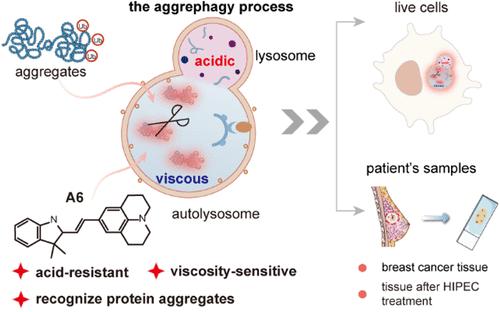
Aggrephagy in cells is defined as the degradation of intracellular aggregated proteins via the macroautophagy process. This process sequesters protein aggregates into autolysosomes, which bear characteristic viscous and acidic microenvironments. Limited protein aggregation sensors are environmentally compatible with the cellular aggrephagy process. Here, we report an acid-resistant and viscosity-sensitive proteome aggregation sensor to detect cellular aggrephagy in stressed cells and clinical samples. This sensor fluoresces upon selectively and ubiquitously binding to different aggregated proteins. Importantly, unlike other reported protein aggregation sensors, our probe offers unique acid-resistant fluorescence inside aggregated proteins, enabling its application in the acidic autolysosome microenvironment. In live cells under various stressed conditions, the optimal probe (A6) successfully detects aggregated proteome in autolysosomes, as validated by colocalization with a lysosomal tracker. Additionally, we demonstrate that the sensor can detect proteome aggregation in heat-stressed clinical tissue samples biopsied from cancer patients undergoing thermal perfusion treatment. Together, the reported acid-resistant and viscosity-sensitive protein aggregation sensor facilitates the detection of cellular aggrephagy by chemically matching its microenvironmental characteristics.
期刊介绍:
ACS Sensors is a peer-reviewed research journal that focuses on the dissemination of new and original knowledge in the field of sensor science, particularly those that selectively sense chemical or biological species or processes. The journal covers a broad range of topics, including but not limited to biosensors, chemical sensors, gas sensors, intracellular sensors, single molecule sensors, cell chips, and microfluidic devices. It aims to publish articles that address conceptual advances in sensing technology applicable to various types of analytes or application papers that report on the use of existing sensing concepts in new ways or for new analytes.




 京公网安备 11010802042870号
京ICP备2023020795号-1
京公网安备 11010802042870号
京ICP备2023020795号-1

 分享
分享
 求助内容:
求助内容: 应助结果提醒方式:
 扫码关注我们
