Li Li , Xian-Yong Wei , Shun-Hong Lv , Xiang Bai , Yierxiati Dilixiati , Jun-Long Wang , Xiao-Yan He , Zhi-Min Zong , Xing Fan
{"title":"将 2-丁炔-1,4-二醇特定催化加氢为丁烷-1,4-二醇","authors":"Li Li , Xian-Yong Wei , Shun-Hong Lv , Xiang Bai , Yierxiati Dilixiati , Jun-Long Wang , Xiao-Yan He , Zhi-Min Zong , Xing Fan","doi":"10.1016/j.fuel.2025.134673","DOIUrl":null,"url":null,"abstract":"<div><div>Butane-1,4-diol (BDO) is a crucial platform compound for producing tetrahydrofuran, γ-butyrolactone, polytetramethylene ether glycol, and polybutylene terephthalate. A novel supported Pd catalyst was prepared, over which 2-butyne-1,4-diol (BYD) can be completely converted to BDO in the yield of 99.8 % in methanol under 3 MPa of H<sub>2</sub> at 35 °C for 80 min. Such mild conditions are far superior to the NVIDTA technology over a rodlike supported nickel under 30 MPa of H<sub>2</sub> at 130–135 °C in industry, so our technology is more practical for industry. The mechanisms for the formation of both BDO and by-products (BPs) were revealed. The type of active hydrogen species generated from H<sub>2</sub> activation has a great influence on the formation of BPs. H<sup>…</sup>H transfer plays an essential role in hydrogenating C≡C in BYD to produce BDO, while H<sup>+</sup> and H<sup>-</sup> transfer leads to the generation of the BPs. The BPs from BYD hydrogenation in methanol and ethanol are 2-methoxytetrahydrofuran and 2-hydroxytetrahydrofuran, respectively.</div></div>","PeriodicalId":325,"journal":{"name":"Fuel","volume":"396 ","pages":"Article 134673"},"PeriodicalIF":7.5000,"publicationDate":"2025-09-15","publicationTypes":"Journal Article","fieldsOfStudy":null,"isOpenAccess":false,"openAccessPdf":"","citationCount":"0","resultStr":"{\"title\":\"Specific catalytic hydrogenation of 2-butyne-1,4-diol to butane-1,4-diol\",\"authors\":\"Li Li , Xian-Yong Wei , Shun-Hong Lv , Xiang Bai , Yierxiati Dilixiati , Jun-Long Wang , Xiao-Yan He , Zhi-Min Zong , Xing Fan\",\"doi\":\"10.1016/j.fuel.2025.134673\",\"DOIUrl\":null,\"url\":null,\"abstract\":\"<div><div>Butane-1,4-diol (BDO) is a crucial platform compound for producing tetrahydrofuran, γ-butyrolactone, polytetramethylene ether glycol, and polybutylene terephthalate. A novel supported Pd catalyst was prepared, over which 2-butyne-1,4-diol (BYD) can be completely converted to BDO in the yield of 99.8 % in methanol under 3 MPa of H<sub>2</sub> at 35 °C for 80 min. Such mild conditions are far superior to the NVIDTA technology over a rodlike supported nickel under 30 MPa of H<sub>2</sub> at 130–135 °C in industry, so our technology is more practical for industry. The mechanisms for the formation of both BDO and by-products (BPs) were revealed. The type of active hydrogen species generated from H<sub>2</sub> activation has a great influence on the formation of BPs. H<sup>…</sup>H transfer plays an essential role in hydrogenating C≡C in BYD to produce BDO, while H<sup>+</sup> and H<sup>-</sup> transfer leads to the generation of the BPs. The BPs from BYD hydrogenation in methanol and ethanol are 2-methoxytetrahydrofuran and 2-hydroxytetrahydrofuran, respectively.</div></div>\",\"PeriodicalId\":325,\"journal\":{\"name\":\"Fuel\",\"volume\":\"396 \",\"pages\":\"Article 134673\"},\"PeriodicalIF\":7.5000,\"publicationDate\":\"2025-09-15\",\"publicationTypes\":\"Journal Article\",\"fieldsOfStudy\":null,\"isOpenAccess\":false,\"openAccessPdf\":\"\",\"citationCount\":\"0\",\"resultStr\":null,\"platform\":\"Semanticscholar\",\"paperid\":null,\"PeriodicalName\":\"Fuel\",\"FirstCategoryId\":\"5\",\"ListUrlMain\":\"https://www.sciencedirect.com/science/article/pii/S0016236125003977\",\"RegionNum\":1,\"RegionCategory\":\"工程技术\",\"ArticlePicture\":[],\"TitleCN\":null,\"AbstractTextCN\":null,\"PMCID\":null,\"EPubDate\":\"2025/4/8 0:00:00\",\"PubModel\":\"Epub\",\"JCR\":\"Q2\",\"JCRName\":\"ENERGY & FUELS\",\"Score\":null,\"Total\":0}","platform":"Semanticscholar","paperid":null,"PeriodicalName":"Fuel","FirstCategoryId":"5","ListUrlMain":"https://www.sciencedirect.com/science/article/pii/S0016236125003977","RegionNum":1,"RegionCategory":"工程技术","ArticlePicture":[],"TitleCN":null,"AbstractTextCN":null,"PMCID":null,"EPubDate":"2025/4/8 0:00:00","PubModel":"Epub","JCR":"Q2","JCRName":"ENERGY & FUELS","Score":null,"Total":0}
Specific catalytic hydrogenation of 2-butyne-1,4-diol to butane-1,4-diol
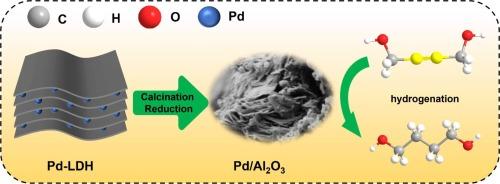
Butane-1,4-diol (BDO) is a crucial platform compound for producing tetrahydrofuran, γ-butyrolactone, polytetramethylene ether glycol, and polybutylene terephthalate. A novel supported Pd catalyst was prepared, over which 2-butyne-1,4-diol (BYD) can be completely converted to BDO in the yield of 99.8 % in methanol under 3 MPa of H2 at 35 °C for 80 min. Such mild conditions are far superior to the NVIDTA technology over a rodlike supported nickel under 30 MPa of H2 at 130–135 °C in industry, so our technology is more practical for industry. The mechanisms for the formation of both BDO and by-products (BPs) were revealed. The type of active hydrogen species generated from H2 activation has a great influence on the formation of BPs. H…H transfer plays an essential role in hydrogenating C≡C in BYD to produce BDO, while H+ and H- transfer leads to the generation of the BPs. The BPs from BYD hydrogenation in methanol and ethanol are 2-methoxytetrahydrofuran and 2-hydroxytetrahydrofuran, respectively.
期刊介绍:
The exploration of energy sources remains a critical matter of study. For the past nine decades, fuel has consistently held the forefront in primary research efforts within the field of energy science. This area of investigation encompasses a wide range of subjects, with a particular emphasis on emerging concerns like environmental factors and pollution.




 京公网安备 11010802042870号
京ICP备2023020795号-1
京公网安备 11010802042870号
京ICP备2023020795号-1

 分享
分享
 求助内容:
求助内容: 应助结果提醒方式:
 扫码关注我们
