{"title":"苯乙基铵掺杂Cs3Bi2Br9卤化物钙钛矿纳米片的结构和光学意义","authors":"Fency Sunny, Priyakumari Chakkingal Parambil, Nandakumar Kalarikkal and Kurukkal Balakrishnan Subila","doi":"10.1039/D5DT00325C","DOIUrl":null,"url":null,"abstract":"<p >Lead-free halide perovskites have been explored ardently for optoelectronic applications. Organic–inorganic hybrid halide perovskites have shown promise with novel optical properties, bandgap tuning and improved carrier dynamics, while introducing a quantum well structure. Herein, phenylethyl ammonium (PEA), an organic cation, was incorporated into cesium bismuth bromide (CBB) to enhance its multi-quantum well structure and synthesize organic–inorganic hybrid nanosheets of PEA-doped cesium bismuth bromide (PEA:CBB). Optimal doping conditions led to the formation of stable layered PEA:CBB hybrid nanosheets, evidenced by XRD and HRTEM analyses. DFT calculations revealed a minimum-energy structure in which PEA adopts a horizontal alignment between the inorganic slabs of CBB. The incorporation of PEA introduces new electronic states, resulting in extended luminescence tails and altered carrier lifetime. Third-order non-linear optical characterization of pristine and hybrid particles revealed that the multi-quantum well structure and additional trap states induced by PEA increase the two-photon absorption coefficient and reduce the optical limiting threshold of CBB. The present study indicates conceivable relevance of lead-free bismuth-based halide perovskites and their variants in optical limiting applications.</p>","PeriodicalId":71,"journal":{"name":"Dalton Transactions","volume":" 20","pages":" 8159-8168"},"PeriodicalIF":3.3000,"publicationDate":"2025-04-08","publicationTypes":"Journal Article","fieldsOfStudy":null,"isOpenAccess":false,"openAccessPdf":"","citationCount":"0","resultStr":"{\"title\":\"Probing the significance of phenylethyl ammonium doping in Cs3Bi2Br9 halide perovskite nanosheets: a structural and optical perspective†\",\"authors\":\"Fency Sunny, Priyakumari Chakkingal Parambil, Nandakumar Kalarikkal and Kurukkal Balakrishnan Subila\",\"doi\":\"10.1039/D5DT00325C\",\"DOIUrl\":null,\"url\":null,\"abstract\":\"<p >Lead-free halide perovskites have been explored ardently for optoelectronic applications. Organic–inorganic hybrid halide perovskites have shown promise with novel optical properties, bandgap tuning and improved carrier dynamics, while introducing a quantum well structure. Herein, phenylethyl ammonium (PEA), an organic cation, was incorporated into cesium bismuth bromide (CBB) to enhance its multi-quantum well structure and synthesize organic–inorganic hybrid nanosheets of PEA-doped cesium bismuth bromide (PEA:CBB). Optimal doping conditions led to the formation of stable layered PEA:CBB hybrid nanosheets, evidenced by XRD and HRTEM analyses. DFT calculations revealed a minimum-energy structure in which PEA adopts a horizontal alignment between the inorganic slabs of CBB. The incorporation of PEA introduces new electronic states, resulting in extended luminescence tails and altered carrier lifetime. Third-order non-linear optical characterization of pristine and hybrid particles revealed that the multi-quantum well structure and additional trap states induced by PEA increase the two-photon absorption coefficient and reduce the optical limiting threshold of CBB. The present study indicates conceivable relevance of lead-free bismuth-based halide perovskites and their variants in optical limiting applications.</p>\",\"PeriodicalId\":71,\"journal\":{\"name\":\"Dalton Transactions\",\"volume\":\" 20\",\"pages\":\" 8159-8168\"},\"PeriodicalIF\":3.3000,\"publicationDate\":\"2025-04-08\",\"publicationTypes\":\"Journal Article\",\"fieldsOfStudy\":null,\"isOpenAccess\":false,\"openAccessPdf\":\"\",\"citationCount\":\"0\",\"resultStr\":null,\"platform\":\"Semanticscholar\",\"paperid\":null,\"PeriodicalName\":\"Dalton Transactions\",\"FirstCategoryId\":\"92\",\"ListUrlMain\":\"https://pubs.rsc.org/en/content/articlelanding/2025/dt/d5dt00325c\",\"RegionNum\":3,\"RegionCategory\":\"化学\",\"ArticlePicture\":[],\"TitleCN\":null,\"AbstractTextCN\":null,\"PMCID\":null,\"EPubDate\":\"\",\"PubModel\":\"\",\"JCR\":\"Q2\",\"JCRName\":\"CHEMISTRY, INORGANIC & NUCLEAR\",\"Score\":null,\"Total\":0}","platform":"Semanticscholar","paperid":null,"PeriodicalName":"Dalton Transactions","FirstCategoryId":"92","ListUrlMain":"https://pubs.rsc.org/en/content/articlelanding/2025/dt/d5dt00325c","RegionNum":3,"RegionCategory":"化学","ArticlePicture":[],"TitleCN":null,"AbstractTextCN":null,"PMCID":null,"EPubDate":"","PubModel":"","JCR":"Q2","JCRName":"CHEMISTRY, INORGANIC & NUCLEAR","Score":null,"Total":0}
引用次数: 0
摘要
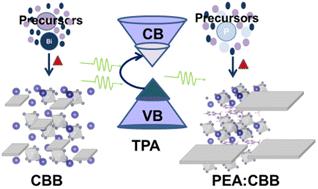
人们一直在积极探索无铅卤化物包晶在光电领域的应用。有机-无机混合卤化物包晶在引入量子阱结构的同时,还显示出了新颖的光学特性、带隙调整和载流子动力学改进的前景。在此,我们在溴化铯铋(CBB)中加入了有机阳离子苯乙基铵(PEA),以增强 CBB 的多量子阱结构,并形成掺杂 PEA 的溴化铯铋(CBB)有机-无机混合纳米片。XRD 和 HRTEM 分析表明,掺杂剂的最佳添加量导致形成了稳定的层状 PEA:CBB 混合纳米片。通过 DFT 计算阐明了杂化纳米片可能的稳定结构。计算显示,在 CBB 的无机板块之间,PEA 以水平构型配位,形成最低能量结构。PEA 的加入导致形成了新的电子态,从而使发光光谱中的尾巴更长,载流子寿命也发生了变化。纯粒子和混合粒子的三阶非线性光学特性表明,多量子阱结构和 PEA 的加入所带来的额外阱态增加了双光子吸收系数,降低了 CBB 的光学极限阈值。本研究表明,无铅铋基卤化物包晶石及其变体在光学极限应用中的相关性是可以想象的。
Probing the significance of phenylethyl ammonium doping in Cs3Bi2Br9 halide perovskite nanosheets: a structural and optical perspective†
Lead-free halide perovskites have been explored ardently for optoelectronic applications. Organic–inorganic hybrid halide perovskites have shown promise with novel optical properties, bandgap tuning and improved carrier dynamics, while introducing a quantum well structure. Herein, phenylethyl ammonium (PEA), an organic cation, was incorporated into cesium bismuth bromide (CBB) to enhance its multi-quantum well structure and synthesize organic–inorganic hybrid nanosheets of PEA-doped cesium bismuth bromide (PEA:CBB). Optimal doping conditions led to the formation of stable layered PEA:CBB hybrid nanosheets, evidenced by XRD and HRTEM analyses. DFT calculations revealed a minimum-energy structure in which PEA adopts a horizontal alignment between the inorganic slabs of CBB. The incorporation of PEA introduces new electronic states, resulting in extended luminescence tails and altered carrier lifetime. Third-order non-linear optical characterization of pristine and hybrid particles revealed that the multi-quantum well structure and additional trap states induced by PEA increase the two-photon absorption coefficient and reduce the optical limiting threshold of CBB. The present study indicates conceivable relevance of lead-free bismuth-based halide perovskites and their variants in optical limiting applications.
期刊介绍:
Dalton Transactions is a journal for all areas of inorganic chemistry, which encompasses the organometallic, bioinorganic and materials chemistry of the elements, with applications including synthesis, catalysis, energy conversion/storage, electrical devices and medicine. Dalton Transactions welcomes high-quality, original submissions in all of these areas and more, where the advancement of knowledge in inorganic chemistry is significant.




 京公网安备 11010802042870号
京ICP备2023020795号-1
京公网安备 11010802042870号
京ICP备2023020795号-1

 分享
分享
 求助内容:
求助内容: 应助结果提醒方式:
 扫码关注我们
