Emma Radice , Marco Salvalaglio , Roberto Bergamaschini
{"title":"图案化基底上各向异性固态脱湿的相场模拟","authors":"Emma Radice , Marco Salvalaglio , Roberto Bergamaschini","doi":"10.1016/j.actamat.2025.120992","DOIUrl":null,"url":null,"abstract":"<div><div>We present a phase-field model for simulating the solid-state dewetting of anisotropic crystalline films on non-planar substrates. This model exploits two order parameters to trace implicitly the crystal free surface and the substrate profile in both two and three dimensions. First, we validate the model by comparing numerical simulation results for planar substrates with those obtained by a conventional phase-field approach and by assessing the convergence toward the equilibrium shape predicted by the Winterbottom construction. We then explore non-planar geometries, examining the combined effects of surface-energy anisotropies and parameters controlling the contact angle. Our findings reveal that crystalline particles on curved supports lose self-similarity and exhibit a volume-dependent apparent contact angle, with opposite trends for convex versus concave profiles. Additionally, we investigate the migration of faceted particles on substrates with variable curvature. Applying this model to experimentally relevant cases like spheroidal and pit-patterned substrates demonstrates various behaviours that could be leveraged to direct self-assembly of nanostructures, from ordered nanoparticles to interconnected networks with complex topology.</div></div>","PeriodicalId":238,"journal":{"name":"Acta Materialia","volume":"292 ","pages":"Article 120992"},"PeriodicalIF":9.3000,"publicationDate":"2025-06-15","publicationTypes":"Journal Article","fieldsOfStudy":null,"isOpenAccess":false,"openAccessPdf":"","citationCount":"0","resultStr":"{\"title\":\"Phase-field modelling of anisotropic solid-state dewetting on patterned substrates\",\"authors\":\"Emma Radice , Marco Salvalaglio , Roberto Bergamaschini\",\"doi\":\"10.1016/j.actamat.2025.120992\",\"DOIUrl\":null,\"url\":null,\"abstract\":\"<div><div>We present a phase-field model for simulating the solid-state dewetting of anisotropic crystalline films on non-planar substrates. This model exploits two order parameters to trace implicitly the crystal free surface and the substrate profile in both two and three dimensions. First, we validate the model by comparing numerical simulation results for planar substrates with those obtained by a conventional phase-field approach and by assessing the convergence toward the equilibrium shape predicted by the Winterbottom construction. We then explore non-planar geometries, examining the combined effects of surface-energy anisotropies and parameters controlling the contact angle. Our findings reveal that crystalline particles on curved supports lose self-similarity and exhibit a volume-dependent apparent contact angle, with opposite trends for convex versus concave profiles. Additionally, we investigate the migration of faceted particles on substrates with variable curvature. Applying this model to experimentally relevant cases like spheroidal and pit-patterned substrates demonstrates various behaviours that could be leveraged to direct self-assembly of nanostructures, from ordered nanoparticles to interconnected networks with complex topology.</div></div>\",\"PeriodicalId\":238,\"journal\":{\"name\":\"Acta Materialia\",\"volume\":\"292 \",\"pages\":\"Article 120992\"},\"PeriodicalIF\":9.3000,\"publicationDate\":\"2025-06-15\",\"publicationTypes\":\"Journal Article\",\"fieldsOfStudy\":null,\"isOpenAccess\":false,\"openAccessPdf\":\"\",\"citationCount\":\"0\",\"resultStr\":null,\"platform\":\"Semanticscholar\",\"paperid\":null,\"PeriodicalName\":\"Acta Materialia\",\"FirstCategoryId\":\"88\",\"ListUrlMain\":\"https://www.sciencedirect.com/science/article/pii/S1359645425002836\",\"RegionNum\":1,\"RegionCategory\":\"材料科学\",\"ArticlePicture\":[],\"TitleCN\":null,\"AbstractTextCN\":null,\"PMCID\":null,\"EPubDate\":\"2025/4/8 0:00:00\",\"PubModel\":\"Epub\",\"JCR\":\"Q1\",\"JCRName\":\"MATERIALS SCIENCE, MULTIDISCIPLINARY\",\"Score\":null,\"Total\":0}","platform":"Semanticscholar","paperid":null,"PeriodicalName":"Acta Materialia","FirstCategoryId":"88","ListUrlMain":"https://www.sciencedirect.com/science/article/pii/S1359645425002836","RegionNum":1,"RegionCategory":"材料科学","ArticlePicture":[],"TitleCN":null,"AbstractTextCN":null,"PMCID":null,"EPubDate":"2025/4/8 0:00:00","PubModel":"Epub","JCR":"Q1","JCRName":"MATERIALS SCIENCE, MULTIDISCIPLINARY","Score":null,"Total":0}
Phase-field modelling of anisotropic solid-state dewetting on patterned substrates
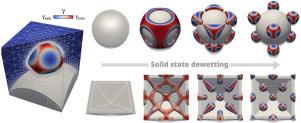
We present a phase-field model for simulating the solid-state dewetting of anisotropic crystalline films on non-planar substrates. This model exploits two order parameters to trace implicitly the crystal free surface and the substrate profile in both two and three dimensions. First, we validate the model by comparing numerical simulation results for planar substrates with those obtained by a conventional phase-field approach and by assessing the convergence toward the equilibrium shape predicted by the Winterbottom construction. We then explore non-planar geometries, examining the combined effects of surface-energy anisotropies and parameters controlling the contact angle. Our findings reveal that crystalline particles on curved supports lose self-similarity and exhibit a volume-dependent apparent contact angle, with opposite trends for convex versus concave profiles. Additionally, we investigate the migration of faceted particles on substrates with variable curvature. Applying this model to experimentally relevant cases like spheroidal and pit-patterned substrates demonstrates various behaviours that could be leveraged to direct self-assembly of nanostructures, from ordered nanoparticles to interconnected networks with complex topology.
期刊介绍:
Acta Materialia serves as a platform for publishing full-length, original papers and commissioned overviews that contribute to a profound understanding of the correlation between the processing, structure, and properties of inorganic materials. The journal seeks papers with high impact potential or those that significantly propel the field forward. The scope includes the atomic and molecular arrangements, chemical and electronic structures, and microstructure of materials, focusing on their mechanical or functional behavior across all length scales, including nanostructures.





 京公网安备 11010802042870号
京ICP备2023020795号-1
京公网安备 11010802042870号
京ICP备2023020795号-1

 分享
分享
 求助内容:
求助内容: 应助结果提醒方式:
 扫码关注我们
