Angela Giunta, Paul Bouyssoux, Frédéric Becquart, Jean-Charles Majesté, Fabien Dutertre
{"title":"衣康酸:从单体性质到自由基在水中的均聚","authors":"Angela Giunta, Paul Bouyssoux, Frédéric Becquart, Jean-Charles Majesté, Fabien Dutertre","doi":"10.1016/j.polymer.2025.128365","DOIUrl":null,"url":null,"abstract":"<div><div>Itaconic acid (ITA) is a promising renewable chemical building block. Previous research on its radical homo-polymerization in aqueous media has shown slow kinetics, low conversion, and low molecular weight polymers. In this paper, we demonstrate the impact of the intrinsic properties of itaconic acid on its polymerization conditions. Specifically, the role of the degree of ionization (α) on its structure, solubility, and reactivity towards radical polymerization in water was investigated. The results indicate that the highest solubility in water occurs when itaconic acid is half-deprotonated. At a given concentration, the reaction rate and final molecular weight decrease as the degree of ionization increases, presumably due to electrostatic effects and hydrophobic/hydrophilic variations. Despite lower reactivity, full conversion can be achieved in a relatively short time with the half-deprotonated form of itaconic acid, because the polymerization can be achieved at higher monomer concentrations. These experimental findings are further supported by computational simulations of the monomer's structure and reactivity.</div></div>","PeriodicalId":405,"journal":{"name":"Polymer","volume":"327 ","pages":"Article 128365"},"PeriodicalIF":4.5000,"publicationDate":"2025-05-16","publicationTypes":"Journal Article","fieldsOfStudy":null,"isOpenAccess":false,"openAccessPdf":"","citationCount":"0","resultStr":"{\"title\":\"Itaconic acid: From monomer properties to radical homo-polymerization in water\",\"authors\":\"Angela Giunta, Paul Bouyssoux, Frédéric Becquart, Jean-Charles Majesté, Fabien Dutertre\",\"doi\":\"10.1016/j.polymer.2025.128365\",\"DOIUrl\":null,\"url\":null,\"abstract\":\"<div><div>Itaconic acid (ITA) is a promising renewable chemical building block. Previous research on its radical homo-polymerization in aqueous media has shown slow kinetics, low conversion, and low molecular weight polymers. In this paper, we demonstrate the impact of the intrinsic properties of itaconic acid on its polymerization conditions. Specifically, the role of the degree of ionization (α) on its structure, solubility, and reactivity towards radical polymerization in water was investigated. The results indicate that the highest solubility in water occurs when itaconic acid is half-deprotonated. At a given concentration, the reaction rate and final molecular weight decrease as the degree of ionization increases, presumably due to electrostatic effects and hydrophobic/hydrophilic variations. Despite lower reactivity, full conversion can be achieved in a relatively short time with the half-deprotonated form of itaconic acid, because the polymerization can be achieved at higher monomer concentrations. These experimental findings are further supported by computational simulations of the monomer's structure and reactivity.</div></div>\",\"PeriodicalId\":405,\"journal\":{\"name\":\"Polymer\",\"volume\":\"327 \",\"pages\":\"Article 128365\"},\"PeriodicalIF\":4.5000,\"publicationDate\":\"2025-05-16\",\"publicationTypes\":\"Journal Article\",\"fieldsOfStudy\":null,\"isOpenAccess\":false,\"openAccessPdf\":\"\",\"citationCount\":\"0\",\"resultStr\":null,\"platform\":\"Semanticscholar\",\"paperid\":null,\"PeriodicalName\":\"Polymer\",\"FirstCategoryId\":\"92\",\"ListUrlMain\":\"https://www.sciencedirect.com/science/article/pii/S0032386125003519\",\"RegionNum\":2,\"RegionCategory\":\"化学\",\"ArticlePicture\":[],\"TitleCN\":null,\"AbstractTextCN\":null,\"PMCID\":null,\"EPubDate\":\"2025/4/7 0:00:00\",\"PubModel\":\"Epub\",\"JCR\":\"Q2\",\"JCRName\":\"POLYMER SCIENCE\",\"Score\":null,\"Total\":0}","platform":"Semanticscholar","paperid":null,"PeriodicalName":"Polymer","FirstCategoryId":"92","ListUrlMain":"https://www.sciencedirect.com/science/article/pii/S0032386125003519","RegionNum":2,"RegionCategory":"化学","ArticlePicture":[],"TitleCN":null,"AbstractTextCN":null,"PMCID":null,"EPubDate":"2025/4/7 0:00:00","PubModel":"Epub","JCR":"Q2","JCRName":"POLYMER SCIENCE","Score":null,"Total":0}
Itaconic acid: From monomer properties to radical homo-polymerization in water
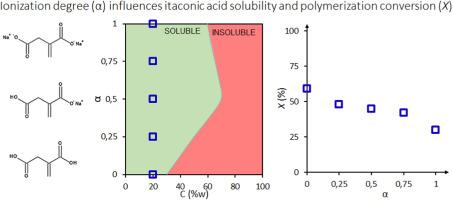
Itaconic acid (ITA) is a promising renewable chemical building block. Previous research on its radical homo-polymerization in aqueous media has shown slow kinetics, low conversion, and low molecular weight polymers. In this paper, we demonstrate the impact of the intrinsic properties of itaconic acid on its polymerization conditions. Specifically, the role of the degree of ionization (α) on its structure, solubility, and reactivity towards radical polymerization in water was investigated. The results indicate that the highest solubility in water occurs when itaconic acid is half-deprotonated. At a given concentration, the reaction rate and final molecular weight decrease as the degree of ionization increases, presumably due to electrostatic effects and hydrophobic/hydrophilic variations. Despite lower reactivity, full conversion can be achieved in a relatively short time with the half-deprotonated form of itaconic acid, because the polymerization can be achieved at higher monomer concentrations. These experimental findings are further supported by computational simulations of the monomer's structure and reactivity.
期刊介绍:
Polymer is an interdisciplinary journal dedicated to publishing innovative and significant advances in Polymer Physics, Chemistry and Technology. We welcome submissions on polymer hybrids, nanocomposites, characterisation and self-assembly. Polymer also publishes work on the technological application of polymers in energy and optoelectronics.
The main scope is covered but not limited to the following core areas:
Polymer Materials
Nanocomposites and hybrid nanomaterials
Polymer blends, films, fibres, networks and porous materials
Physical Characterization
Characterisation, modelling and simulation* of molecular and materials properties in bulk, solution, and thin films
Polymer Engineering
Advanced multiscale processing methods
Polymer Synthesis, Modification and Self-assembly
Including designer polymer architectures, mechanisms and kinetics, and supramolecular polymerization
Technological Applications
Polymers for energy generation and storage
Polymer membranes for separation technology
Polymers for opto- and microelectronics.





 京公网安备 11010802042870号
京ICP备2023020795号-1
京公网安备 11010802042870号
京ICP备2023020795号-1

 分享
分享
 求助内容:
求助内容: 应助结果提醒方式:
 扫码关注我们
