Guoquan Chen, Yan Chen, Jingqi Gong, Jiangyu Zhu, Yaxiong Tian, Yuanli Liu
{"title":"热熔胶用生物基聚酰胺的合成:利用可再生二聚酸和 1,5-戊二胺单体","authors":"Guoquan Chen, Yan Chen, Jingqi Gong, Jiangyu Zhu, Yaxiong Tian, Yuanli Liu","doi":"10.1016/j.polymer.2025.128368","DOIUrl":null,"url":null,"abstract":"<div><div>Biobased polyamides (BPAs) are increasingly attractive alternatives to conventional petroleum-derived polymers, owing to their bio-renewable and environmentally friendly. Nonetheless, their practical applications are severely restricted by excessive prices, limited scalability, and poor mechanical-thermal properties. Herein, a series of copolyamides (COPAs) were successfully synthesized by the one-pot polycondensation using sebacic acid<strong>-</strong>1,10-decane-diamine salt, biobased dimer acid, and biobased 1,5-pentanediamine monomers as raw materials. The thermal analysis revealed that the COPAs exhibited high thermal stability and suitable melting points with a Tm of 71–152 °C. The processing properties and strong tensile strength were enhanced up to 24 MPa. Thus, as hot melt adhesives, the COPA30 demonstrated an adhesion strength of 8.28 MPa, making them suitable for various substrates such as aluminum, wood and iron. Notably, the COPA50 only slightly swelled after being immersed in organic solutions at room temperature for 30 days, which exhibited a remarkable chemical resistance. This study presents a viable approach for developing BPA as hot melt adhesives with desirable performance, which future foster applications in a range of areas.</div></div>","PeriodicalId":405,"journal":{"name":"Polymer","volume":"327 ","pages":"Article 128368"},"PeriodicalIF":4.5000,"publicationDate":"2025-05-16","publicationTypes":"Journal Article","fieldsOfStudy":null,"isOpenAccess":false,"openAccessPdf":"","citationCount":"0","resultStr":"{\"title\":\"Synthesis of biobased polyamides for hot melt adhesives: Utilizing renewable dimer acids and 1,5-pentanediamine monomers\",\"authors\":\"Guoquan Chen, Yan Chen, Jingqi Gong, Jiangyu Zhu, Yaxiong Tian, Yuanli Liu\",\"doi\":\"10.1016/j.polymer.2025.128368\",\"DOIUrl\":null,\"url\":null,\"abstract\":\"<div><div>Biobased polyamides (BPAs) are increasingly attractive alternatives to conventional petroleum-derived polymers, owing to their bio-renewable and environmentally friendly. Nonetheless, their practical applications are severely restricted by excessive prices, limited scalability, and poor mechanical-thermal properties. Herein, a series of copolyamides (COPAs) were successfully synthesized by the one-pot polycondensation using sebacic acid<strong>-</strong>1,10-decane-diamine salt, biobased dimer acid, and biobased 1,5-pentanediamine monomers as raw materials. The thermal analysis revealed that the COPAs exhibited high thermal stability and suitable melting points with a Tm of 71–152 °C. The processing properties and strong tensile strength were enhanced up to 24 MPa. Thus, as hot melt adhesives, the COPA30 demonstrated an adhesion strength of 8.28 MPa, making them suitable for various substrates such as aluminum, wood and iron. Notably, the COPA50 only slightly swelled after being immersed in organic solutions at room temperature for 30 days, which exhibited a remarkable chemical resistance. This study presents a viable approach for developing BPA as hot melt adhesives with desirable performance, which future foster applications in a range of areas.</div></div>\",\"PeriodicalId\":405,\"journal\":{\"name\":\"Polymer\",\"volume\":\"327 \",\"pages\":\"Article 128368\"},\"PeriodicalIF\":4.5000,\"publicationDate\":\"2025-05-16\",\"publicationTypes\":\"Journal Article\",\"fieldsOfStudy\":null,\"isOpenAccess\":false,\"openAccessPdf\":\"\",\"citationCount\":\"0\",\"resultStr\":null,\"platform\":\"Semanticscholar\",\"paperid\":null,\"PeriodicalName\":\"Polymer\",\"FirstCategoryId\":\"92\",\"ListUrlMain\":\"https://www.sciencedirect.com/science/article/pii/S0032386125003544\",\"RegionNum\":2,\"RegionCategory\":\"化学\",\"ArticlePicture\":[],\"TitleCN\":null,\"AbstractTextCN\":null,\"PMCID\":null,\"EPubDate\":\"2025/4/7 0:00:00\",\"PubModel\":\"Epub\",\"JCR\":\"Q2\",\"JCRName\":\"POLYMER SCIENCE\",\"Score\":null,\"Total\":0}","platform":"Semanticscholar","paperid":null,"PeriodicalName":"Polymer","FirstCategoryId":"92","ListUrlMain":"https://www.sciencedirect.com/science/article/pii/S0032386125003544","RegionNum":2,"RegionCategory":"化学","ArticlePicture":[],"TitleCN":null,"AbstractTextCN":null,"PMCID":null,"EPubDate":"2025/4/7 0:00:00","PubModel":"Epub","JCR":"Q2","JCRName":"POLYMER SCIENCE","Score":null,"Total":0}
Synthesis of biobased polyamides for hot melt adhesives: Utilizing renewable dimer acids and 1,5-pentanediamine monomers
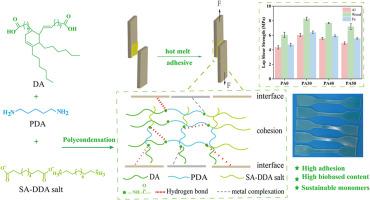
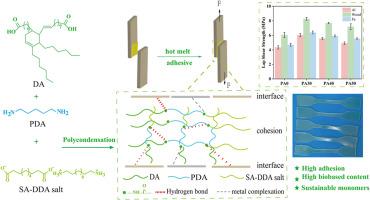
Biobased polyamides (BPAs) are increasingly attractive alternatives to conventional petroleum-derived polymers, owing to their bio-renewable and environmentally friendly. Nonetheless, their practical applications are severely restricted by excessive prices, limited scalability, and poor mechanical-thermal properties. Herein, a series of copolyamides (COPAs) were successfully synthesized by the one-pot polycondensation using sebacic acid-1,10-decane-diamine salt, biobased dimer acid, and biobased 1,5-pentanediamine monomers as raw materials. The thermal analysis revealed that the COPAs exhibited high thermal stability and suitable melting points with a Tm of 71–152 °C. The processing properties and strong tensile strength were enhanced up to 24 MPa. Thus, as hot melt adhesives, the COPA30 demonstrated an adhesion strength of 8.28 MPa, making them suitable for various substrates such as aluminum, wood and iron. Notably, the COPA50 only slightly swelled after being immersed in organic solutions at room temperature for 30 days, which exhibited a remarkable chemical resistance. This study presents a viable approach for developing BPA as hot melt adhesives with desirable performance, which future foster applications in a range of areas.
期刊介绍:
Polymer is an interdisciplinary journal dedicated to publishing innovative and significant advances in Polymer Physics, Chemistry and Technology. We welcome submissions on polymer hybrids, nanocomposites, characterisation and self-assembly. Polymer also publishes work on the technological application of polymers in energy and optoelectronics.
The main scope is covered but not limited to the following core areas:
Polymer Materials
Nanocomposites and hybrid nanomaterials
Polymer blends, films, fibres, networks and porous materials
Physical Characterization
Characterisation, modelling and simulation* of molecular and materials properties in bulk, solution, and thin films
Polymer Engineering
Advanced multiscale processing methods
Polymer Synthesis, Modification and Self-assembly
Including designer polymer architectures, mechanisms and kinetics, and supramolecular polymerization
Technological Applications
Polymers for energy generation and storage
Polymer membranes for separation technology
Polymers for opto- and microelectronics.




 京公网安备 11010802042870号
京ICP备2023020795号-1
京公网安备 11010802042870号
京ICP备2023020795号-1

 分享
分享
 求助内容:
求助内容: 应助结果提醒方式:
 扫码关注我们
