{"title":"用掺硼金刚石微电极实时监测滴眼液浓度及其与药物疗效的相关性","authors":"Risa Ogawa, Genki Ogata, Reiko Yamagishi, Megumi Honjo, Makoto Aihara and Yasuaki Einaga*, ","doi":"10.1021/acssensors.5c00220","DOIUrl":null,"url":null,"abstract":"<p >The corneal permeability of an eye drop is crucial in drug delivery into the eye, but our understanding of drug migration through the cornea and drug distribution within the anterior chamber still requires improvement. To this end, we developed an electrochemical method using boron-doped diamond (BDD) to monitor real-time changes in the drug concentration in the anterior chamber. A needle-shaped BDD microelectrode, with a respective length and tip diameter of ∼200 and ∼40 μm, was used in the in vivo detection of brimonidine tartrate (BRM), which is a widely used antiglaucoma drug. We inserted the tip of the electrode into the right cornea of an anesthetized mouse. BRM was then administered to the right eye, resulting in the successful real-time monitoring of the changes in current. The recorded current reflected the combined reduction of BRM and dissolved oxygen within the anterior chamber. Based on the subtraction of the contribution of the oxygen, the BRM-specific reduction current increased immediately after administration, corresponding to 4.1 μM. Validation via liquid chromatography-tandem mass spectrometry confirmed the accuracy of this approach. Notably, the pharmacological effect of BRM, i.e., a reduced intraocular pressure, was observed 30 min after administration, lagging behind drug migration. These findings may provide valuable insights into the ocular pharmacokinetics of novel drugs and facilitate the development of more effective therapeutic approaches.</p>","PeriodicalId":24,"journal":{"name":"ACS Sensors","volume":"10 6","pages":"4145–4152"},"PeriodicalIF":10.9000,"publicationDate":"2025-04-07","publicationTypes":"Journal Article","fieldsOfStudy":null,"isOpenAccess":false,"openAccessPdf":"","citationCount":"0","resultStr":"{\"title\":\"Real-Time In Vivo Monitoring of Eye Drop Concentration Using Boron-Doped Diamond Microelectrodes and Its Relevance to Drug Efficacy\",\"authors\":\"Risa Ogawa, Genki Ogata, Reiko Yamagishi, Megumi Honjo, Makoto Aihara and Yasuaki Einaga*, \",\"doi\":\"10.1021/acssensors.5c00220\",\"DOIUrl\":null,\"url\":null,\"abstract\":\"<p >The corneal permeability of an eye drop is crucial in drug delivery into the eye, but our understanding of drug migration through the cornea and drug distribution within the anterior chamber still requires improvement. To this end, we developed an electrochemical method using boron-doped diamond (BDD) to monitor real-time changes in the drug concentration in the anterior chamber. A needle-shaped BDD microelectrode, with a respective length and tip diameter of ∼200 and ∼40 μm, was used in the in vivo detection of brimonidine tartrate (BRM), which is a widely used antiglaucoma drug. We inserted the tip of the electrode into the right cornea of an anesthetized mouse. BRM was then administered to the right eye, resulting in the successful real-time monitoring of the changes in current. The recorded current reflected the combined reduction of BRM and dissolved oxygen within the anterior chamber. Based on the subtraction of the contribution of the oxygen, the BRM-specific reduction current increased immediately after administration, corresponding to 4.1 μM. Validation via liquid chromatography-tandem mass spectrometry confirmed the accuracy of this approach. Notably, the pharmacological effect of BRM, i.e., a reduced intraocular pressure, was observed 30 min after administration, lagging behind drug migration. These findings may provide valuable insights into the ocular pharmacokinetics of novel drugs and facilitate the development of more effective therapeutic approaches.</p>\",\"PeriodicalId\":24,\"journal\":{\"name\":\"ACS Sensors\",\"volume\":\"10 6\",\"pages\":\"4145–4152\"},\"PeriodicalIF\":10.9000,\"publicationDate\":\"2025-04-07\",\"publicationTypes\":\"Journal Article\",\"fieldsOfStudy\":null,\"isOpenAccess\":false,\"openAccessPdf\":\"\",\"citationCount\":\"0\",\"resultStr\":null,\"platform\":\"Semanticscholar\",\"paperid\":null,\"PeriodicalName\":\"ACS Sensors\",\"FirstCategoryId\":\"92\",\"ListUrlMain\":\"https://pubs.acs.org/doi/10.1021/acssensors.5c00220\",\"RegionNum\":1,\"RegionCategory\":\"化学\",\"ArticlePicture\":[],\"TitleCN\":null,\"AbstractTextCN\":null,\"PMCID\":null,\"EPubDate\":\"\",\"PubModel\":\"\",\"JCR\":\"Q1\",\"JCRName\":\"CHEMISTRY, ANALYTICAL\",\"Score\":null,\"Total\":0}","platform":"Semanticscholar","paperid":null,"PeriodicalName":"ACS Sensors","FirstCategoryId":"92","ListUrlMain":"https://pubs.acs.org/doi/10.1021/acssensors.5c00220","RegionNum":1,"RegionCategory":"化学","ArticlePicture":[],"TitleCN":null,"AbstractTextCN":null,"PMCID":null,"EPubDate":"","PubModel":"","JCR":"Q1","JCRName":"CHEMISTRY, ANALYTICAL","Score":null,"Total":0}
Real-Time In Vivo Monitoring of Eye Drop Concentration Using Boron-Doped Diamond Microelectrodes and Its Relevance to Drug Efficacy
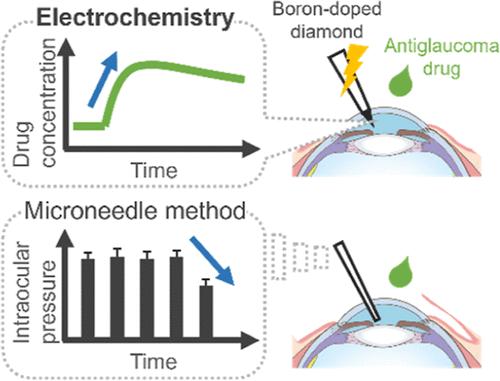
The corneal permeability of an eye drop is crucial in drug delivery into the eye, but our understanding of drug migration through the cornea and drug distribution within the anterior chamber still requires improvement. To this end, we developed an electrochemical method using boron-doped diamond (BDD) to monitor real-time changes in the drug concentration in the anterior chamber. A needle-shaped BDD microelectrode, with a respective length and tip diameter of ∼200 and ∼40 μm, was used in the in vivo detection of brimonidine tartrate (BRM), which is a widely used antiglaucoma drug. We inserted the tip of the electrode into the right cornea of an anesthetized mouse. BRM was then administered to the right eye, resulting in the successful real-time monitoring of the changes in current. The recorded current reflected the combined reduction of BRM and dissolved oxygen within the anterior chamber. Based on the subtraction of the contribution of the oxygen, the BRM-specific reduction current increased immediately after administration, corresponding to 4.1 μM. Validation via liquid chromatography-tandem mass spectrometry confirmed the accuracy of this approach. Notably, the pharmacological effect of BRM, i.e., a reduced intraocular pressure, was observed 30 min after administration, lagging behind drug migration. These findings may provide valuable insights into the ocular pharmacokinetics of novel drugs and facilitate the development of more effective therapeutic approaches.
期刊介绍:
ACS Sensors is a peer-reviewed research journal that focuses on the dissemination of new and original knowledge in the field of sensor science, particularly those that selectively sense chemical or biological species or processes. The journal covers a broad range of topics, including but not limited to biosensors, chemical sensors, gas sensors, intracellular sensors, single molecule sensors, cell chips, and microfluidic devices. It aims to publish articles that address conceptual advances in sensing technology applicable to various types of analytes or application papers that report on the use of existing sensing concepts in new ways or for new analytes.





 京公网安备 11010802042870号
京ICP备2023020795号-1
京公网安备 11010802042870号
京ICP备2023020795号-1

 分享
分享
 求助内容:
求助内容: 应助结果提醒方式:
 扫码关注我们
