Mao Chen , Guosong Ni , Sherif A. El-Khodary , Qianqian Liu , Shan Zhong , Bin Cao , Shuang Wang , Chuan Yuan
{"title":"从生物油中提取的纳米花多孔碳,通过热塑性温度控制增强了超级电容器","authors":"Mao Chen , Guosong Ni , Sherif A. El-Khodary , Qianqian Liu , Shan Zhong , Bin Cao , Shuang Wang , Chuan Yuan","doi":"10.1016/j.biombioe.2025.107883","DOIUrl":null,"url":null,"abstract":"<div><div>The utilization of biomass resources in the development of carbon-based supercapacitor electrode materials shows considerable promise as an effective energy storage system. In this regard, the elevated carbon content and favorable thermoplasticity of bio-oils facilitate its utilization as a precursor for the manufacture of carbon electrode materials for supercapacitors. Herein, a flower-like hierarchical porous carbon was prepared <em>via</em> the chemical carbonization activation of heavy bio-oils derived from rice husk along with alkali magnesium carbonate (Mg(OH)<sub>2</sub>•4MgCO<sub>3</sub>•xH<sub>2</sub>O), and potassium oxalate (K<sub>2</sub>C<sub>2</sub>O<sub>4</sub>) as a hard template and chemical activator, respectively. The temperature-controlled synthesis of flower-like carbon materials (RK<sub>1</sub>M<sub>3</sub>C-800) with a maximum specific surface area of 1806.87 m<sup>2</sup> g<sup>−1</sup> was achieved with suitable additive ratios. When employed as a supercapacitor electrode, the RK<sub>1</sub>M<sub>3</sub>C-800 sample exhibited a specific capacitance of 248 F g<sup>−1</sup> in a three-electrode system (measured at 0.5 A g<sup>−1</sup>). Further application to symmetric capacitors demonstrated a high energy density of 8.75 Wh kg<sup>−1</sup> in 6 M KOH electrolyte, corresponding to a power density of 142.33 W kg<sup>−1</sup>. Additionally, excellent cycling stability was observed in 0.5 M Na<sub>2</sub>SO<sub>4</sub> electrolyte. This research contributes to the development of a theoretical framework for the high-value utilization of heavy bio-oils, and represents a crucial step in the advancement of green energy storage technologies.</div></div>","PeriodicalId":253,"journal":{"name":"Biomass & Bioenergy","volume":"198 ","pages":"Article 107883"},"PeriodicalIF":7.0000,"publicationDate":"2025-07-01","publicationTypes":"Journal Article","fieldsOfStudy":null,"isOpenAccess":false,"openAccessPdf":"","citationCount":"0","resultStr":"{\"title\":\"Nanoflower porous carbon derived from bio-oils with enhanced supercapacitors by thermoplastic temperature control\",\"authors\":\"Mao Chen , Guosong Ni , Sherif A. El-Khodary , Qianqian Liu , Shan Zhong , Bin Cao , Shuang Wang , Chuan Yuan\",\"doi\":\"10.1016/j.biombioe.2025.107883\",\"DOIUrl\":null,\"url\":null,\"abstract\":\"<div><div>The utilization of biomass resources in the development of carbon-based supercapacitor electrode materials shows considerable promise as an effective energy storage system. In this regard, the elevated carbon content and favorable thermoplasticity of bio-oils facilitate its utilization as a precursor for the manufacture of carbon electrode materials for supercapacitors. Herein, a flower-like hierarchical porous carbon was prepared <em>via</em> the chemical carbonization activation of heavy bio-oils derived from rice husk along with alkali magnesium carbonate (Mg(OH)<sub>2</sub>•4MgCO<sub>3</sub>•xH<sub>2</sub>O), and potassium oxalate (K<sub>2</sub>C<sub>2</sub>O<sub>4</sub>) as a hard template and chemical activator, respectively. The temperature-controlled synthesis of flower-like carbon materials (RK<sub>1</sub>M<sub>3</sub>C-800) with a maximum specific surface area of 1806.87 m<sup>2</sup> g<sup>−1</sup> was achieved with suitable additive ratios. When employed as a supercapacitor electrode, the RK<sub>1</sub>M<sub>3</sub>C-800 sample exhibited a specific capacitance of 248 F g<sup>−1</sup> in a three-electrode system (measured at 0.5 A g<sup>−1</sup>). Further application to symmetric capacitors demonstrated a high energy density of 8.75 Wh kg<sup>−1</sup> in 6 M KOH electrolyte, corresponding to a power density of 142.33 W kg<sup>−1</sup>. Additionally, excellent cycling stability was observed in 0.5 M Na<sub>2</sub>SO<sub>4</sub> electrolyte. This research contributes to the development of a theoretical framework for the high-value utilization of heavy bio-oils, and represents a crucial step in the advancement of green energy storage technologies.</div></div>\",\"PeriodicalId\":253,\"journal\":{\"name\":\"Biomass & Bioenergy\",\"volume\":\"198 \",\"pages\":\"Article 107883\"},\"PeriodicalIF\":7.0000,\"publicationDate\":\"2025-07-01\",\"publicationTypes\":\"Journal Article\",\"fieldsOfStudy\":null,\"isOpenAccess\":false,\"openAccessPdf\":\"\",\"citationCount\":\"0\",\"resultStr\":null,\"platform\":\"Semanticscholar\",\"paperid\":null,\"PeriodicalName\":\"Biomass & Bioenergy\",\"FirstCategoryId\":\"5\",\"ListUrlMain\":\"https://www.sciencedirect.com/science/article/pii/S0961953425002946\",\"RegionNum\":2,\"RegionCategory\":\"生物学\",\"ArticlePicture\":[],\"TitleCN\":null,\"AbstractTextCN\":null,\"PMCID\":null,\"EPubDate\":\"2025/4/9 0:00:00\",\"PubModel\":\"Epub\",\"JCR\":\"Q1\",\"JCRName\":\"AGRICULTURAL ENGINEERING\",\"Score\":null,\"Total\":0}","platform":"Semanticscholar","paperid":null,"PeriodicalName":"Biomass & Bioenergy","FirstCategoryId":"5","ListUrlMain":"https://www.sciencedirect.com/science/article/pii/S0961953425002946","RegionNum":2,"RegionCategory":"生物学","ArticlePicture":[],"TitleCN":null,"AbstractTextCN":null,"PMCID":null,"EPubDate":"2025/4/9 0:00:00","PubModel":"Epub","JCR":"Q1","JCRName":"AGRICULTURAL ENGINEERING","Score":null,"Total":0}
引用次数: 0
摘要
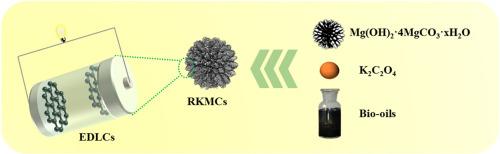
利用生物质资源开发碳基超级电容器电极材料是一种有效的储能系统,具有广阔的应用前景。在这方面,生物油的高碳含量和良好的热塑性促进了其作为制造超级电容器碳电极材料的前体的利用。本文以稻壳重质生物油为原料,以碱碳酸镁(Mg(OH)2•4MgCO3•xH2O)和草酸钾(K2C2O4)分别作为硬模板和化学活化剂,通过化学碳化活化制备了花状分层多孔碳。在合适的添加剂配比下,温度控制合成了最大比表面积为1806.87 m2 g−1的花状碳材料(rk1m3c800)。当用作超级电容器电极时,RK1M3C-800样品在三电极系统中显示出248 F g−1的比电容(在0.5 a g−1下测量)。进一步应用于对称电容器表明,在6 M KOH电解液中,能量密度高达8.75 Wh kg - 1,对应的功率密度为142.33 W kg - 1。此外,在0.5 M Na2SO4电解质中,还观察到良好的循环稳定性。该研究为重质生物油的高价值利用提供了理论框架,代表了绿色储能技术进步的关键一步。
Nanoflower porous carbon derived from bio-oils with enhanced supercapacitors by thermoplastic temperature control
The utilization of biomass resources in the development of carbon-based supercapacitor electrode materials shows considerable promise as an effective energy storage system. In this regard, the elevated carbon content and favorable thermoplasticity of bio-oils facilitate its utilization as a precursor for the manufacture of carbon electrode materials for supercapacitors. Herein, a flower-like hierarchical porous carbon was prepared via the chemical carbonization activation of heavy bio-oils derived from rice husk along with alkali magnesium carbonate (Mg(OH)2•4MgCO3•xH2O), and potassium oxalate (K2C2O4) as a hard template and chemical activator, respectively. The temperature-controlled synthesis of flower-like carbon materials (RK1M3C-800) with a maximum specific surface area of 1806.87 m2 g−1 was achieved with suitable additive ratios. When employed as a supercapacitor electrode, the RK1M3C-800 sample exhibited a specific capacitance of 248 F g−1 in a three-electrode system (measured at 0.5 A g−1). Further application to symmetric capacitors demonstrated a high energy density of 8.75 Wh kg−1 in 6 M KOH electrolyte, corresponding to a power density of 142.33 W kg−1. Additionally, excellent cycling stability was observed in 0.5 M Na2SO4 electrolyte. This research contributes to the development of a theoretical framework for the high-value utilization of heavy bio-oils, and represents a crucial step in the advancement of green energy storage technologies.
期刊介绍:
Biomass & Bioenergy is an international journal publishing original research papers and short communications, review articles and case studies on biological resources, chemical and biological processes, and biomass products for new renewable sources of energy and materials.
The scope of the journal extends to the environmental, management and economic aspects of biomass and bioenergy.
Key areas covered by the journal:
• Biomass: sources, energy crop production processes, genetic improvements, composition. Please note that research on these biomass subjects must be linked directly to bioenergy generation.
• Biological Residues: residues/rests from agricultural production, forestry and plantations (palm, sugar etc), processing industries, and municipal sources (MSW). Papers on the use of biomass residues through innovative processes/technological novelty and/or consideration of feedstock/system sustainability (or unsustainability) are welcomed. However waste treatment processes and pollution control or mitigation which are only tangentially related to bioenergy are not in the scope of the journal, as they are more suited to publications in the environmental arena. Papers that describe conventional waste streams (ie well described in existing literature) that do not empirically address ''new'' added value from the process are not suitable for submission to the journal.
• Bioenergy Processes: fermentations, thermochemical conversions, liquid and gaseous fuels, and petrochemical substitutes
• Bioenergy Utilization: direct combustion, gasification, electricity production, chemical processes, and by-product remediation
• Biomass and the Environment: carbon cycle, the net energy efficiency of bioenergy systems, assessment of sustainability, and biodiversity issues.




 京公网安备 11010802042870号
京ICP备2023020795号-1
京公网安备 11010802042870号
京ICP备2023020795号-1

 分享
分享
 求助内容:
求助内容: 应助结果提醒方式:
 扫码关注我们
