Kentaro Shoji, Yui Kitajima, Tomonori Yuasa and Yoshiko Hirakawa
{"title":"膳食发酵蓝莓叶茶对睡眠的影响:一项随机双盲对照试验。","authors":"Kentaro Shoji, Yui Kitajima, Tomonori Yuasa and Yoshiko Hirakawa","doi":"10.1039/D4FO05341A","DOIUrl":null,"url":null,"abstract":"<p >This study investigated the effects of dietary fermented blueberry leaf tea on sleep quality through a 3-week double-blind randomized controlled trial. Fifty healthy individuals (BMI: 22.3 ± 0.6 kg m<small><sup>−2</sup></small>), aged 20–69 years, were randomly assigned to either an active group consuming the fermented blueberry leaf tea or a placebo group. They consumed 200 mL of active tea (1.8 mg hyperoside/serving) or placebo tea three times daily. Sleep quality was assessed using both objective and subjective measures <em>via</em> actigraphy and the Oguri–Shirakawa–Azumi Sleep Inventory MA (OSA-MA) version questionnaire, respectively. We observed significantly higher sleep efficiency (active: from 82.2 ± 1.4% to 81.2 ± 1.6%, placebo: from 83.8 ± 1.6% to 80.4 ± 1.8%) and lower wake after sleep onset (WASO) (active: from 68.9 ± 6.6 min to 70.5 ± 6.8 min, placebo: from 61.9 ± 6.9 min to 77.9 ± 8.6 min) in the active group compared to the placebo group. Specifically, the active group exhibited higher sleep efficiency after 3 weeks and reduced WASO after 2 weeks of active tea consumption. Subjective evaluations indicated significant improvements in sleep onset and maintenance as early as one week, correlating with the objective sleep efficiency measures. On the other hand, no significant differences were observed in other parameters of actigraphy or OSA-MA. These findings suggest that hyperoside, a quercetin glycoside found in blueberry leaves, may positively influence sleep quality by increasing serotonin and melatonin levels, thereby enhancing non-rapid eye movement sleep. Regular consumption of dietary fermented blueberry leaf tea may improve daily sleep quality, leading to a better overall quality of life.</p>","PeriodicalId":77,"journal":{"name":"Food & Function","volume":" 9","pages":" 3400-3407"},"PeriodicalIF":5.4000,"publicationDate":"2025-04-08","publicationTypes":"Journal Article","fieldsOfStudy":null,"isOpenAccess":false,"openAccessPdf":"","citationCount":"0","resultStr":"{\"title\":\"Effects of dietary fermented blueberry leaf tea on sleep: a randomized double-blind controlled trial\",\"authors\":\"Kentaro Shoji, Yui Kitajima, Tomonori Yuasa and Yoshiko Hirakawa\",\"doi\":\"10.1039/D4FO05341A\",\"DOIUrl\":null,\"url\":null,\"abstract\":\"<p >This study investigated the effects of dietary fermented blueberry leaf tea on sleep quality through a 3-week double-blind randomized controlled trial. Fifty healthy individuals (BMI: 22.3 ± 0.6 kg m<small><sup>−2</sup></small>), aged 20–69 years, were randomly assigned to either an active group consuming the fermented blueberry leaf tea or a placebo group. They consumed 200 mL of active tea (1.8 mg hyperoside/serving) or placebo tea three times daily. Sleep quality was assessed using both objective and subjective measures <em>via</em> actigraphy and the Oguri–Shirakawa–Azumi Sleep Inventory MA (OSA-MA) version questionnaire, respectively. We observed significantly higher sleep efficiency (active: from 82.2 ± 1.4% to 81.2 ± 1.6%, placebo: from 83.8 ± 1.6% to 80.4 ± 1.8%) and lower wake after sleep onset (WASO) (active: from 68.9 ± 6.6 min to 70.5 ± 6.8 min, placebo: from 61.9 ± 6.9 min to 77.9 ± 8.6 min) in the active group compared to the placebo group. Specifically, the active group exhibited higher sleep efficiency after 3 weeks and reduced WASO after 2 weeks of active tea consumption. Subjective evaluations indicated significant improvements in sleep onset and maintenance as early as one week, correlating with the objective sleep efficiency measures. On the other hand, no significant differences were observed in other parameters of actigraphy or OSA-MA. These findings suggest that hyperoside, a quercetin glycoside found in blueberry leaves, may positively influence sleep quality by increasing serotonin and melatonin levels, thereby enhancing non-rapid eye movement sleep. Regular consumption of dietary fermented blueberry leaf tea may improve daily sleep quality, leading to a better overall quality of life.</p>\",\"PeriodicalId\":77,\"journal\":{\"name\":\"Food & Function\",\"volume\":\" 9\",\"pages\":\" 3400-3407\"},\"PeriodicalIF\":5.4000,\"publicationDate\":\"2025-04-08\",\"publicationTypes\":\"Journal Article\",\"fieldsOfStudy\":null,\"isOpenAccess\":false,\"openAccessPdf\":\"\",\"citationCount\":\"0\",\"resultStr\":null,\"platform\":\"Semanticscholar\",\"paperid\":null,\"PeriodicalName\":\"Food & Function\",\"FirstCategoryId\":\"97\",\"ListUrlMain\":\"https://pubs.rsc.org/en/content/articlelanding/2025/fo/d4fo05341a\",\"RegionNum\":1,\"RegionCategory\":\"农林科学\",\"ArticlePicture\":[],\"TitleCN\":null,\"AbstractTextCN\":null,\"PMCID\":null,\"EPubDate\":\"\",\"PubModel\":\"\",\"JCR\":\"Q1\",\"JCRName\":\"BIOCHEMISTRY & MOLECULAR BIOLOGY\",\"Score\":null,\"Total\":0}","platform":"Semanticscholar","paperid":null,"PeriodicalName":"Food & Function","FirstCategoryId":"97","ListUrlMain":"https://pubs.rsc.org/en/content/articlelanding/2025/fo/d4fo05341a","RegionNum":1,"RegionCategory":"农林科学","ArticlePicture":[],"TitleCN":null,"AbstractTextCN":null,"PMCID":null,"EPubDate":"","PubModel":"","JCR":"Q1","JCRName":"BIOCHEMISTRY & MOLECULAR BIOLOGY","Score":null,"Total":0}
引用次数: 0
摘要
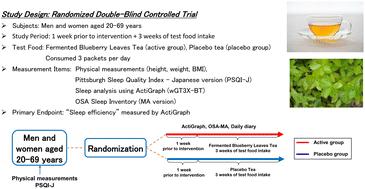
本研究通过为期3周的双盲随机对照试验,探讨了膳食发酵蓝莓叶茶对睡眠质量的影响。50名年龄在20-69岁的健康个体(BMI: 22.3±0.6 kg m-2)被随机分配到饮用发酵蓝莓叶茶的活跃组和安慰剂组。他们每天三次饮用200毫升活性茶(1.8毫克金丝桃苷/份)或安慰剂茶。通过活动记录仪和Oguri-Shirakawa-Azumi睡眠量表(OSA-MA)对睡眠质量进行客观和主观测量。我们观察到,与安慰剂组相比,活动组的睡眠效率显著提高(活跃度从82.2±1.4%提高到81.2±1.6%,安慰剂组从83.8±1.6%提高到80.4±1.8%),睡眠后觉醒(WASO)(活跃度从68.9±6.6分钟降低到70.5±6.8分钟,安慰剂组从61.9±6.9分钟降低到77.9±8.6分钟)。具体来说,积极饮茶组在3周后表现出更高的睡眠效率,在2周后减少了WASO。主观评估表明,早在一周内,睡眠开始和维持就有了显著改善,这与客观的睡眠效率测量相关联。另一方面,两组在其他活动描记和OSA-MA参数上无显著差异。这些发现表明,在蓝莓叶子中发现的一种槲皮素苷,金丝桃苷可能通过增加血清素和褪黑素水平,从而改善非快速眼动睡眠,对睡眠质量产生积极影响。经常食用发酵蓝莓叶茶可以改善每天的睡眠质量,从而提高整体生活质量。
Effects of dietary fermented blueberry leaf tea on sleep: a randomized double-blind controlled trial
This study investigated the effects of dietary fermented blueberry leaf tea on sleep quality through a 3-week double-blind randomized controlled trial. Fifty healthy individuals (BMI: 22.3 ± 0.6 kg m−2), aged 20–69 years, were randomly assigned to either an active group consuming the fermented blueberry leaf tea or a placebo group. They consumed 200 mL of active tea (1.8 mg hyperoside/serving) or placebo tea three times daily. Sleep quality was assessed using both objective and subjective measures via actigraphy and the Oguri–Shirakawa–Azumi Sleep Inventory MA (OSA-MA) version questionnaire, respectively. We observed significantly higher sleep efficiency (active: from 82.2 ± 1.4% to 81.2 ± 1.6%, placebo: from 83.8 ± 1.6% to 80.4 ± 1.8%) and lower wake after sleep onset (WASO) (active: from 68.9 ± 6.6 min to 70.5 ± 6.8 min, placebo: from 61.9 ± 6.9 min to 77.9 ± 8.6 min) in the active group compared to the placebo group. Specifically, the active group exhibited higher sleep efficiency after 3 weeks and reduced WASO after 2 weeks of active tea consumption. Subjective evaluations indicated significant improvements in sleep onset and maintenance as early as one week, correlating with the objective sleep efficiency measures. On the other hand, no significant differences were observed in other parameters of actigraphy or OSA-MA. These findings suggest that hyperoside, a quercetin glycoside found in blueberry leaves, may positively influence sleep quality by increasing serotonin and melatonin levels, thereby enhancing non-rapid eye movement sleep. Regular consumption of dietary fermented blueberry leaf tea may improve daily sleep quality, leading to a better overall quality of life.
期刊介绍:
Food & Function provides a unique venue for physicists, chemists, biochemists, nutritionists and other food scientists to publish work at the interface of the chemistry, physics and biology of food. The journal focuses on food and the functions of food in relation to health.




 京公网安备 11010802042870号
京ICP备2023020795号-1
京公网安备 11010802042870号
京ICP备2023020795号-1

 分享
分享
 求助内容:
求助内容: 应助结果提醒方式:
 扫码关注我们
