Chao Deng, Zui Chen, Jie Ling, Yangchun Xie, Xiayan Zhao, Chunhong Hu, Xianling Liu, Yuhua Feng, Tao Hou
{"title":"预处理外周血hemoglobin×lymphocyte/单核细胞比值对鼻咽癌患者预后的价值。","authors":"Chao Deng, Zui Chen, Jie Ling, Yangchun Xie, Xiayan Zhao, Chunhong Hu, Xianling Liu, Yuhua Feng, Tao Hou","doi":"10.11817/j.issn.1672-7347.2024.240194","DOIUrl":null,"url":null,"abstract":"<p><strong>Objectives: </strong>Peripheral whole blood cell counts have been used as prognostic indicators for various cancers, but their predictive value in nasopharyngeal carcinoma remain unclear. This study aims to evaluate the prognostic significance of the pretreatment hemoglobin×lymphocyte/monocyte ratio (HLMR) in non-recurrent, non-metastatic NPC patients undergoing definitive radiotherapy.</p><p><strong>Methods: </strong>Clinical and follow-up data from 805 NPC patients who completed definitive radiotherapy or chemoradiotherapy were retrospectively analyzed. Pretreatment hemoglobin, lymphocyte count, and monocyte count were collected to calculate HLMR. Receiver operating characteristic (ROC) curves were used to determine the optimal cut-off value of HLMR. Patients were then classified into high and low HLMR groups. The association between HLMR and clinicopathological characteristic was assessed using chi-square tests. Independent prognostic factors for overall survival (OS) and progression-free survival (PFS) were identified using Cox proportional hazards models. A nomogram was constructed based on the independent predictors to estimate patient survival rates, and internal validation was performed using a validation cohort.</p><p><strong>Results: </strong>The ROC curve identified 605.5 as the optimal HLMR cut-off value for predicting 5-year survival. Multivariate Cox regression analysis revealed that T stage (<i>HR</i>=1.886, 95% <i>CI</i> 1.331 to 2.673, <i>P</i><0.001), N stage (<i>HR</i>=2.021, 95% <i>CI</i> 1.267 to 3.225, <i>P</i>=0.003), Eastern Cooperative Oncology Group (ECOG) score (<i>HR</i>=3.991, 95% <i>CI</i> 1.257 to 12.677, <i>P</i>=0.019), concurrent chemoradiotherapy regimen (<i>HR</i>=0.338, 95% <i>CI</i> 0.156 to 0.731, <i>P</i>=0.006), and HLMR (<i>HR</i>=0.648, 95% <i>CI</i> 0.460 to 0.912, <i>P</i>=0.013) were independent prognostic factors for OS. A nomogram including T stage, N stage, and HLMR in the training cohort was constructed to predict 3-, 5-, and 7-year OS, with a C-index of 0.713. The area under the curves for predicting 3-, 5-, and 7-year OS were 0.744, 0.665, and 0.682, respectively. Calibration curves showed good agreement between predicted and observed survival rates. The above results were further confirmed in the validation cohort.</p><p><strong>Conclusions: </strong>Pretreatment HLMR may serve as a promising prognostic biomarker for patients with nasopharyngeal carcinoma.</p>","PeriodicalId":39801,"journal":{"name":"中南大学学报(医学版)","volume":"49 12","pages":"1909-1918"},"PeriodicalIF":0.0000,"publicationDate":"2024-12-28","publicationTypes":"Journal Article","fieldsOfStudy":null,"isOpenAccess":false,"openAccessPdf":"https://www.ncbi.nlm.nih.gov/pmc/articles/PMC11975518/pdf/","citationCount":"0","resultStr":"{\"title\":\"Prognostic value of pretreatment peripheral blood hemoglobin×lymphocyte/monocyte ratio in patients with nasopharyngeal carcinoma.\",\"authors\":\"Chao Deng, Zui Chen, Jie Ling, Yangchun Xie, Xiayan Zhao, Chunhong Hu, Xianling Liu, Yuhua Feng, Tao Hou\",\"doi\":\"10.11817/j.issn.1672-7347.2024.240194\",\"DOIUrl\":null,\"url\":null,\"abstract\":\"<p><strong>Objectives: </strong>Peripheral whole blood cell counts have been used as prognostic indicators for various cancers, but their predictive value in nasopharyngeal carcinoma remain unclear. This study aims to evaluate the prognostic significance of the pretreatment hemoglobin×lymphocyte/monocyte ratio (HLMR) in non-recurrent, non-metastatic NPC patients undergoing definitive radiotherapy.</p><p><strong>Methods: </strong>Clinical and follow-up data from 805 NPC patients who completed definitive radiotherapy or chemoradiotherapy were retrospectively analyzed. Pretreatment hemoglobin, lymphocyte count, and monocyte count were collected to calculate HLMR. Receiver operating characteristic (ROC) curves were used to determine the optimal cut-off value of HLMR. Patients were then classified into high and low HLMR groups. The association between HLMR and clinicopathological characteristic was assessed using chi-square tests. Independent prognostic factors for overall survival (OS) and progression-free survival (PFS) were identified using Cox proportional hazards models. A nomogram was constructed based on the independent predictors to estimate patient survival rates, and internal validation was performed using a validation cohort.</p><p><strong>Results: </strong>The ROC curve identified 605.5 as the optimal HLMR cut-off value for predicting 5-year survival. Multivariate Cox regression analysis revealed that T stage (<i>HR</i>=1.886, 95% <i>CI</i> 1.331 to 2.673, <i>P</i><0.001), N stage (<i>HR</i>=2.021, 95% <i>CI</i> 1.267 to 3.225, <i>P</i>=0.003), Eastern Cooperative Oncology Group (ECOG) score (<i>HR</i>=3.991, 95% <i>CI</i> 1.257 to 12.677, <i>P</i>=0.019), concurrent chemoradiotherapy regimen (<i>HR</i>=0.338, 95% <i>CI</i> 0.156 to 0.731, <i>P</i>=0.006), and HLMR (<i>HR</i>=0.648, 95% <i>CI</i> 0.460 to 0.912, <i>P</i>=0.013) were independent prognostic factors for OS. A nomogram including T stage, N stage, and HLMR in the training cohort was constructed to predict 3-, 5-, and 7-year OS, with a C-index of 0.713. The area under the curves for predicting 3-, 5-, and 7-year OS were 0.744, 0.665, and 0.682, respectively. Calibration curves showed good agreement between predicted and observed survival rates. The above results were further confirmed in the validation cohort.</p><p><strong>Conclusions: </strong>Pretreatment HLMR may serve as a promising prognostic biomarker for patients with nasopharyngeal carcinoma.</p>\",\"PeriodicalId\":39801,\"journal\":{\"name\":\"中南大学学报(医学版)\",\"volume\":\"49 12\",\"pages\":\"1909-1918\"},\"PeriodicalIF\":0.0000,\"publicationDate\":\"2024-12-28\",\"publicationTypes\":\"Journal Article\",\"fieldsOfStudy\":null,\"isOpenAccess\":false,\"openAccessPdf\":\"https://www.ncbi.nlm.nih.gov/pmc/articles/PMC11975518/pdf/\",\"citationCount\":\"0\",\"resultStr\":null,\"platform\":\"Semanticscholar\",\"paperid\":null,\"PeriodicalName\":\"中南大学学报(医学版)\",\"FirstCategoryId\":\"3\",\"ListUrlMain\":\"https://doi.org/10.11817/j.issn.1672-7347.2024.240194\",\"RegionNum\":0,\"RegionCategory\":null,\"ArticlePicture\":[],\"TitleCN\":null,\"AbstractTextCN\":null,\"PMCID\":null,\"EPubDate\":\"\",\"PubModel\":\"\",\"JCR\":\"Q3\",\"JCRName\":\"Medicine\",\"Score\":null,\"Total\":0}","platform":"Semanticscholar","paperid":null,"PeriodicalName":"中南大学学报(医学版)","FirstCategoryId":"3","ListUrlMain":"https://doi.org/10.11817/j.issn.1672-7347.2024.240194","RegionNum":0,"RegionCategory":null,"ArticlePicture":[],"TitleCN":null,"AbstractTextCN":null,"PMCID":null,"EPubDate":"","PubModel":"","JCR":"Q3","JCRName":"Medicine","Score":null,"Total":0}
引用次数: 0
摘要
目的:外周血全血细胞计数已被用作各种癌症的预后指标,但其在鼻咽癌中的预测价值尚不清楚。本研究旨在评估预处理hemoglobin×lymphocyte/单核细胞比例(HLMR)在非复发、非转移鼻咽癌患者接受最终放疗中的预后意义。方法:回顾性分析805例完成放疗或放化疗的鼻咽癌患者的临床及随访资料。收集预处理血红蛋白、淋巴细胞计数、单核细胞计数计算HLMR。采用受试者工作特征(ROC)曲线确定HLMR的最佳临界值。然后将患者分为高和低HLMR组。采用卡方检验评估HLMR与临床病理特征之间的关系。使用Cox比例风险模型确定总生存期(OS)和无进展生存期(PFS)的独立预后因素。基于独立预测因子构建nomogram来估计患者生存率,并使用验证队列进行内部验证。结果:ROC曲线确定605.5为预测5年生存率的最佳HLMR临界值。多因素Cox回归分析显示,T分期(HR=1.886, 95% CI 1.331 ~ 2.673, PHR=2.021, 95% CI 1.267 ~ 3.225, P=0.003)、东部肿瘤合作组(ECOG)评分(HR=3.991, 95% CI 1.257 ~ 12.677, P=0.019)、同步放化疗方案(HR=0.338, 95% CI 0.156 ~ 0.731, P=0.006)、HLMR (HR=0.648, 95% CI 0.460 ~ 0.912, P=0.013)是OS的独立预后因素。构建包括T期、N期和训练队列HLMR的nomogram来预测3年、5年和7年OS, C-index为0.713。预测3年、5年和7年OS的曲线下面积分别为0.744、0.665和0.682。校正曲线显示预测存活率与观察存活率吻合良好。上述结果在验证队列中得到进一步证实。结论:预处理HLMR可作为鼻咽癌患者预后的生物标志物。
Prognostic value of pretreatment peripheral blood hemoglobin×lymphocyte/monocyte ratio in patients with nasopharyngeal carcinoma.
Objectives: Peripheral whole blood cell counts have been used as prognostic indicators for various cancers, but their predictive value in nasopharyngeal carcinoma remain unclear. This study aims to evaluate the prognostic significance of the pretreatment hemoglobin×lymphocyte/monocyte ratio (HLMR) in non-recurrent, non-metastatic NPC patients undergoing definitive radiotherapy.
Methods: Clinical and follow-up data from 805 NPC patients who completed definitive radiotherapy or chemoradiotherapy were retrospectively analyzed. Pretreatment hemoglobin, lymphocyte count, and monocyte count were collected to calculate HLMR. Receiver operating characteristic (ROC) curves were used to determine the optimal cut-off value of HLMR. Patients were then classified into high and low HLMR groups. The association between HLMR and clinicopathological characteristic was assessed using chi-square tests. Independent prognostic factors for overall survival (OS) and progression-free survival (PFS) were identified using Cox proportional hazards models. A nomogram was constructed based on the independent predictors to estimate patient survival rates, and internal validation was performed using a validation cohort.
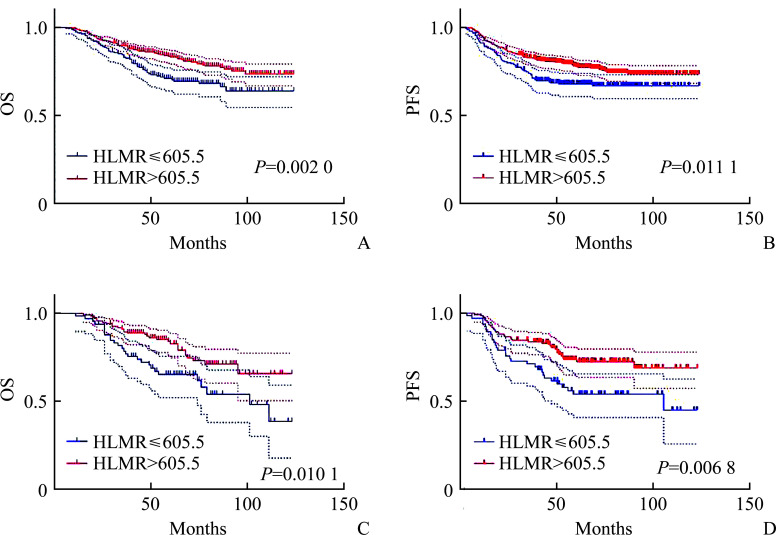
Results: The ROC curve identified 605.5 as the optimal HLMR cut-off value for predicting 5-year survival. Multivariate Cox regression analysis revealed that T stage (HR=1.886, 95% CI 1.331 to 2.673, P<0.001), N stage (HR=2.021, 95% CI 1.267 to 3.225, P=0.003), Eastern Cooperative Oncology Group (ECOG) score (HR=3.991, 95% CI 1.257 to 12.677, P=0.019), concurrent chemoradiotherapy regimen (HR=0.338, 95% CI 0.156 to 0.731, P=0.006), and HLMR (HR=0.648, 95% CI 0.460 to 0.912, P=0.013) were independent prognostic factors for OS. A nomogram including T stage, N stage, and HLMR in the training cohort was constructed to predict 3-, 5-, and 7-year OS, with a C-index of 0.713. The area under the curves for predicting 3-, 5-, and 7-year OS were 0.744, 0.665, and 0.682, respectively. Calibration curves showed good agreement between predicted and observed survival rates. The above results were further confirmed in the validation cohort.
Conclusions: Pretreatment HLMR may serve as a promising prognostic biomarker for patients with nasopharyngeal carcinoma.
期刊介绍:
Journal of Central South University (Medical Sciences), founded in 1958, is a comprehensive academic journal of medicine and health sponsored by the Ministry of Education and Central South University. The journal has been included in many important databases and authoritative abstract journals at home and abroad, such as the American Medline, Pubmed and its Index Medicus (IM), the Netherlands Medical Abstracts (EM), the American Chemical Abstracts (CA), the WHO Western Pacific Region Medical Index (WPRIM), and the Chinese Science Citation Database (Core Database) (CSCD); it is a statistical source journal of Chinese scientific and technological papers, a Chinese core journal, and a "double-effect" journal of the Chinese Journal Matrix; it is the "2nd, 3rd, and 4th China University Excellent Science and Technology Journal", "2008 China Excellent Science and Technology Journal", "RCCSE China Authoritative Academic Journal (A+)" and Hunan Province's "Top Ten Science and Technology Journals". The purpose of the journal is to reflect the new achievements, new technologies, and new experiences in medical research, medical treatment, and teaching, report new medical trends at home and abroad, promote academic exchanges, improve academic standards, and promote scientific and technological progress.






 京公网安备 11010802042870号
京ICP备2023020795号-1
京公网安备 11010802042870号
京ICP备2023020795号-1

 分享
分享
 求助内容:
求助内容: 应助结果提醒方式:
 扫码关注我们
