Jun Gou, Xiutao Yang, Hang Yu, He Yu, Yuchao Wei, Ziyi Fu, Laijiang Wei, Zexu Wang, Jiayue Han, Zhiming Wu, Yadong Jiang, Jun Wang
{"title":"面向近红外偏振敏感探测和高灵敏度通信的二维ReS2/3D Bi2O2Se同质异质结光电探测器","authors":"Jun Gou, Xiutao Yang, Hang Yu, He Yu, Yuchao Wei, Ziyi Fu, Laijiang Wei, Zexu Wang, Jiayue Han, Zhiming Wu, Yadong Jiang, Jun Wang","doi":"10.1002/lpor.202500577","DOIUrl":null,"url":null,"abstract":"<p>Conventional nm-scale Bi<sub>2</sub>O<sub>2</sub>Se-based near-infrared (NIR) photodetectors (PDs) exhibit commendable performance in terms of responsivity and response speed. Currently, the growing complexity of application scenarios requires NIR PDs to possess not only these fundamental functionalities but also the capability for NIR polarization detection and operation well under dim light conditions. Here, this study proposes the 2D ReS<sub>2</sub>/3D Bi<sub>2</sub>O<sub>2</sub>Se homo-heterojunction PD, which exhibits high photo-response speed, polarization-sensitive detection capabilities, and enhanced sensitivity in the NIR spectrum. In detail, a device constructed from µm-thick Bi<sub>2</sub>O<sub>2</sub>Se demonstrates polarization-sensitive photodetection at a wavelength of 850 nm, exhibiting a polarization ratio of 1.4 achieved by applied voltage modulation. Based on photogating effect and strong intrinsic absorption, the homo-heterojunction PD also can detect light power level of nW at 1310 nm, with a response speed of ≈10 µs and responsivity of 34.8 A W<sup>−1</sup> at this wavelength. Additionally, this configuration exhibits an outstanding specific detectivity exceeding 10<sup>10</sup> Jones within the wavelength range of 700 to 1310 nm. Even at a cut-off wavelength of 1550 nm, the device achieves a specific detectivity of ≈10<sup>9</sup> Jones. The ReS<sub>2</sub>/Bi<sub>2</sub>O<sub>2</sub>Se heterojunction NIR PD shows promise for advanced optoelectronic applications due to its high sensitivity and polarization-sensitive photodetection in NIR band.</p>","PeriodicalId":204,"journal":{"name":"Laser & Photonics Reviews","volume":"19 14","pages":""},"PeriodicalIF":10.0000,"publicationDate":"2025-04-08","publicationTypes":"Journal Article","fieldsOfStudy":null,"isOpenAccess":false,"openAccessPdf":"","citationCount":"0","resultStr":"{\"title\":\"2D ReS2/3D Bi2O2Se Homo-Heterojunction Photodetector Toward Near-Infrared Polarization Sensitive Detection and High Sensitivity Communication\",\"authors\":\"Jun Gou, Xiutao Yang, Hang Yu, He Yu, Yuchao Wei, Ziyi Fu, Laijiang Wei, Zexu Wang, Jiayue Han, Zhiming Wu, Yadong Jiang, Jun Wang\",\"doi\":\"10.1002/lpor.202500577\",\"DOIUrl\":null,\"url\":null,\"abstract\":\"<p>Conventional nm-scale Bi<sub>2</sub>O<sub>2</sub>Se-based near-infrared (NIR) photodetectors (PDs) exhibit commendable performance in terms of responsivity and response speed. Currently, the growing complexity of application scenarios requires NIR PDs to possess not only these fundamental functionalities but also the capability for NIR polarization detection and operation well under dim light conditions. Here, this study proposes the 2D ReS<sub>2</sub>/3D Bi<sub>2</sub>O<sub>2</sub>Se homo-heterojunction PD, which exhibits high photo-response speed, polarization-sensitive detection capabilities, and enhanced sensitivity in the NIR spectrum. In detail, a device constructed from µm-thick Bi<sub>2</sub>O<sub>2</sub>Se demonstrates polarization-sensitive photodetection at a wavelength of 850 nm, exhibiting a polarization ratio of 1.4 achieved by applied voltage modulation. Based on photogating effect and strong intrinsic absorption, the homo-heterojunction PD also can detect light power level of nW at 1310 nm, with a response speed of ≈10 µs and responsivity of 34.8 A W<sup>−1</sup> at this wavelength. Additionally, this configuration exhibits an outstanding specific detectivity exceeding 10<sup>10</sup> Jones within the wavelength range of 700 to 1310 nm. Even at a cut-off wavelength of 1550 nm, the device achieves a specific detectivity of ≈10<sup>9</sup> Jones. The ReS<sub>2</sub>/Bi<sub>2</sub>O<sub>2</sub>Se heterojunction NIR PD shows promise for advanced optoelectronic applications due to its high sensitivity and polarization-sensitive photodetection in NIR band.</p>\",\"PeriodicalId\":204,\"journal\":{\"name\":\"Laser & Photonics Reviews\",\"volume\":\"19 14\",\"pages\":\"\"},\"PeriodicalIF\":10.0000,\"publicationDate\":\"2025-04-08\",\"publicationTypes\":\"Journal Article\",\"fieldsOfStudy\":null,\"isOpenAccess\":false,\"openAccessPdf\":\"\",\"citationCount\":\"0\",\"resultStr\":null,\"platform\":\"Semanticscholar\",\"paperid\":null,\"PeriodicalName\":\"Laser & Photonics Reviews\",\"FirstCategoryId\":\"101\",\"ListUrlMain\":\"https://onlinelibrary.wiley.com/doi/10.1002/lpor.202500577\",\"RegionNum\":1,\"RegionCategory\":\"物理与天体物理\",\"ArticlePicture\":[],\"TitleCN\":null,\"AbstractTextCN\":null,\"PMCID\":null,\"EPubDate\":\"\",\"PubModel\":\"\",\"JCR\":\"Q1\",\"JCRName\":\"OPTICS\",\"Score\":null,\"Total\":0}","platform":"Semanticscholar","paperid":null,"PeriodicalName":"Laser & Photonics Reviews","FirstCategoryId":"101","ListUrlMain":"https://onlinelibrary.wiley.com/doi/10.1002/lpor.202500577","RegionNum":1,"RegionCategory":"物理与天体物理","ArticlePicture":[],"TitleCN":null,"AbstractTextCN":null,"PMCID":null,"EPubDate":"","PubModel":"","JCR":"Q1","JCRName":"OPTICS","Score":null,"Total":0}
引用次数: 0
摘要
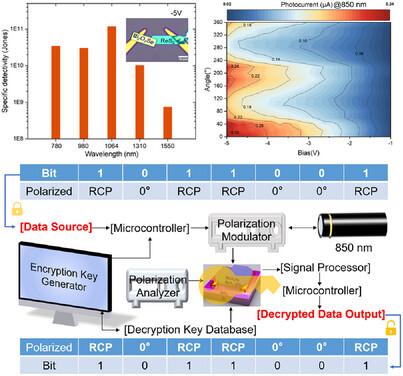
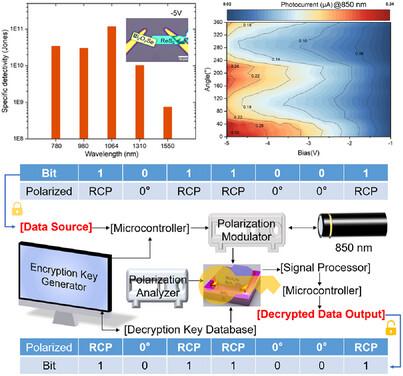
传统的纳米级bi2o2se基近红外(NIR)光电探测器(pd)在响应性和响应速度方面表现出令人称道的性能。目前,越来越复杂的应用场景要求近红外发光二极管不仅要具备这些基本功能,还要具备近红外偏振检测能力和在昏暗条件下良好工作的能力。在此,本研究提出了2D ReS2/3D Bi2O2Se同质异质结PD,该PD具有高光响应速度,偏振灵敏的检测能力,并且在近红外光谱中具有更高的灵敏度。详细地说,一个由微米厚Bi2O2Se构成的器件在850 nm波长下显示出偏振敏感的光探测,通过施加电压调制实现了1.4的偏振比。基于光门效应和强本征吸收,该器件在1310 nm处也能检测到nW的光功率电平,响应速度为≈10µs,响应率为34.8 a W−1。此外,这种结构在700到1310nm的波长范围内具有超过1010jones的特异探测能力。即使在1550 nm的截止波长下,该器件的比探测率也达到了≈109琼斯。ReS2/Bi2O2Se异质结近红外PD由于其在近红外波段的高灵敏度和偏振敏感的光探测而具有先进的光电子应用前景。
2D ReS2/3D Bi2O2Se Homo-Heterojunction Photodetector Toward Near-Infrared Polarization Sensitive Detection and High Sensitivity Communication
Conventional nm-scale Bi2O2Se-based near-infrared (NIR) photodetectors (PDs) exhibit commendable performance in terms of responsivity and response speed. Currently, the growing complexity of application scenarios requires NIR PDs to possess not only these fundamental functionalities but also the capability for NIR polarization detection and operation well under dim light conditions. Here, this study proposes the 2D ReS2/3D Bi2O2Se homo-heterojunction PD, which exhibits high photo-response speed, polarization-sensitive detection capabilities, and enhanced sensitivity in the NIR spectrum. In detail, a device constructed from µm-thick Bi2O2Se demonstrates polarization-sensitive photodetection at a wavelength of 850 nm, exhibiting a polarization ratio of 1.4 achieved by applied voltage modulation. Based on photogating effect and strong intrinsic absorption, the homo-heterojunction PD also can detect light power level of nW at 1310 nm, with a response speed of ≈10 µs and responsivity of 34.8 A W−1 at this wavelength. Additionally, this configuration exhibits an outstanding specific detectivity exceeding 1010 Jones within the wavelength range of 700 to 1310 nm. Even at a cut-off wavelength of 1550 nm, the device achieves a specific detectivity of ≈109 Jones. The ReS2/Bi2O2Se heterojunction NIR PD shows promise for advanced optoelectronic applications due to its high sensitivity and polarization-sensitive photodetection in NIR band.
期刊介绍:
Laser & Photonics Reviews is a reputable journal that publishes high-quality Reviews, original Research Articles, and Perspectives in the field of photonics and optics. It covers both theoretical and experimental aspects, including recent groundbreaking research, specific advancements, and innovative applications.
As evidence of its impact and recognition, Laser & Photonics Reviews boasts a remarkable 2022 Impact Factor of 11.0, according to the Journal Citation Reports from Clarivate Analytics (2023). Moreover, it holds impressive rankings in the InCites Journal Citation Reports: in 2021, it was ranked 6th out of 101 in the field of Optics, 15th out of 161 in Applied Physics, and 12th out of 69 in Condensed Matter Physics.
The journal uses the ISSN numbers 1863-8880 for print and 1863-8899 for online publications.




 京公网安备 11010802042870号
京ICP备2023020795号-1
京公网安备 11010802042870号
京ICP备2023020795号-1

 分享
分享
 求助内容:
求助内容: 应助结果提醒方式:
 扫码关注我们
