Su Yan , Sicheng Zhang , Qirun Han , Decheng Jin , Xiaoyu Yong , Jun Zhou , Xueying Zhang
{"title":"高速率内循环(IC)反应器处理含亚硒酸盐废水:水力停留时间的影响","authors":"Su Yan , Sicheng Zhang , Qirun Han , Decheng Jin , Xiaoyu Yong , Jun Zhou , Xueying Zhang","doi":"10.1016/j.seppur.2025.132944","DOIUrl":null,"url":null,"abstract":"<div><div>Waste activated sludge (WAS) is promising for treating selenium laden wastewater by converting selenite to low-toxicity Se<sup>0</sup>. However, WAS reduction capacity is limited for practical application. This study for the first time introduced stepwise declining bioreactor hydraulic retention time (HRT) strategy to enhance WAS activity. A pilot-scale internal circulation (IC) reactor was selected to cultivate WAS due to its high biomass retention and mass transfer. Acetate was used as electron donor and carbon source for selenite reduction. At 168 h–12 h HRTs, IC removed 93.62 %–98.68 % of selenite, but the efficiency dropped to 81.65 %–10.53 % at 6 h–1 h HRTs. Stepwise declining HRT from 108 h to 3 h screened high-rate selenite-reducing consortia with stronger selenite tolerance (∼21 mM). The maximum specific activity reached 3.53 ± 0.21 m mol Se g<sup>−1</sup> VSS h<sup>−1</sup> at 12 h HRT. WAS had good electrochemical activity at HRTs ≥ 6h. The dominant selenite reducers were family <em>Rhodobacteraceae</em>, <em>Rhodocyclacea</em>, <em>Comamonadaceae</em>, and <em>Chitinophagaceae</em> at 168 h HRT, while shifting to <em>Pseudomonadaceae</em>, <em>Comamonadaceae</em>, and <em>Rhizobiaceae</em> at shorter HRTs of 12 h–1 h. Function predication suggested selenite reduction was contributed by electron transport-linked phosphorylation and detoxification pathways, which displayed different response to HRT changes. Overall, IC reactor is promising for remediating selenite laden wastewater and stepwise declining HRT can selectively cultivate high-rate selenite-reducing consortia from WAS.</div></div>","PeriodicalId":427,"journal":{"name":"Separation and Purification Technology","volume":"368 ","pages":"Article 132944"},"PeriodicalIF":9.0000,"publicationDate":"2025-09-17","publicationTypes":"Journal Article","fieldsOfStudy":null,"isOpenAccess":false,"openAccessPdf":"","citationCount":"0","resultStr":"{\"title\":\"Biological treatment of selenite laden wastewater by a high-rate internal circulation (IC) reactor: Role of hydraulic retention time\",\"authors\":\"Su Yan , Sicheng Zhang , Qirun Han , Decheng Jin , Xiaoyu Yong , Jun Zhou , Xueying Zhang\",\"doi\":\"10.1016/j.seppur.2025.132944\",\"DOIUrl\":null,\"url\":null,\"abstract\":\"<div><div>Waste activated sludge (WAS) is promising for treating selenium laden wastewater by converting selenite to low-toxicity Se<sup>0</sup>. However, WAS reduction capacity is limited for practical application. This study for the first time introduced stepwise declining bioreactor hydraulic retention time (HRT) strategy to enhance WAS activity. A pilot-scale internal circulation (IC) reactor was selected to cultivate WAS due to its high biomass retention and mass transfer. Acetate was used as electron donor and carbon source for selenite reduction. At 168 h–12 h HRTs, IC removed 93.62 %–98.68 % of selenite, but the efficiency dropped to 81.65 %–10.53 % at 6 h–1 h HRTs. Stepwise declining HRT from 108 h to 3 h screened high-rate selenite-reducing consortia with stronger selenite tolerance (∼21 mM). The maximum specific activity reached 3.53 ± 0.21 m mol Se g<sup>−1</sup> VSS h<sup>−1</sup> at 12 h HRT. WAS had good electrochemical activity at HRTs ≥ 6h. The dominant selenite reducers were family <em>Rhodobacteraceae</em>, <em>Rhodocyclacea</em>, <em>Comamonadaceae</em>, and <em>Chitinophagaceae</em> at 168 h HRT, while shifting to <em>Pseudomonadaceae</em>, <em>Comamonadaceae</em>, and <em>Rhizobiaceae</em> at shorter HRTs of 12 h–1 h. Function predication suggested selenite reduction was contributed by electron transport-linked phosphorylation and detoxification pathways, which displayed different response to HRT changes. Overall, IC reactor is promising for remediating selenite laden wastewater and stepwise declining HRT can selectively cultivate high-rate selenite-reducing consortia from WAS.</div></div>\",\"PeriodicalId\":427,\"journal\":{\"name\":\"Separation and Purification Technology\",\"volume\":\"368 \",\"pages\":\"Article 132944\"},\"PeriodicalIF\":9.0000,\"publicationDate\":\"2025-09-17\",\"publicationTypes\":\"Journal Article\",\"fieldsOfStudy\":null,\"isOpenAccess\":false,\"openAccessPdf\":\"\",\"citationCount\":\"0\",\"resultStr\":null,\"platform\":\"Semanticscholar\",\"paperid\":null,\"PeriodicalName\":\"Separation and Purification Technology\",\"FirstCategoryId\":\"5\",\"ListUrlMain\":\"https://www.sciencedirect.com/science/article/pii/S1383586625015412\",\"RegionNum\":1,\"RegionCategory\":\"工程技术\",\"ArticlePicture\":[],\"TitleCN\":null,\"AbstractTextCN\":null,\"PMCID\":null,\"EPubDate\":\"2025/4/9 0:00:00\",\"PubModel\":\"Epub\",\"JCR\":\"Q1\",\"JCRName\":\"ENGINEERING, CHEMICAL\",\"Score\":null,\"Total\":0}","platform":"Semanticscholar","paperid":null,"PeriodicalName":"Separation and Purification Technology","FirstCategoryId":"5","ListUrlMain":"https://www.sciencedirect.com/science/article/pii/S1383586625015412","RegionNum":1,"RegionCategory":"工程技术","ArticlePicture":[],"TitleCN":null,"AbstractTextCN":null,"PMCID":null,"EPubDate":"2025/4/9 0:00:00","PubModel":"Epub","JCR":"Q1","JCRName":"ENGINEERING, CHEMICAL","Score":null,"Total":0}
引用次数: 0
摘要
废活性污泥(WAS)通过将亚硒酸盐转化为低毒的Se0,有望处理含硒废水。然而,在实际应用中,WAS的还原能力有限。本研究首次引入逐步降低生物反应器水力停留时间(HRT)的策略来提高WAS活性。由于was具有较高的生物质保留率和传质性,因此选择了一个中试规模的内循环反应器来培养was。以乙酸酯为电子给体和碳源进行亚硒酸盐还原。当HRTs为168 h - 12 h时,IC对亚硒酸盐的去除率为93.62% % -98.68 %,而当HRTs为6 h - 1 h时,IC对亚硒酸盐的去除率降至81.65 % -10.53 %。HRT从108 h逐步下降到3 h,筛选出具有较强亚硒酸盐耐受性的高速率亚硒酸盐还原菌群(~ 21 mM)。在12 h HRT下,最大比活性达到3.53 ± 0.21 m mol Se g−1 VSS h−1。WAS在HRTs下具有良好的电化学活性 ≥ 6h。当HRT为168 h时,亚硒酸盐还原剂以Rhodobacteraceae、Rhodocyclacea、Comamonadaceae和Chitinophagaceae为主;当HRT为12 h - 1 h时,亚硒酸盐还原剂以Pseudomonadaceae、Comamonadaceae和Rhizobiaceae为主。功能预测表明,亚硒酸盐的还原主要通过电子传递磷酸化和解毒途径进行,这两种途径对HRT的变化有不同的响应。综上所述,IC反应器具有修复亚硒酸盐废水的潜力,逐步下降的HRT可以选择性地培养出高速率的亚硒酸盐还原菌群。
Biological treatment of selenite laden wastewater by a high-rate internal circulation (IC) reactor: Role of hydraulic retention time
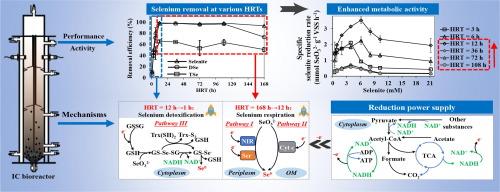
Waste activated sludge (WAS) is promising for treating selenium laden wastewater by converting selenite to low-toxicity Se0. However, WAS reduction capacity is limited for practical application. This study for the first time introduced stepwise declining bioreactor hydraulic retention time (HRT) strategy to enhance WAS activity. A pilot-scale internal circulation (IC) reactor was selected to cultivate WAS due to its high biomass retention and mass transfer. Acetate was used as electron donor and carbon source for selenite reduction. At 168 h–12 h HRTs, IC removed 93.62 %–98.68 % of selenite, but the efficiency dropped to 81.65 %–10.53 % at 6 h–1 h HRTs. Stepwise declining HRT from 108 h to 3 h screened high-rate selenite-reducing consortia with stronger selenite tolerance (∼21 mM). The maximum specific activity reached 3.53 ± 0.21 m mol Se g−1 VSS h−1 at 12 h HRT. WAS had good electrochemical activity at HRTs ≥ 6h. The dominant selenite reducers were family Rhodobacteraceae, Rhodocyclacea, Comamonadaceae, and Chitinophagaceae at 168 h HRT, while shifting to Pseudomonadaceae, Comamonadaceae, and Rhizobiaceae at shorter HRTs of 12 h–1 h. Function predication suggested selenite reduction was contributed by electron transport-linked phosphorylation and detoxification pathways, which displayed different response to HRT changes. Overall, IC reactor is promising for remediating selenite laden wastewater and stepwise declining HRT can selectively cultivate high-rate selenite-reducing consortia from WAS.
期刊介绍:
Separation and Purification Technology is a premier journal committed to sharing innovative methods for separation and purification in chemical and environmental engineering, encompassing both homogeneous solutions and heterogeneous mixtures. Our scope includes the separation and/or purification of liquids, vapors, and gases, as well as carbon capture and separation techniques. However, it's important to note that methods solely intended for analytical purposes are not within the scope of the journal. Additionally, disciplines such as soil science, polymer science, and metallurgy fall outside the purview of Separation and Purification Technology. Join us in advancing the field of separation and purification methods for sustainable solutions in chemical and environmental engineering.





 京公网安备 11010802042870号
京ICP备2023020795号-1
京公网安备 11010802042870号
京ICP备2023020795号-1

 分享
分享
 求助内容:
求助内容: 应助结果提醒方式:
 扫码关注我们
