Xin Luo , Changjian Ling , Tingrui Xu , Weihua Liu , Zhongfeng Tang
{"title":"用FPMD模拟了NaCl-KCl-CaCl2熔盐在高温下的热物性和微观结构","authors":"Xin Luo , Changjian Ling , Tingrui Xu , Weihua Liu , Zhongfeng Tang","doi":"10.1016/j.solmat.2025.113630","DOIUrl":null,"url":null,"abstract":"<div><div>The lack of thermophysical property data and kinetic characteristics parameter for the molten NaCl-KCl-CaCl<sub>2</sub> (NKC) salt over 873K limit its practical application in thermal energy storage systems. In order to solve this problem, the thermophysical properties and structural characteristics of the NKC molten salts were investigated using the first-principles molecular dynamics (FPMD) simulations coupling experiment test at 873−1173 K. The results show that the simulated specific heat capacity within the temperature range of 873 K–1173 K is in good agreement with the experimental values. Compared with the experimental values, the simulated density of the NKC molten salt has a maximum error of no more than 3.26 %. The viscosity values (1.26−2.13 cP) at the temperature range of 1073 K–1173 K were supplemented, and these values are consistent with the theoretically calculated values. The self-diffusion coefficients of each ion show the pattern of <em>D</em><sub>Na</sub><sup>+</sup>><em>D</em><sub>K</sub><sup>+</sup>><em>D</em><sub>Cl</sub><sup>‒</sup>><em>D</em><sub>Ca</sub><sup>2+</sup>. The causes of the changes in the thermophysical properties of the molten salts were also elaborated from the perspective of structural changes. With the increase in temperature, the high-coordination structure decreases and the low-coordination structure increases. The overall structure of the molten salt becomes loose, which leads to a decrease in density and viscosity. Ca−Cl shows a distorted octahedral configuration. It provides insights into the application of NKC in molten salt energy storage.</div></div>","PeriodicalId":429,"journal":{"name":"Solar Energy Materials and Solar Cells","volume":"288 ","pages":"Article 113630"},"PeriodicalIF":6.3000,"publicationDate":"2025-08-15","publicationTypes":"Journal Article","fieldsOfStudy":null,"isOpenAccess":false,"openAccessPdf":"","citationCount":"0","resultStr":"{\"title\":\"Thermophysical property and micro-structure of the molten NaCl-KCl-CaCl2 salt at high temperature by FPMD simulation\",\"authors\":\"Xin Luo , Changjian Ling , Tingrui Xu , Weihua Liu , Zhongfeng Tang\",\"doi\":\"10.1016/j.solmat.2025.113630\",\"DOIUrl\":null,\"url\":null,\"abstract\":\"<div><div>The lack of thermophysical property data and kinetic characteristics parameter for the molten NaCl-KCl-CaCl<sub>2</sub> (NKC) salt over 873K limit its practical application in thermal energy storage systems. In order to solve this problem, the thermophysical properties and structural characteristics of the NKC molten salts were investigated using the first-principles molecular dynamics (FPMD) simulations coupling experiment test at 873−1173 K. The results show that the simulated specific heat capacity within the temperature range of 873 K–1173 K is in good agreement with the experimental values. Compared with the experimental values, the simulated density of the NKC molten salt has a maximum error of no more than 3.26 %. The viscosity values (1.26−2.13 cP) at the temperature range of 1073 K–1173 K were supplemented, and these values are consistent with the theoretically calculated values. The self-diffusion coefficients of each ion show the pattern of <em>D</em><sub>Na</sub><sup>+</sup>><em>D</em><sub>K</sub><sup>+</sup>><em>D</em><sub>Cl</sub><sup>‒</sup>><em>D</em><sub>Ca</sub><sup>2+</sup>. The causes of the changes in the thermophysical properties of the molten salts were also elaborated from the perspective of structural changes. With the increase in temperature, the high-coordination structure decreases and the low-coordination structure increases. The overall structure of the molten salt becomes loose, which leads to a decrease in density and viscosity. Ca−Cl shows a distorted octahedral configuration. It provides insights into the application of NKC in molten salt energy storage.</div></div>\",\"PeriodicalId\":429,\"journal\":{\"name\":\"Solar Energy Materials and Solar Cells\",\"volume\":\"288 \",\"pages\":\"Article 113630\"},\"PeriodicalIF\":6.3000,\"publicationDate\":\"2025-08-15\",\"publicationTypes\":\"Journal Article\",\"fieldsOfStudy\":null,\"isOpenAccess\":false,\"openAccessPdf\":\"\",\"citationCount\":\"0\",\"resultStr\":null,\"platform\":\"Semanticscholar\",\"paperid\":null,\"PeriodicalName\":\"Solar Energy Materials and Solar Cells\",\"FirstCategoryId\":\"88\",\"ListUrlMain\":\"https://www.sciencedirect.com/science/article/pii/S0927024825002314\",\"RegionNum\":2,\"RegionCategory\":\"材料科学\",\"ArticlePicture\":[],\"TitleCN\":null,\"AbstractTextCN\":null,\"PMCID\":null,\"EPubDate\":\"2025/4/10 0:00:00\",\"PubModel\":\"Epub\",\"JCR\":\"Q2\",\"JCRName\":\"ENERGY & FUELS\",\"Score\":null,\"Total\":0}","platform":"Semanticscholar","paperid":null,"PeriodicalName":"Solar Energy Materials and Solar Cells","FirstCategoryId":"88","ListUrlMain":"https://www.sciencedirect.com/science/article/pii/S0927024825002314","RegionNum":2,"RegionCategory":"材料科学","ArticlePicture":[],"TitleCN":null,"AbstractTextCN":null,"PMCID":null,"EPubDate":"2025/4/10 0:00:00","PubModel":"Epub","JCR":"Q2","JCRName":"ENERGY & FUELS","Score":null,"Total":0}
引用次数: 0
摘要
在873K以上的NaCl-KCl-CaCl2 (NKC)熔盐缺乏热物性数据和动力学特性参数,限制了其在储热系统中的实际应用。为了解决这一问题,采用第一性原理分子动力学(FPMD)模拟耦合实验方法研究了NKC熔盐在873 ~ 1173 K下的热物理性质和结构特征。结果表明,在873 K ~ 1173 K温度范围内的模拟比热容与实验值吻合较好。与实验值相比,NKC熔盐密度模拟值的最大误差不超过3.26%。补充了1073 K ~ 1173 K温度范围内的粘度值(1.26 ~ 2.13 cP),与理论计算值一致。各离子的自扩散系数表现为DNa+>;DK+>DCl ->DCa2+。并从结构变化的角度阐述了熔盐热物性变化的原因。随着温度的升高,高配位结构减少,低配位结构增加。熔盐的整体结构变得松散,导致密度和粘度下降。Ca−Cl呈畸变八面体构型。为NKC在熔盐储能中的应用提供了新的见解。
Thermophysical property and micro-structure of the molten NaCl-KCl-CaCl2 salt at high temperature by FPMD simulation
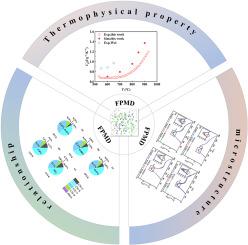
The lack of thermophysical property data and kinetic characteristics parameter for the molten NaCl-KCl-CaCl2 (NKC) salt over 873K limit its practical application in thermal energy storage systems. In order to solve this problem, the thermophysical properties and structural characteristics of the NKC molten salts were investigated using the first-principles molecular dynamics (FPMD) simulations coupling experiment test at 873−1173 K. The results show that the simulated specific heat capacity within the temperature range of 873 K–1173 K is in good agreement with the experimental values. Compared with the experimental values, the simulated density of the NKC molten salt has a maximum error of no more than 3.26 %. The viscosity values (1.26−2.13 cP) at the temperature range of 1073 K–1173 K were supplemented, and these values are consistent with the theoretically calculated values. The self-diffusion coefficients of each ion show the pattern of DNa+>DK+>DCl‒>DCa2+. The causes of the changes in the thermophysical properties of the molten salts were also elaborated from the perspective of structural changes. With the increase in temperature, the high-coordination structure decreases and the low-coordination structure increases. The overall structure of the molten salt becomes loose, which leads to a decrease in density and viscosity. Ca−Cl shows a distorted octahedral configuration. It provides insights into the application of NKC in molten salt energy storage.
期刊介绍:
Solar Energy Materials & Solar Cells is intended as a vehicle for the dissemination of research results on materials science and technology related to photovoltaic, photothermal and photoelectrochemical solar energy conversion. Materials science is taken in the broadest possible sense and encompasses physics, chemistry, optics, materials fabrication and analysis for all types of materials.




 京公网安备 11010802042870号
京ICP备2023020795号-1
京公网安备 11010802042870号
京ICP备2023020795号-1

 分享
分享
 求助内容:
求助内容: 应助结果提醒方式:
 扫码关注我们
