{"title":"躯干加速度运动标准差作为体育活动量化指标的验证研究。","authors":"Takuya Suzuki, Yuji Kono, Takayuki Ogasawara, Masahiko Mukaino, Yasushi Aoshima, Shotaro Furuzawa, Yurie Fujita, Hirotaka Matsuura, Masumi Yamaguchi, Shingo Tsukada, Yohei Otaka","doi":"10.2196/63064","DOIUrl":null,"url":null,"abstract":"<p><strong>Background: </strong>Step count is used to quantify activity in individuals using accelerometers. However, challenges such as difficulty in detecting steps during slow or irregular gait patterns and the inability to apply this method to wheelchair (WC) users limit the broader utility of accelerometers. Alternative device-specific measures of physical activity exist, but their specificity limits cross-applicability between different device sensors. Moving standard deviation of acceleration (MSDA), obtained from truncal acceleration measurements, is proposed as another alternative variable to quantify physical activity in patients.</p><p><strong>Objective: </strong>This study aimed to evaluate the validity and feasibility of MSDA for quantifying physical activity in patients with stroke-induced hemiparesis by comparing it with the traditional step count.</p><p><strong>Methods: </strong>We enrolled 197 consecutive patients with stroke hemiparesis admitted to a convalescent rehabilitation ward. Using the hitoe system, a smart clothing-based physical activity measurement system, we measured the MSDA of trunk movement and step count. The correlation between MSDA and step count was examined in all participants. Based on their daily living mobility levels, measured using the Functional Independence Measure (FIM), participants were categorized into 6 subgroups: FIM1-4, FIM5 (WC), FIM5 (walking), FIM6 (WC), FIM6 (walking), and FIM7 (walking). Intersubgroup differences in MSDA were analyzed.</p><p><strong>Results: </strong>A strong correlation was observed between MSDA and step count (r=0.78; P<.001), with a stronger correlation in the walking group (r=0.79; P<.001) compared with the WC group (r=0.55; P<.001). The Shapiro-Wilk test indicated no significant results for MSDA across all subgroups, supporting a normal distribution within these groups. In contrast, the step count data for the WC subgroups showed significant results, indicating a deviation from a normal distribution. Additionally, 10.2% (20/197) of participants recorded zero steps, demonstrating a floor effect in the step count data. The median MSDA values for the 6 subgroups (FIM1-4, FIM5 WC, FIM5 walking, FIM6 WC, FIM6 walking, and FIM7) were 0.006, 0.007, 0.010, 0.011, 0.011, and 0.014, respectively, reflecting their levels of independence based on the FIM mobility scores. The median step counts for these subgroups were 68, 233, 1386, 367, 2835, and 4462, respectively. FIM5 participants who walked had higher step counts than FIM6 participants using WCs, though the difference was marginally but not statistically significant (P=.07), highlighting the impact of mobility type (walking vs WC).</p><p><strong>Conclusions: </strong>The results suggest the validity of MSDA as a variable for physical activity in patients with stroke, applicable to patients with stroke irrespective of their mobility measures. This finding highlights the potential of MSDA for use in individuals with motor impairments, including WC users, underscoring its broad utility in rehabilitation clinical practice.</p>","PeriodicalId":14841,"journal":{"name":"JMIR Formative Research","volume":"9 ","pages":"e63064"},"PeriodicalIF":2.0000,"publicationDate":"2025-04-08","publicationTypes":"Journal Article","fieldsOfStudy":null,"isOpenAccess":false,"openAccessPdf":"https://www.ncbi.nlm.nih.gov/pmc/articles/PMC11999377/pdf/","citationCount":"0","resultStr":"{\"title\":\"Moving Standard Deviation of Trunk Acceleration as a Quantification Index for Physical Activities: Validation Study.\",\"authors\":\"Takuya Suzuki, Yuji Kono, Takayuki Ogasawara, Masahiko Mukaino, Yasushi Aoshima, Shotaro Furuzawa, Yurie Fujita, Hirotaka Matsuura, Masumi Yamaguchi, Shingo Tsukada, Yohei Otaka\",\"doi\":\"10.2196/63064\",\"DOIUrl\":null,\"url\":null,\"abstract\":\"<p><strong>Background: </strong>Step count is used to quantify activity in individuals using accelerometers. However, challenges such as difficulty in detecting steps during slow or irregular gait patterns and the inability to apply this method to wheelchair (WC) users limit the broader utility of accelerometers. Alternative device-specific measures of physical activity exist, but their specificity limits cross-applicability between different device sensors. Moving standard deviation of acceleration (MSDA), obtained from truncal acceleration measurements, is proposed as another alternative variable to quantify physical activity in patients.</p><p><strong>Objective: </strong>This study aimed to evaluate the validity and feasibility of MSDA for quantifying physical activity in patients with stroke-induced hemiparesis by comparing it with the traditional step count.</p><p><strong>Methods: </strong>We enrolled 197 consecutive patients with stroke hemiparesis admitted to a convalescent rehabilitation ward. Using the hitoe system, a smart clothing-based physical activity measurement system, we measured the MSDA of trunk movement and step count. The correlation between MSDA and step count was examined in all participants. Based on their daily living mobility levels, measured using the Functional Independence Measure (FIM), participants were categorized into 6 subgroups: FIM1-4, FIM5 (WC), FIM5 (walking), FIM6 (WC), FIM6 (walking), and FIM7 (walking). Intersubgroup differences in MSDA were analyzed.</p><p><strong>Results: </strong>A strong correlation was observed between MSDA and step count (r=0.78; P<.001), with a stronger correlation in the walking group (r=0.79; P<.001) compared with the WC group (r=0.55; P<.001). The Shapiro-Wilk test indicated no significant results for MSDA across all subgroups, supporting a normal distribution within these groups. In contrast, the step count data for the WC subgroups showed significant results, indicating a deviation from a normal distribution. Additionally, 10.2% (20/197) of participants recorded zero steps, demonstrating a floor effect in the step count data. The median MSDA values for the 6 subgroups (FIM1-4, FIM5 WC, FIM5 walking, FIM6 WC, FIM6 walking, and FIM7) were 0.006, 0.007, 0.010, 0.011, 0.011, and 0.014, respectively, reflecting their levels of independence based on the FIM mobility scores. The median step counts for these subgroups were 68, 233, 1386, 367, 2835, and 4462, respectively. FIM5 participants who walked had higher step counts than FIM6 participants using WCs, though the difference was marginally but not statistically significant (P=.07), highlighting the impact of mobility type (walking vs WC).</p><p><strong>Conclusions: </strong>The results suggest the validity of MSDA as a variable for physical activity in patients with stroke, applicable to patients with stroke irrespective of their mobility measures. This finding highlights the potential of MSDA for use in individuals with motor impairments, including WC users, underscoring its broad utility in rehabilitation clinical practice.</p>\",\"PeriodicalId\":14841,\"journal\":{\"name\":\"JMIR Formative Research\",\"volume\":\"9 \",\"pages\":\"e63064\"},\"PeriodicalIF\":2.0000,\"publicationDate\":\"2025-04-08\",\"publicationTypes\":\"Journal Article\",\"fieldsOfStudy\":null,\"isOpenAccess\":false,\"openAccessPdf\":\"https://www.ncbi.nlm.nih.gov/pmc/articles/PMC11999377/pdf/\",\"citationCount\":\"0\",\"resultStr\":null,\"platform\":\"Semanticscholar\",\"paperid\":null,\"PeriodicalName\":\"JMIR Formative Research\",\"FirstCategoryId\":\"1085\",\"ListUrlMain\":\"https://doi.org/10.2196/63064\",\"RegionNum\":0,\"RegionCategory\":null,\"ArticlePicture\":[],\"TitleCN\":null,\"AbstractTextCN\":null,\"PMCID\":null,\"EPubDate\":\"\",\"PubModel\":\"\",\"JCR\":\"Q3\",\"JCRName\":\"HEALTH CARE SCIENCES & SERVICES\",\"Score\":null,\"Total\":0}","platform":"Semanticscholar","paperid":null,"PeriodicalName":"JMIR Formative Research","FirstCategoryId":"1085","ListUrlMain":"https://doi.org/10.2196/63064","RegionNum":0,"RegionCategory":null,"ArticlePicture":[],"TitleCN":null,"AbstractTextCN":null,"PMCID":null,"EPubDate":"","PubModel":"","JCR":"Q3","JCRName":"HEALTH CARE SCIENCES & SERVICES","Score":null,"Total":0}
Moving Standard Deviation of Trunk Acceleration as a Quantification Index for Physical Activities: Validation Study.
Background: Step count is used to quantify activity in individuals using accelerometers. However, challenges such as difficulty in detecting steps during slow or irregular gait patterns and the inability to apply this method to wheelchair (WC) users limit the broader utility of accelerometers. Alternative device-specific measures of physical activity exist, but their specificity limits cross-applicability between different device sensors. Moving standard deviation of acceleration (MSDA), obtained from truncal acceleration measurements, is proposed as another alternative variable to quantify physical activity in patients.
Objective: This study aimed to evaluate the validity and feasibility of MSDA for quantifying physical activity in patients with stroke-induced hemiparesis by comparing it with the traditional step count.
Methods: We enrolled 197 consecutive patients with stroke hemiparesis admitted to a convalescent rehabilitation ward. Using the hitoe system, a smart clothing-based physical activity measurement system, we measured the MSDA of trunk movement and step count. The correlation between MSDA and step count was examined in all participants. Based on their daily living mobility levels, measured using the Functional Independence Measure (FIM), participants were categorized into 6 subgroups: FIM1-4, FIM5 (WC), FIM5 (walking), FIM6 (WC), FIM6 (walking), and FIM7 (walking). Intersubgroup differences in MSDA were analyzed.
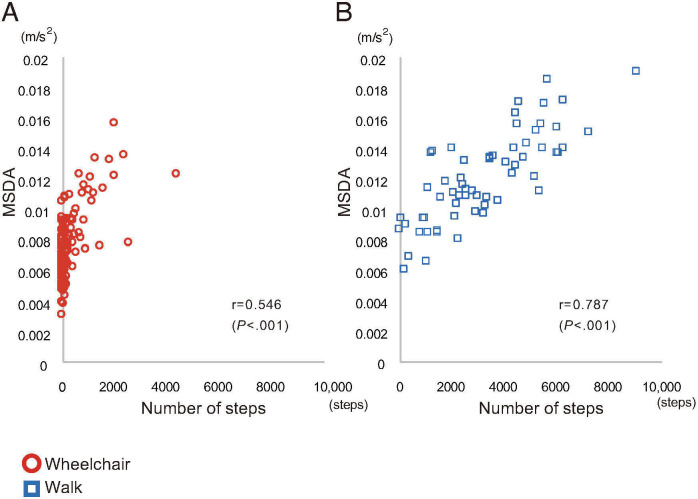
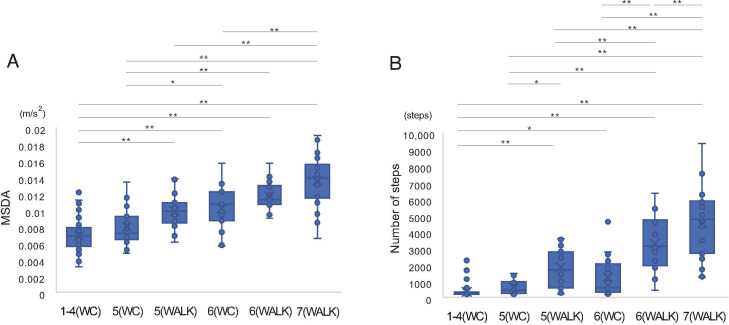
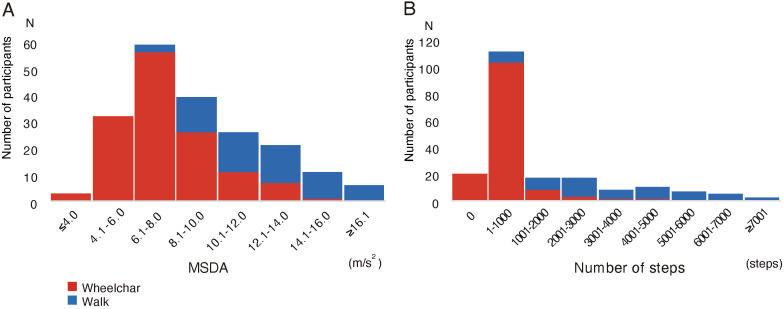
Results: A strong correlation was observed between MSDA and step count (r=0.78; P<.001), with a stronger correlation in the walking group (r=0.79; P<.001) compared with the WC group (r=0.55; P<.001). The Shapiro-Wilk test indicated no significant results for MSDA across all subgroups, supporting a normal distribution within these groups. In contrast, the step count data for the WC subgroups showed significant results, indicating a deviation from a normal distribution. Additionally, 10.2% (20/197) of participants recorded zero steps, demonstrating a floor effect in the step count data. The median MSDA values for the 6 subgroups (FIM1-4, FIM5 WC, FIM5 walking, FIM6 WC, FIM6 walking, and FIM7) were 0.006, 0.007, 0.010, 0.011, 0.011, and 0.014, respectively, reflecting their levels of independence based on the FIM mobility scores. The median step counts for these subgroups were 68, 233, 1386, 367, 2835, and 4462, respectively. FIM5 participants who walked had higher step counts than FIM6 participants using WCs, though the difference was marginally but not statistically significant (P=.07), highlighting the impact of mobility type (walking vs WC).
Conclusions: The results suggest the validity of MSDA as a variable for physical activity in patients with stroke, applicable to patients with stroke irrespective of their mobility measures. This finding highlights the potential of MSDA for use in individuals with motor impairments, including WC users, underscoring its broad utility in rehabilitation clinical practice.





 京公网安备 11010802042870号
京ICP备2023020795号-1
京公网安备 11010802042870号
京ICP备2023020795号-1

 分享
分享
 求助内容:
求助内容: 应助结果提醒方式:
 扫码关注我们
