Ce Shi , Yujing Tang , Jiaqi Zhang , Ying Lu , Yongfeng Men
{"title":"超声微注射成型乙烯-乙烯醇共聚物中间相的形成与分布","authors":"Ce Shi , Yujing Tang , Jiaqi Zhang , Ying Lu , Yongfeng Men","doi":"10.1016/j.polymer.2025.128388","DOIUrl":null,"url":null,"abstract":"<div><div>The formation and distribution of mesophase in ethylene vinyl alcohol copolymer ultrasonic micro-injection-molded at different mold temperature and filling velocity were investigated using wide angle X-ray diffraction (WAXD) technique and dynamic rheological characterizations. The one-dimensional WAXD profiles of unoriented and oriented components was separated to evaluate the fraction of mesophase, orthorhombic crystals and amorphous phase in each part. The results demonstrated that mesophase mostly existed in samples with mold temperature lower than 90 °C. Compared to the mold temperature, the filling velocity had slight influence on the formation of mesophase. With the WAXD mapping experiments along the thickness direction, it was found that mesophase mainly appeared in the core layer of unoriented component, regardless of mold temperature and filling velocity. The formation of the mesophase is found to depend on the competition between the time needed for polymer chain relaxation and crystallization. Only the polymer chains relaxed to a random coil state in the core layer is possible to form mesophase, otherwise polymer chains will crystallize into orthorhombic crystals.</div></div>","PeriodicalId":405,"journal":{"name":"Polymer","volume":"327 ","pages":"Article 128388"},"PeriodicalIF":4.5000,"publicationDate":"2025-05-16","publicationTypes":"Journal Article","fieldsOfStudy":null,"isOpenAccess":false,"openAccessPdf":"","citationCount":"0","resultStr":"{\"title\":\"Formation and distribution of the mesophase in ultrasonic micro-injection-molded ethylene vinyl alcohol copolymer\",\"authors\":\"Ce Shi , Yujing Tang , Jiaqi Zhang , Ying Lu , Yongfeng Men\",\"doi\":\"10.1016/j.polymer.2025.128388\",\"DOIUrl\":null,\"url\":null,\"abstract\":\"<div><div>The formation and distribution of mesophase in ethylene vinyl alcohol copolymer ultrasonic micro-injection-molded at different mold temperature and filling velocity were investigated using wide angle X-ray diffraction (WAXD) technique and dynamic rheological characterizations. The one-dimensional WAXD profiles of unoriented and oriented components was separated to evaluate the fraction of mesophase, orthorhombic crystals and amorphous phase in each part. The results demonstrated that mesophase mostly existed in samples with mold temperature lower than 90 °C. Compared to the mold temperature, the filling velocity had slight influence on the formation of mesophase. With the WAXD mapping experiments along the thickness direction, it was found that mesophase mainly appeared in the core layer of unoriented component, regardless of mold temperature and filling velocity. The formation of the mesophase is found to depend on the competition between the time needed for polymer chain relaxation and crystallization. Only the polymer chains relaxed to a random coil state in the core layer is possible to form mesophase, otherwise polymer chains will crystallize into orthorhombic crystals.</div></div>\",\"PeriodicalId\":405,\"journal\":{\"name\":\"Polymer\",\"volume\":\"327 \",\"pages\":\"Article 128388\"},\"PeriodicalIF\":4.5000,\"publicationDate\":\"2025-05-16\",\"publicationTypes\":\"Journal Article\",\"fieldsOfStudy\":null,\"isOpenAccess\":false,\"openAccessPdf\":\"\",\"citationCount\":\"0\",\"resultStr\":null,\"platform\":\"Semanticscholar\",\"paperid\":null,\"PeriodicalName\":\"Polymer\",\"FirstCategoryId\":\"92\",\"ListUrlMain\":\"https://www.sciencedirect.com/science/article/pii/S003238612500374X\",\"RegionNum\":2,\"RegionCategory\":\"化学\",\"ArticlePicture\":[],\"TitleCN\":null,\"AbstractTextCN\":null,\"PMCID\":null,\"EPubDate\":\"2025/4/10 0:00:00\",\"PubModel\":\"Epub\",\"JCR\":\"Q2\",\"JCRName\":\"POLYMER SCIENCE\",\"Score\":null,\"Total\":0}","platform":"Semanticscholar","paperid":null,"PeriodicalName":"Polymer","FirstCategoryId":"92","ListUrlMain":"https://www.sciencedirect.com/science/article/pii/S003238612500374X","RegionNum":2,"RegionCategory":"化学","ArticlePicture":[],"TitleCN":null,"AbstractTextCN":null,"PMCID":null,"EPubDate":"2025/4/10 0:00:00","PubModel":"Epub","JCR":"Q2","JCRName":"POLYMER SCIENCE","Score":null,"Total":0}
引用次数: 0
摘要
利用广角 X 射线衍射(WAXD)技术和动态流变特性研究了在不同模具温度和填充速度下超声微注塑成型的乙烯-乙烯醇共聚物中介相的形成和分布。对无取向和取向组分的一维 WAXD 曲线进行了分离,以评估各组分中的介相、正交晶相和无定形相的比例。结果表明,介相主要存在于模具温度低于 90 摄氏度的样品中。与模具温度相比,填充速度对介相的形成影响较小。通过沿厚度方向的 WAXD 制图实验发现,无论模具温度和填充速度如何,介相主要出现在无取向部件的芯层中。介相的形成取决于聚合物链松弛和结晶所需的时间之间的竞争。只有聚合物链在芯层中松弛成无规线圈状态时才有可能形成介相,否则聚合物链将结晶成正方晶。
Formation and distribution of the mesophase in ultrasonic micro-injection-molded ethylene vinyl alcohol copolymer
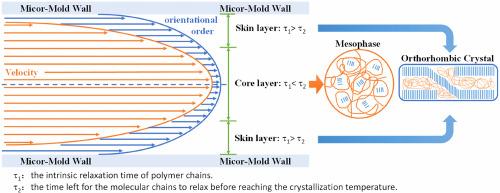
The formation and distribution of mesophase in ethylene vinyl alcohol copolymer ultrasonic micro-injection-molded at different mold temperature and filling velocity were investigated using wide angle X-ray diffraction (WAXD) technique and dynamic rheological characterizations. The one-dimensional WAXD profiles of unoriented and oriented components was separated to evaluate the fraction of mesophase, orthorhombic crystals and amorphous phase in each part. The results demonstrated that mesophase mostly existed in samples with mold temperature lower than 90 °C. Compared to the mold temperature, the filling velocity had slight influence on the formation of mesophase. With the WAXD mapping experiments along the thickness direction, it was found that mesophase mainly appeared in the core layer of unoriented component, regardless of mold temperature and filling velocity. The formation of the mesophase is found to depend on the competition between the time needed for polymer chain relaxation and crystallization. Only the polymer chains relaxed to a random coil state in the core layer is possible to form mesophase, otherwise polymer chains will crystallize into orthorhombic crystals.
期刊介绍:
Polymer is an interdisciplinary journal dedicated to publishing innovative and significant advances in Polymer Physics, Chemistry and Technology. We welcome submissions on polymer hybrids, nanocomposites, characterisation and self-assembly. Polymer also publishes work on the technological application of polymers in energy and optoelectronics.
The main scope is covered but not limited to the following core areas:
Polymer Materials
Nanocomposites and hybrid nanomaterials
Polymer blends, films, fibres, networks and porous materials
Physical Characterization
Characterisation, modelling and simulation* of molecular and materials properties in bulk, solution, and thin films
Polymer Engineering
Advanced multiscale processing methods
Polymer Synthesis, Modification and Self-assembly
Including designer polymer architectures, mechanisms and kinetics, and supramolecular polymerization
Technological Applications
Polymers for energy generation and storage
Polymer membranes for separation technology
Polymers for opto- and microelectronics.





 京公网安备 11010802042870号
京ICP备2023020795号-1
京公网安备 11010802042870号
京ICP备2023020795号-1

 分享
分享
 求助内容:
求助内容: 应助结果提醒方式:
 扫码关注我们
