Zongyu Ma , Weiwei Liu , Wanyang Li , Jianrong Song , Huanqiang Liu , Zhenxin Lv , Tandong Wang , Guangda Hu , Shitong Peng , Fengtao Wang , Yue Zhao , Hongchao Zhang
{"title":"激光定向能沉积制备SS 316L/IN718梯度材料的组织演变、成分分布及裂纹形成机制","authors":"Zongyu Ma , Weiwei Liu , Wanyang Li , Jianrong Song , Huanqiang Liu , Zhenxin Lv , Tandong Wang , Guangda Hu , Shitong Peng , Fengtao Wang , Yue Zhao , Hongchao Zhang","doi":"10.1016/j.jmatprotec.2025.118843","DOIUrl":null,"url":null,"abstract":"<div><div>The preparation of functionally graded materials (FGMs) via laser directed energy deposition (LDED) involves the coupling of multiple material parameters, the mechanisms of microstructural evolution and composition distribution under non-equilibrium solidification conditions, and the formation mechanisms of defects during the deposition process, which remain critical scientific challenges to be addressed. Taking the SS 316 L/IN718 material system as an example, this study establishes a multiphase, multicomponent fluid model and a thermo-mechanical coupling simulation framework. Combined with microstructural, crystallographic characterization, and microhardness analysis, it systematically investigates the microstructural transitions, composition distribution, and crack formation mechanisms under a 25 wt% compositional gradient condition. The study reveals that as the deposition layers transition from 100 % SS 316 L to 100 % IN718, the microstructure undergoes a discontinuous change from fine columnar and cellular crystals to coarse columnar and short dendritic crystals. This evolution is jointly influenced by variations in local temperature gradients and uneven solute distribution. Temperature accumulation and differences in the materials' thermal properties enhance molten pool stirring and remelting dilution effects, leading to significant segregation of solute elements (e.g., Nb, Mo). This further reduces the local solidification rate and destabilizes the solid-liquid interface. Cracks are primarily concentrated in the 50 % SS 316 L/50 % IN718 and 25 % SS 316 L/75 % IN718 gradient layers, attributed to liquation cracking caused by local compositional segregation, thermal stress concentration, and the presence of brittle carbides. Thermo-mechanical coupled simulations further confirm that the residual tensile stress is highest in the 25 % SS 316 L/75 % IN718 and 100 % IN718 gradient layers, making them the primary regions for crack initiation. This study proposes a comprehensive analytical method suitable for multi-material additive manufacturing (AM), providing theoretical guidance for compositional distribution regulation, microstructural design, and crack suppression in FGMs.</div></div>","PeriodicalId":367,"journal":{"name":"Journal of Materials Processing Technology","volume":"340 ","pages":"Article 118843"},"PeriodicalIF":7.5000,"publicationDate":"2025-06-01","publicationTypes":"Journal Article","fieldsOfStudy":null,"isOpenAccess":false,"openAccessPdf":"","citationCount":"0","resultStr":"{\"title\":\"Microstructure evolution, composition distribution, and crack formation mechanisms of SS 316L/IN718 graded materials fabricated by laser directed energy deposition\",\"authors\":\"Zongyu Ma , Weiwei Liu , Wanyang Li , Jianrong Song , Huanqiang Liu , Zhenxin Lv , Tandong Wang , Guangda Hu , Shitong Peng , Fengtao Wang , Yue Zhao , Hongchao Zhang\",\"doi\":\"10.1016/j.jmatprotec.2025.118843\",\"DOIUrl\":null,\"url\":null,\"abstract\":\"<div><div>The preparation of functionally graded materials (FGMs) via laser directed energy deposition (LDED) involves the coupling of multiple material parameters, the mechanisms of microstructural evolution and composition distribution under non-equilibrium solidification conditions, and the formation mechanisms of defects during the deposition process, which remain critical scientific challenges to be addressed. Taking the SS 316 L/IN718 material system as an example, this study establishes a multiphase, multicomponent fluid model and a thermo-mechanical coupling simulation framework. Combined with microstructural, crystallographic characterization, and microhardness analysis, it systematically investigates the microstructural transitions, composition distribution, and crack formation mechanisms under a 25 wt% compositional gradient condition. The study reveals that as the deposition layers transition from 100 % SS 316 L to 100 % IN718, the microstructure undergoes a discontinuous change from fine columnar and cellular crystals to coarse columnar and short dendritic crystals. This evolution is jointly influenced by variations in local temperature gradients and uneven solute distribution. Temperature accumulation and differences in the materials' thermal properties enhance molten pool stirring and remelting dilution effects, leading to significant segregation of solute elements (e.g., Nb, Mo). This further reduces the local solidification rate and destabilizes the solid-liquid interface. Cracks are primarily concentrated in the 50 % SS 316 L/50 % IN718 and 25 % SS 316 L/75 % IN718 gradient layers, attributed to liquation cracking caused by local compositional segregation, thermal stress concentration, and the presence of brittle carbides. Thermo-mechanical coupled simulations further confirm that the residual tensile stress is highest in the 25 % SS 316 L/75 % IN718 and 100 % IN718 gradient layers, making them the primary regions for crack initiation. This study proposes a comprehensive analytical method suitable for multi-material additive manufacturing (AM), providing theoretical guidance for compositional distribution regulation, microstructural design, and crack suppression in FGMs.</div></div>\",\"PeriodicalId\":367,\"journal\":{\"name\":\"Journal of Materials Processing Technology\",\"volume\":\"340 \",\"pages\":\"Article 118843\"},\"PeriodicalIF\":7.5000,\"publicationDate\":\"2025-06-01\",\"publicationTypes\":\"Journal Article\",\"fieldsOfStudy\":null,\"isOpenAccess\":false,\"openAccessPdf\":\"\",\"citationCount\":\"0\",\"resultStr\":null,\"platform\":\"Semanticscholar\",\"paperid\":null,\"PeriodicalName\":\"Journal of Materials Processing Technology\",\"FirstCategoryId\":\"88\",\"ListUrlMain\":\"https://www.sciencedirect.com/science/article/pii/S0924013625001335\",\"RegionNum\":2,\"RegionCategory\":\"材料科学\",\"ArticlePicture\":[],\"TitleCN\":null,\"AbstractTextCN\":null,\"PMCID\":null,\"EPubDate\":\"2025/4/5 0:00:00\",\"PubModel\":\"Epub\",\"JCR\":\"Q1\",\"JCRName\":\"ENGINEERING, INDUSTRIAL\",\"Score\":null,\"Total\":0}","platform":"Semanticscholar","paperid":null,"PeriodicalName":"Journal of Materials Processing Technology","FirstCategoryId":"88","ListUrlMain":"https://www.sciencedirect.com/science/article/pii/S0924013625001335","RegionNum":2,"RegionCategory":"材料科学","ArticlePicture":[],"TitleCN":null,"AbstractTextCN":null,"PMCID":null,"EPubDate":"2025/4/5 0:00:00","PubModel":"Epub","JCR":"Q1","JCRName":"ENGINEERING, INDUSTRIAL","Score":null,"Total":0}
引用次数: 0
摘要
通过激光定向能沉积(LDED)制备功能分级材料(FGMs)涉及多种材料参数的耦合、非平衡凝固条件下的微结构演化和成分分布机理以及沉积过程中缺陷的形成机理,这些仍是亟待解决的关键科学难题。本研究以 SS 316 L/IN718 材料体系为例,建立了多相、多组分流体模型和热机械耦合模拟框架。结合微观结构、晶体学表征和显微硬度分析,系统地研究了 25 wt% 成分梯度条件下的微观结构转变、成分分布和裂纹形成机制。研究发现,当沉积层从 100% SS 316 L 过渡到 100% IN718 时,微观结构发生了不连续的变化,从细柱状和蜂窝状晶体变为粗柱状和短树枝状晶体。这种演变受局部温度梯度变化和溶质分布不均的共同影响。温度积累和材料热特性的差异会增强熔池搅拌和重熔稀释效应,导致溶质元素(如铌、钼)的显著偏析。这进一步降低了局部凝固速率,破坏了固液界面的稳定性。裂纹主要集中在 50 % SS 316 L/50 % IN718 和 25 % SS 316 L/75 % IN718 梯度层,这是由于局部成分偏析、热应力集中和脆性碳化物的存在造成的液化裂纹。热机械耦合模拟进一步证实,25 % SS 316 L/75 % IN718 和 100 % IN718 梯度层的残余拉伸应力最大,使其成为裂纹萌生的主要区域。本研究提出了一种适用于多材料增材制造(AM)的综合分析方法,为 FGM 中的成分分布调节、微结构设计和裂纹抑制提供了理论指导。
Microstructure evolution, composition distribution, and crack formation mechanisms of SS 316L/IN718 graded materials fabricated by laser directed energy deposition
The preparation of functionally graded materials (FGMs) via laser directed energy deposition (LDED) involves the coupling of multiple material parameters, the mechanisms of microstructural evolution and composition distribution under non-equilibrium solidification conditions, and the formation mechanisms of defects during the deposition process, which remain critical scientific challenges to be addressed. Taking the SS 316 L/IN718 material system as an example, this study establishes a multiphase, multicomponent fluid model and a thermo-mechanical coupling simulation framework. Combined with microstructural, crystallographic characterization, and microhardness analysis, it systematically investigates the microstructural transitions, composition distribution, and crack formation mechanisms under a 25 wt% compositional gradient condition. The study reveals that as the deposition layers transition from 100 % SS 316 L to 100 % IN718, the microstructure undergoes a discontinuous change from fine columnar and cellular crystals to coarse columnar and short dendritic crystals. This evolution is jointly influenced by variations in local temperature gradients and uneven solute distribution. Temperature accumulation and differences in the materials' thermal properties enhance molten pool stirring and remelting dilution effects, leading to significant segregation of solute elements (e.g., Nb, Mo). This further reduces the local solidification rate and destabilizes the solid-liquid interface. Cracks are primarily concentrated in the 50 % SS 316 L/50 % IN718 and 25 % SS 316 L/75 % IN718 gradient layers, attributed to liquation cracking caused by local compositional segregation, thermal stress concentration, and the presence of brittle carbides. Thermo-mechanical coupled simulations further confirm that the residual tensile stress is highest in the 25 % SS 316 L/75 % IN718 and 100 % IN718 gradient layers, making them the primary regions for crack initiation. This study proposes a comprehensive analytical method suitable for multi-material additive manufacturing (AM), providing theoretical guidance for compositional distribution regulation, microstructural design, and crack suppression in FGMs.
期刊介绍:
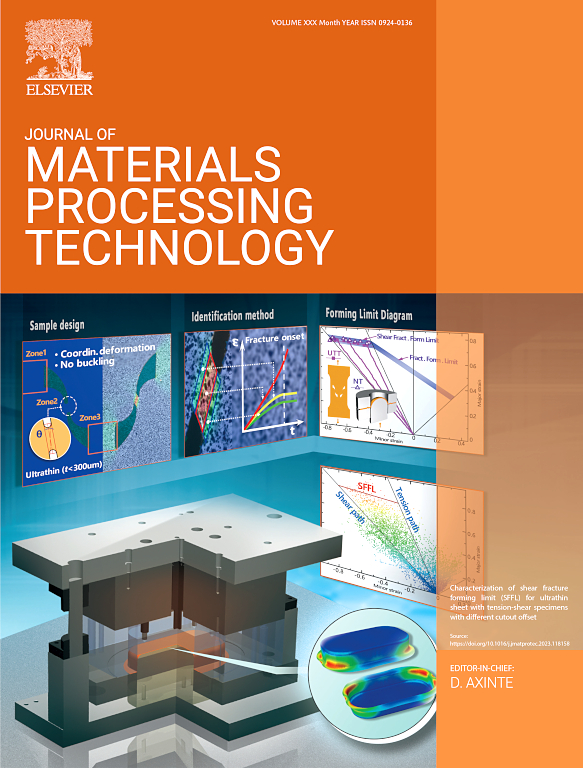
The Journal of Materials Processing Technology covers the processing techniques used in manufacturing components from metals and other materials. The journal aims to publish full research papers of original, significant and rigorous work and so to contribute to increased production efficiency and improved component performance.
Areas of interest to the journal include:
• Casting, forming and machining
• Additive processing and joining technologies
• The evolution of material properties under the specific conditions met in manufacturing processes
• Surface engineering when it relates specifically to a manufacturing process
• Design and behavior of equipment and tools.




 京公网安备 11010802042870号
京ICP备2023020795号-1
京公网安备 11010802042870号
京ICP备2023020795号-1

 分享
分享
 求助内容:
求助内容: 应助结果提醒方式:
 扫码关注我们
