S.V. Jasira , V.P. Veena , C.K. Shilpa , S.S. Ancy , Benjamin Hudson Baby , K. Greeshma , K.M. Nissamudeen , P. Sakthivel
{"title":"双敏化镨掺杂钡铈的协同发光增强:光电子学白光发射的意义","authors":"S.V. Jasira , V.P. Veena , C.K. Shilpa , S.S. Ancy , Benjamin Hudson Baby , K. Greeshma , K.M. Nissamudeen , P. Sakthivel","doi":"10.1016/j.saa.2025.126179","DOIUrl":null,"url":null,"abstract":"<div><div>Praseodymium-incorporated barium cerate perovskites (BaCeO<sub>3</sub>:1 wt% Pr<sup>3+</sup>) show promise for use in white LEDs. The present study focuses on the influence of bismuth as the sensitizer in the luminescence of BaCeO<sub>3</sub>:1 wt% Pr<sup>3+</sup>. The novel perovskites were prepared using a low-temperature solution combustion method, with citric acid (fuel) and ammonium nitrate (extra oxidizer). In this study involving co-doping BaCeO<sub>3</sub>:1 wt% Pr<sup>3+</sup> with bismuth, the influence of sensitizer concentration (0–2 wt%) on crystalline phases, band gap energy, and the luminescent properties of ceramic powders was explored through X-ray diffraction, UV–visible absorption spectra, and photoluminescence characterization methods. The experimental results revealed the orthorhombic single-phase formation of BaCeO<sub>3</sub>:1 wt% Pr<sup>3+</sup>:xwt% Bi<sup>3+</sup> perovskites yielding high crystallinity and luminescence maximum at critical sensitizer concentration of 1 wt% Bi<sup>3+</sup>. Also, all the perovskites’ bright white light emission was confirmed using the CIE color chromaticity diagram. Consequently, the nano-perovskite BaCeO<sub>3</sub>:1 wt% Pr<sup>3+</sup>:1 wt% Bi<sup>3+</sup> emerges as an inevitable white-light-emitting phosphor with significant potential for energy-saving applications.</div></div>","PeriodicalId":433,"journal":{"name":"Spectrochimica Acta Part A: Molecular and Biomolecular Spectroscopy","volume":"338 ","pages":"Article 126179"},"PeriodicalIF":4.6000,"publicationDate":"2025-10-05","publicationTypes":"Journal Article","fieldsOfStudy":null,"isOpenAccess":false,"openAccessPdf":"","citationCount":"0","resultStr":"{\"title\":\"Synergistic luminescence enhancement in bi-sensitized praseodymium-doped barium cerates: Implications for white light emission in optoelectronics\",\"authors\":\"S.V. Jasira , V.P. Veena , C.K. Shilpa , S.S. Ancy , Benjamin Hudson Baby , K. Greeshma , K.M. Nissamudeen , P. Sakthivel\",\"doi\":\"10.1016/j.saa.2025.126179\",\"DOIUrl\":null,\"url\":null,\"abstract\":\"<div><div>Praseodymium-incorporated barium cerate perovskites (BaCeO<sub>3</sub>:1 wt% Pr<sup>3+</sup>) show promise for use in white LEDs. The present study focuses on the influence of bismuth as the sensitizer in the luminescence of BaCeO<sub>3</sub>:1 wt% Pr<sup>3+</sup>. The novel perovskites were prepared using a low-temperature solution combustion method, with citric acid (fuel) and ammonium nitrate (extra oxidizer). In this study involving co-doping BaCeO<sub>3</sub>:1 wt% Pr<sup>3+</sup> with bismuth, the influence of sensitizer concentration (0–2 wt%) on crystalline phases, band gap energy, and the luminescent properties of ceramic powders was explored through X-ray diffraction, UV–visible absorption spectra, and photoluminescence characterization methods. The experimental results revealed the orthorhombic single-phase formation of BaCeO<sub>3</sub>:1 wt% Pr<sup>3+</sup>:xwt% Bi<sup>3+</sup> perovskites yielding high crystallinity and luminescence maximum at critical sensitizer concentration of 1 wt% Bi<sup>3+</sup>. Also, all the perovskites’ bright white light emission was confirmed using the CIE color chromaticity diagram. Consequently, the nano-perovskite BaCeO<sub>3</sub>:1 wt% Pr<sup>3+</sup>:1 wt% Bi<sup>3+</sup> emerges as an inevitable white-light-emitting phosphor with significant potential for energy-saving applications.</div></div>\",\"PeriodicalId\":433,\"journal\":{\"name\":\"Spectrochimica Acta Part A: Molecular and Biomolecular Spectroscopy\",\"volume\":\"338 \",\"pages\":\"Article 126179\"},\"PeriodicalIF\":4.6000,\"publicationDate\":\"2025-10-05\",\"publicationTypes\":\"Journal Article\",\"fieldsOfStudy\":null,\"isOpenAccess\":false,\"openAccessPdf\":\"\",\"citationCount\":\"0\",\"resultStr\":null,\"platform\":\"Semanticscholar\",\"paperid\":null,\"PeriodicalName\":\"Spectrochimica Acta Part A: Molecular and Biomolecular Spectroscopy\",\"FirstCategoryId\":\"92\",\"ListUrlMain\":\"https://www.sciencedirect.com/science/article/pii/S1386142525004858\",\"RegionNum\":2,\"RegionCategory\":\"化学\",\"ArticlePicture\":[],\"TitleCN\":null,\"AbstractTextCN\":null,\"PMCID\":null,\"EPubDate\":\"2025/4/8 0:00:00\",\"PubModel\":\"Epub\",\"JCR\":\"Q1\",\"JCRName\":\"SPECTROSCOPY\",\"Score\":null,\"Total\":0}","platform":"Semanticscholar","paperid":null,"PeriodicalName":"Spectrochimica Acta Part A: Molecular and Biomolecular Spectroscopy","FirstCategoryId":"92","ListUrlMain":"https://www.sciencedirect.com/science/article/pii/S1386142525004858","RegionNum":2,"RegionCategory":"化学","ArticlePicture":[],"TitleCN":null,"AbstractTextCN":null,"PMCID":null,"EPubDate":"2025/4/8 0:00:00","PubModel":"Epub","JCR":"Q1","JCRName":"SPECTROSCOPY","Score":null,"Total":0}
Synergistic luminescence enhancement in bi-sensitized praseodymium-doped barium cerates: Implications for white light emission in optoelectronics
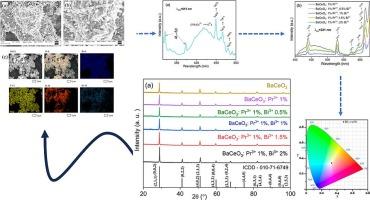
Praseodymium-incorporated barium cerate perovskites (BaCeO3:1 wt% Pr3+) show promise for use in white LEDs. The present study focuses on the influence of bismuth as the sensitizer in the luminescence of BaCeO3:1 wt% Pr3+. The novel perovskites were prepared using a low-temperature solution combustion method, with citric acid (fuel) and ammonium nitrate (extra oxidizer). In this study involving co-doping BaCeO3:1 wt% Pr3+ with bismuth, the influence of sensitizer concentration (0–2 wt%) on crystalline phases, band gap energy, and the luminescent properties of ceramic powders was explored through X-ray diffraction, UV–visible absorption spectra, and photoluminescence characterization methods. The experimental results revealed the orthorhombic single-phase formation of BaCeO3:1 wt% Pr3+:xwt% Bi3+ perovskites yielding high crystallinity and luminescence maximum at critical sensitizer concentration of 1 wt% Bi3+. Also, all the perovskites’ bright white light emission was confirmed using the CIE color chromaticity diagram. Consequently, the nano-perovskite BaCeO3:1 wt% Pr3+:1 wt% Bi3+ emerges as an inevitable white-light-emitting phosphor with significant potential for energy-saving applications.
期刊介绍:
Spectrochimica Acta, Part A: Molecular and Biomolecular Spectroscopy (SAA) is an interdisciplinary journal which spans from basic to applied aspects of optical spectroscopy in chemistry, medicine, biology, and materials science.
The journal publishes original scientific papers that feature high-quality spectroscopic data and analysis. From the broad range of optical spectroscopies, the emphasis is on electronic, vibrational or rotational spectra of molecules, rather than on spectroscopy based on magnetic moments.
Criteria for publication in SAA are novelty, uniqueness, and outstanding quality. Routine applications of spectroscopic techniques and computational methods are not appropriate.
Topics of particular interest of Spectrochimica Acta Part A include, but are not limited to:
Spectroscopy and dynamics of bioanalytical, biomedical, environmental, and atmospheric sciences,
Novel experimental techniques or instrumentation for molecular spectroscopy,
Novel theoretical and computational methods,
Novel applications in photochemistry and photobiology,
Novel interpretational approaches as well as advances in data analysis based on electronic or vibrational spectroscopy.




 京公网安备 11010802042870号
京ICP备2023020795号-1
京公网安备 11010802042870号
京ICP备2023020795号-1

 分享
分享
 求助内容:
求助内容: 应助结果提醒方式:
 扫码关注我们
