Giuseppina Anna Corrente, Luana Malacaria, Amerigo Beneduci, Tiziana Marino and Emilia Furia
{"title":"纯水溶液中槲皮素和木犀草素与第一排过渡金属的络合:化学计量学和结合位点选择性","authors":"Giuseppina Anna Corrente, Luana Malacaria, Amerigo Beneduci, Tiziana Marino and Emilia Furia","doi":"10.1039/D5DT00478K","DOIUrl":null,"url":null,"abstract":"<p >The complexation behaviour of quercetin and luteolin with first-row transition metals (Cr(<small>III</small>), Mn(<small>II</small>), Co(<small>II</small>), Ni(<small>II</small>), and Zn(<small>II</small>)) in aqueous solutions was systematically investigated using potentiometric titrations, UV-Vis and FT-IR spectroscopy, and density functional theory (DFT) calculations. This study aimed to elucidate the stability, stoichiometry, and preferred binding sites of these flavonoid–metal complexes in an entirely aqueous solution at 37 °C as a function of pH under controlled ionic strength. Speciation analysis revealed the formation of 1 : 1, 1 : 2, and 1 : 3 metal-to-ligand complexes, with coordination occurring primarily at the 4,5- or 3,4-binding site, depending on the metal ion and ligand structure. UV-Vis and IR spectral changes confirmed complex formation, while computational modeling provided insights into binding site selectivity and free energy changes associated with coordination. Results highlight the influence of the ligand structure on metal affinity and stability, with quercetin forming more stable complexes than those formed by luteolin owing to the presence of an additional hydroxyl group at position 3. These findings contribute to a deeper understanding of flavonoid–metal interactions, with potential implications for antioxidant activity, metal chelation therapy, and environmental applications.</p>","PeriodicalId":71,"journal":{"name":"Dalton Transactions","volume":" 19","pages":" 7828-7837"},"PeriodicalIF":3.3000,"publicationDate":"2025-04-11","publicationTypes":"Journal Article","fieldsOfStudy":null,"isOpenAccess":false,"openAccessPdf":"https://pubs.rsc.org/en/content/articlepdf/2025/dt/d5dt00478k?page=search","citationCount":"0","resultStr":"{\"title\":\"Quercetin and luteolin complexation with first-row transition metals in purely aqueous solutions: stoichiometry and binding site selectivity†\",\"authors\":\"Giuseppina Anna Corrente, Luana Malacaria, Amerigo Beneduci, Tiziana Marino and Emilia Furia\",\"doi\":\"10.1039/D5DT00478K\",\"DOIUrl\":null,\"url\":null,\"abstract\":\"<p >The complexation behaviour of quercetin and luteolin with first-row transition metals (Cr(<small>III</small>), Mn(<small>II</small>), Co(<small>II</small>), Ni(<small>II</small>), and Zn(<small>II</small>)) in aqueous solutions was systematically investigated using potentiometric titrations, UV-Vis and FT-IR spectroscopy, and density functional theory (DFT) calculations. This study aimed to elucidate the stability, stoichiometry, and preferred binding sites of these flavonoid–metal complexes in an entirely aqueous solution at 37 °C as a function of pH under controlled ionic strength. Speciation analysis revealed the formation of 1 : 1, 1 : 2, and 1 : 3 metal-to-ligand complexes, with coordination occurring primarily at the 4,5- or 3,4-binding site, depending on the metal ion and ligand structure. UV-Vis and IR spectral changes confirmed complex formation, while computational modeling provided insights into binding site selectivity and free energy changes associated with coordination. Results highlight the influence of the ligand structure on metal affinity and stability, with quercetin forming more stable complexes than those formed by luteolin owing to the presence of an additional hydroxyl group at position 3. These findings contribute to a deeper understanding of flavonoid–metal interactions, with potential implications for antioxidant activity, metal chelation therapy, and environmental applications.</p>\",\"PeriodicalId\":71,\"journal\":{\"name\":\"Dalton Transactions\",\"volume\":\" 19\",\"pages\":\" 7828-7837\"},\"PeriodicalIF\":3.3000,\"publicationDate\":\"2025-04-11\",\"publicationTypes\":\"Journal Article\",\"fieldsOfStudy\":null,\"isOpenAccess\":false,\"openAccessPdf\":\"https://pubs.rsc.org/en/content/articlepdf/2025/dt/d5dt00478k?page=search\",\"citationCount\":\"0\",\"resultStr\":null,\"platform\":\"Semanticscholar\",\"paperid\":null,\"PeriodicalName\":\"Dalton Transactions\",\"FirstCategoryId\":\"92\",\"ListUrlMain\":\"https://pubs.rsc.org/en/content/articlelanding/2025/dt/d5dt00478k\",\"RegionNum\":3,\"RegionCategory\":\"化学\",\"ArticlePicture\":[],\"TitleCN\":null,\"AbstractTextCN\":null,\"PMCID\":null,\"EPubDate\":\"\",\"PubModel\":\"\",\"JCR\":\"Q2\",\"JCRName\":\"CHEMISTRY, INORGANIC & NUCLEAR\",\"Score\":null,\"Total\":0}","platform":"Semanticscholar","paperid":null,"PeriodicalName":"Dalton Transactions","FirstCategoryId":"92","ListUrlMain":"https://pubs.rsc.org/en/content/articlelanding/2025/dt/d5dt00478k","RegionNum":3,"RegionCategory":"化学","ArticlePicture":[],"TitleCN":null,"AbstractTextCN":null,"PMCID":null,"EPubDate":"","PubModel":"","JCR":"Q2","JCRName":"CHEMISTRY, INORGANIC & NUCLEAR","Score":null,"Total":0}
Quercetin and luteolin complexation with first-row transition metals in purely aqueous solutions: stoichiometry and binding site selectivity†
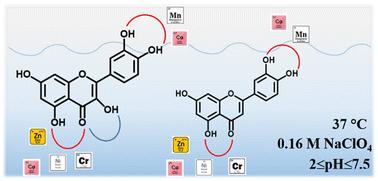
The complexation behaviour of quercetin and luteolin with first-row transition metals (Cr(III), Mn(II), Co(II), Ni(II), and Zn(II)) in aqueous solutions was systematically investigated using potentiometric titrations, UV-Vis and FT-IR spectroscopy, and density functional theory (DFT) calculations. This study aimed to elucidate the stability, stoichiometry, and preferred binding sites of these flavonoid–metal complexes in an entirely aqueous solution at 37 °C as a function of pH under controlled ionic strength. Speciation analysis revealed the formation of 1 : 1, 1 : 2, and 1 : 3 metal-to-ligand complexes, with coordination occurring primarily at the 4,5- or 3,4-binding site, depending on the metal ion and ligand structure. UV-Vis and IR spectral changes confirmed complex formation, while computational modeling provided insights into binding site selectivity and free energy changes associated with coordination. Results highlight the influence of the ligand structure on metal affinity and stability, with quercetin forming more stable complexes than those formed by luteolin owing to the presence of an additional hydroxyl group at position 3. These findings contribute to a deeper understanding of flavonoid–metal interactions, with potential implications for antioxidant activity, metal chelation therapy, and environmental applications.
期刊介绍:
Dalton Transactions is a journal for all areas of inorganic chemistry, which encompasses the organometallic, bioinorganic and materials chemistry of the elements, with applications including synthesis, catalysis, energy conversion/storage, electrical devices and medicine. Dalton Transactions welcomes high-quality, original submissions in all of these areas and more, where the advancement of knowledge in inorganic chemistry is significant.




 京公网安备 11010802042870号
京ICP备2023020795号-1
京公网安备 11010802042870号
京ICP备2023020795号-1

 分享
分享
 求助内容:
求助内容: 应助结果提醒方式:
 扫码关注我们
