Xiaoxue Liu, Xi Chu, Chenghao Li, Hongyi Liu, Yihao Zheng and Hongyan Li
{"title":"含1,10-菲罗啉衍生物的磷光铱(III)配合物作为中性配体的选择性和灵敏度检测CO2","authors":"Xiaoxue Liu, Xi Chu, Chenghao Li, Hongyi Liu, Yihao Zheng and Hongyan Li","doi":"10.1039/D5DT00181A","DOIUrl":null,"url":null,"abstract":"<p >Based on the neutral ligands of 2-phenyl-1<em>H</em>-imidazo[4,5-<em>f</em>][1,10]phenanthroline (pip) and 2-(4-(trifluoromethylphenyl)-1<em>H</em>-imidazo[4,5-<em>f</em>][1,10]phenanthroline) (tfpip), iridium(<small>III</small>) complexes [(F<small><sub>4</sub></small>ppy)<small><sub>2</sub></small>Ir(pip)](PF<small><sub>6</sub></small>) (<strong>1</strong>, F<small><sub>4</sub></small>ppy = 2-(4-fluorophenyl)pyridine), [(F<small><sub>4</sub></small>piq)<small><sub>2</sub></small>Ir(pip)](PF<small><sub>6</sub></small>) (<strong>2</strong>, F<small><sub>4</sub></small>piq = 3-(4-fluorophenyl)isoquinoline), [(F<small><sub>4</sub></small>ppy)<small><sub>2</sub></small>Ir(tfpip)] (PF<small><sub>6</sub></small>) (<strong>3</strong>), [(F<small><sub>4</sub></small>piq)<small><sub>2</sub></small>Ir(tfpip)](PF<small><sub>6</sub></small>) (<strong>4</strong>), [(F<small><sub>3,5</sub></small>ppy)<small><sub>2</sub></small>Ir(pip)](PF<small><sub>6</sub></small>) (<strong>5</strong>, F<small><sub>3,5</sub></small>ppy = 2-(3,5-difluorophenyl)pyridine), [(F<small><sub>3,5</sub></small>piq)<small><sub>2</sub></small>Ir(pip)](PF<small><sub>6</sub></small>) (<strong>6</strong>, F<small><sub>3,5</sub></small>piq = 3-(3,5-difluorophenyl)isoquinoline), [(F<small><sub>3,5</sub></small>ppy)<small><sub>2</sub></small>Ir(tfpip)](PF<small><sub>6</sub></small>) (<strong>7</strong>) and [(F<small><sub>3,5</sub></small>piq)<small><sub>2</sub></small>Ir(tfpip)](PF<small><sub>6</sub></small>) (<strong>8</strong>) were synthesized and characterized. Complexes <strong>1–8</strong> exhibited yellow-green and red luminescence (<em>λ</em> = 528–588 nm) in acetonitrile solution. The photoluminescence quantum yields (PLQYs) of complexes <strong>1–8</strong> ranged from 0.44 to 0.80, and complex <strong>7</strong> with yellow-green emission had the best PLQY of 0.80. An electrochemical study and density functional theory (DFT) calculations showed that the luminescence characteristics of the complexes are mainly controlled through the modification of cyclometalated ligands. Upon addition of CH<small><sub>3</sub></small>COO<small><sup>−</sup></small> to the solution of complexes <strong>1</strong> and <strong>5</strong>, the luminescence intensity of <strong>1</strong> and <strong>5</strong> was quenched by 80% and 91%. After bubbling CO<small><sub>2</sub></small> gas into the solution of iridium complexes containing CH<small><sub>3</sub></small>COO<small><sup>−</sup></small>, complexes <strong>1</strong> and <strong>5</strong> both showed turn-on phosphorescence responses with high sensitivity, excellent selectivity, good reversibility and a low detection limit as low as 22.8 μM.</p>","PeriodicalId":71,"journal":{"name":"Dalton Transactions","volume":" 19","pages":" 7843-7850"},"PeriodicalIF":3.3000,"publicationDate":"2025-04-11","publicationTypes":"Journal Article","fieldsOfStudy":null,"isOpenAccess":false,"openAccessPdf":"","citationCount":"0","resultStr":"{\"title\":\"Selective and sensitive detection of CO2 using phosphorescent iridium(iii) complexes containing 1,10-phenanthroline derivatives as neutral ligands†\",\"authors\":\"Xiaoxue Liu, Xi Chu, Chenghao Li, Hongyi Liu, Yihao Zheng and Hongyan Li\",\"doi\":\"10.1039/D5DT00181A\",\"DOIUrl\":null,\"url\":null,\"abstract\":\"<p >Based on the neutral ligands of 2-phenyl-1<em>H</em>-imidazo[4,5-<em>f</em>][1,10]phenanthroline (pip) and 2-(4-(trifluoromethylphenyl)-1<em>H</em>-imidazo[4,5-<em>f</em>][1,10]phenanthroline) (tfpip), iridium(<small>III</small>) complexes [(F<small><sub>4</sub></small>ppy)<small><sub>2</sub></small>Ir(pip)](PF<small><sub>6</sub></small>) (<strong>1</strong>, F<small><sub>4</sub></small>ppy = 2-(4-fluorophenyl)pyridine), [(F<small><sub>4</sub></small>piq)<small><sub>2</sub></small>Ir(pip)](PF<small><sub>6</sub></small>) (<strong>2</strong>, F<small><sub>4</sub></small>piq = 3-(4-fluorophenyl)isoquinoline), [(F<small><sub>4</sub></small>ppy)<small><sub>2</sub></small>Ir(tfpip)] (PF<small><sub>6</sub></small>) (<strong>3</strong>), [(F<small><sub>4</sub></small>piq)<small><sub>2</sub></small>Ir(tfpip)](PF<small><sub>6</sub></small>) (<strong>4</strong>), [(F<small><sub>3,5</sub></small>ppy)<small><sub>2</sub></small>Ir(pip)](PF<small><sub>6</sub></small>) (<strong>5</strong>, F<small><sub>3,5</sub></small>ppy = 2-(3,5-difluorophenyl)pyridine), [(F<small><sub>3,5</sub></small>piq)<small><sub>2</sub></small>Ir(pip)](PF<small><sub>6</sub></small>) (<strong>6</strong>, F<small><sub>3,5</sub></small>piq = 3-(3,5-difluorophenyl)isoquinoline), [(F<small><sub>3,5</sub></small>ppy)<small><sub>2</sub></small>Ir(tfpip)](PF<small><sub>6</sub></small>) (<strong>7</strong>) and [(F<small><sub>3,5</sub></small>piq)<small><sub>2</sub></small>Ir(tfpip)](PF<small><sub>6</sub></small>) (<strong>8</strong>) were synthesized and characterized. Complexes <strong>1–8</strong> exhibited yellow-green and red luminescence (<em>λ</em> = 528–588 nm) in acetonitrile solution. The photoluminescence quantum yields (PLQYs) of complexes <strong>1–8</strong> ranged from 0.44 to 0.80, and complex <strong>7</strong> with yellow-green emission had the best PLQY of 0.80. An electrochemical study and density functional theory (DFT) calculations showed that the luminescence characteristics of the complexes are mainly controlled through the modification of cyclometalated ligands. Upon addition of CH<small><sub>3</sub></small>COO<small><sup>−</sup></small> to the solution of complexes <strong>1</strong> and <strong>5</strong>, the luminescence intensity of <strong>1</strong> and <strong>5</strong> was quenched by 80% and 91%. After bubbling CO<small><sub>2</sub></small> gas into the solution of iridium complexes containing CH<small><sub>3</sub></small>COO<small><sup>−</sup></small>, complexes <strong>1</strong> and <strong>5</strong> both showed turn-on phosphorescence responses with high sensitivity, excellent selectivity, good reversibility and a low detection limit as low as 22.8 μM.</p>\",\"PeriodicalId\":71,\"journal\":{\"name\":\"Dalton Transactions\",\"volume\":\" 19\",\"pages\":\" 7843-7850\"},\"PeriodicalIF\":3.3000,\"publicationDate\":\"2025-04-11\",\"publicationTypes\":\"Journal Article\",\"fieldsOfStudy\":null,\"isOpenAccess\":false,\"openAccessPdf\":\"\",\"citationCount\":\"0\",\"resultStr\":null,\"platform\":\"Semanticscholar\",\"paperid\":null,\"PeriodicalName\":\"Dalton Transactions\",\"FirstCategoryId\":\"92\",\"ListUrlMain\":\"https://pubs.rsc.org/en/content/articlelanding/2025/dt/d5dt00181a\",\"RegionNum\":3,\"RegionCategory\":\"化学\",\"ArticlePicture\":[],\"TitleCN\":null,\"AbstractTextCN\":null,\"PMCID\":null,\"EPubDate\":\"\",\"PubModel\":\"\",\"JCR\":\"Q2\",\"JCRName\":\"CHEMISTRY, INORGANIC & NUCLEAR\",\"Score\":null,\"Total\":0}","platform":"Semanticscholar","paperid":null,"PeriodicalName":"Dalton Transactions","FirstCategoryId":"92","ListUrlMain":"https://pubs.rsc.org/en/content/articlelanding/2025/dt/d5dt00181a","RegionNum":3,"RegionCategory":"化学","ArticlePicture":[],"TitleCN":null,"AbstractTextCN":null,"PMCID":null,"EPubDate":"","PubModel":"","JCR":"Q2","JCRName":"CHEMISTRY, INORGANIC & NUCLEAR","Score":null,"Total":0}
Selective and sensitive detection of CO2 using phosphorescent iridium(iii) complexes containing 1,10-phenanthroline derivatives as neutral ligands†
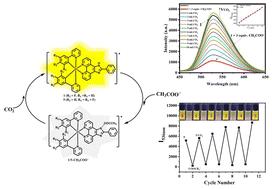
Based on the neutral ligands of 2-phenyl-1H-imidazo[4,5-f][1,10]phenanthroline (pip) and 2-(4-(trifluoromethylphenyl)-1H-imidazo[4,5-f][1,10]phenanthroline) (tfpip), iridium(III) complexes [(F4ppy)2Ir(pip)](PF6) (1, F4ppy = 2-(4-fluorophenyl)pyridine), [(F4piq)2Ir(pip)](PF6) (2, F4piq = 3-(4-fluorophenyl)isoquinoline), [(F4ppy)2Ir(tfpip)] (PF6) (3), [(F4piq)2Ir(tfpip)](PF6) (4), [(F3,5ppy)2Ir(pip)](PF6) (5, F3,5ppy = 2-(3,5-difluorophenyl)pyridine), [(F3,5piq)2Ir(pip)](PF6) (6, F3,5piq = 3-(3,5-difluorophenyl)isoquinoline), [(F3,5ppy)2Ir(tfpip)](PF6) (7) and [(F3,5piq)2Ir(tfpip)](PF6) (8) were synthesized and characterized. Complexes 1–8 exhibited yellow-green and red luminescence (λ = 528–588 nm) in acetonitrile solution. The photoluminescence quantum yields (PLQYs) of complexes 1–8 ranged from 0.44 to 0.80, and complex 7 with yellow-green emission had the best PLQY of 0.80. An electrochemical study and density functional theory (DFT) calculations showed that the luminescence characteristics of the complexes are mainly controlled through the modification of cyclometalated ligands. Upon addition of CH3COO− to the solution of complexes 1 and 5, the luminescence intensity of 1 and 5 was quenched by 80% and 91%. After bubbling CO2 gas into the solution of iridium complexes containing CH3COO−, complexes 1 and 5 both showed turn-on phosphorescence responses with high sensitivity, excellent selectivity, good reversibility and a low detection limit as low as 22.8 μM.
期刊介绍:
Dalton Transactions is a journal for all areas of inorganic chemistry, which encompasses the organometallic, bioinorganic and materials chemistry of the elements, with applications including synthesis, catalysis, energy conversion/storage, electrical devices and medicine. Dalton Transactions welcomes high-quality, original submissions in all of these areas and more, where the advancement of knowledge in inorganic chemistry is significant.




 京公网安备 11010802042870号
京ICP备2023020795号-1
京公网安备 11010802042870号
京ICP备2023020795号-1

 分享
分享
 求助内容:
求助内容: 应助结果提醒方式:
 扫码关注我们
