Na Feng , Xin Guo , Mengmeng Chen , Xushuai Chen , Chen Li , Luke Yan , Peng Yang , Jia Kong
{"title":"用于聚合物分离的水下超多疏淀粉样蛋白涂层","authors":"Na Feng , Xin Guo , Mengmeng Chen , Xushuai Chen , Chen Li , Luke Yan , Peng Yang , Jia Kong","doi":"10.1016/j.seppur.2025.132965","DOIUrl":null,"url":null,"abstract":"<div><div>The widespread use of liquid polymers leads to significant waste and environmental pollution due to their leakage into water, and their removal is challenging due to their high viscosity, low fluidity, and strong adhesion. In this study, we introduce a superpolymphobic amyloid-like protein (ALP) coating for the removal of liquid polymers from water. The composite ALP coating, composed of phase-transitioned lysozyme and oxidized cellulose nanocrystals, was applied to a stainless-steel mesh. This ALP-coated mesh demonstrated excellent underwater superpolymphobicity with a polymer contact angle of 167.7 ± 1.1° and a sliding angle of 1.3 ± 0.1°. The coated mesh effectively repelled various liquid polymers (such as polydimethylsiloxane, epoxy resins, and silicone oils), enabling efficient separation of polymer/water mixtures with a separation efficiency of 99.49 %. The coating exhibited remarkable mechanical and chemical stability, maintaining its performance after multiple cycles of use and stringent durability tests, including bending, sandpaper abrasion, ultrasonic treatment, tape peeling, flushing, and exposure to acidic or alkaline solutions. The ALP coating can be applied to commercially available pre-filters, resulting in the production of pure water free from polymer contaminants. Furthermore, the coating can be regenerated for infinite recycling by simply spraying it on. This approach demonstrates direct applicability for retrofitting existing water purification systems, exhibiting enhanced biocompatibility and superior mechanical stability while providing a simple, mild, and scalable strategy to address polymer contamination in aquatic ecosystems.</div></div>","PeriodicalId":427,"journal":{"name":"Separation and Purification Technology","volume":"367 ","pages":"Article 132965"},"PeriodicalIF":9.1000,"publicationDate":"2025-09-07","publicationTypes":"Journal Article","fieldsOfStudy":null,"isOpenAccess":false,"openAccessPdf":"","citationCount":"0","resultStr":"{\"title\":\"Underwater superpolymphobic amyloid-like protein coating for polymer separation\",\"authors\":\"Na Feng , Xin Guo , Mengmeng Chen , Xushuai Chen , Chen Li , Luke Yan , Peng Yang , Jia Kong\",\"doi\":\"10.1016/j.seppur.2025.132965\",\"DOIUrl\":null,\"url\":null,\"abstract\":\"<div><div>The widespread use of liquid polymers leads to significant waste and environmental pollution due to their leakage into water, and their removal is challenging due to their high viscosity, low fluidity, and strong adhesion. In this study, we introduce a superpolymphobic amyloid-like protein (ALP) coating for the removal of liquid polymers from water. The composite ALP coating, composed of phase-transitioned lysozyme and oxidized cellulose nanocrystals, was applied to a stainless-steel mesh. This ALP-coated mesh demonstrated excellent underwater superpolymphobicity with a polymer contact angle of 167.7 ± 1.1° and a sliding angle of 1.3 ± 0.1°. The coated mesh effectively repelled various liquid polymers (such as polydimethylsiloxane, epoxy resins, and silicone oils), enabling efficient separation of polymer/water mixtures with a separation efficiency of 99.49 %. The coating exhibited remarkable mechanical and chemical stability, maintaining its performance after multiple cycles of use and stringent durability tests, including bending, sandpaper abrasion, ultrasonic treatment, tape peeling, flushing, and exposure to acidic or alkaline solutions. The ALP coating can be applied to commercially available pre-filters, resulting in the production of pure water free from polymer contaminants. Furthermore, the coating can be regenerated for infinite recycling by simply spraying it on. This approach demonstrates direct applicability for retrofitting existing water purification systems, exhibiting enhanced biocompatibility and superior mechanical stability while providing a simple, mild, and scalable strategy to address polymer contamination in aquatic ecosystems.</div></div>\",\"PeriodicalId\":427,\"journal\":{\"name\":\"Separation and Purification Technology\",\"volume\":\"367 \",\"pages\":\"Article 132965\"},\"PeriodicalIF\":9.1000,\"publicationDate\":\"2025-09-07\",\"publicationTypes\":\"Journal Article\",\"fieldsOfStudy\":null,\"isOpenAccess\":false,\"openAccessPdf\":\"\",\"citationCount\":\"0\",\"resultStr\":null,\"platform\":\"Semanticscholar\",\"paperid\":null,\"PeriodicalName\":\"Separation and Purification Technology\",\"FirstCategoryId\":\"5\",\"ListUrlMain\":\"https://www.sciencedirect.com/science/article/pii/S138358662501562X\",\"RegionNum\":1,\"RegionCategory\":\"工程技术\",\"ArticlePicture\":[],\"TitleCN\":null,\"AbstractTextCN\":null,\"PMCID\":null,\"EPubDate\":\"2025/4/10 0:00:00\",\"PubModel\":\"Epub\",\"JCR\":\"Q1\",\"JCRName\":\"ENGINEERING, CHEMICAL\",\"Score\":null,\"Total\":0}","platform":"Semanticscholar","paperid":null,"PeriodicalName":"Separation and Purification Technology","FirstCategoryId":"5","ListUrlMain":"https://www.sciencedirect.com/science/article/pii/S138358662501562X","RegionNum":1,"RegionCategory":"工程技术","ArticlePicture":[],"TitleCN":null,"AbstractTextCN":null,"PMCID":null,"EPubDate":"2025/4/10 0:00:00","PubModel":"Epub","JCR":"Q1","JCRName":"ENGINEERING, CHEMICAL","Score":null,"Total":0}
引用次数: 0
摘要
液态聚合物的广泛使用会导致大量废物和环境污染,因为它们会渗漏到水中,而由于它们的高粘度、低流动性和强粘附性,清除它们是一项挑战。在本研究中,我们介绍了一种超疏水淀粉样蛋白(ALP)涂层,用于去除水中的液态聚合物。由相变溶菌酶和氧化纤维素纳米晶体组成的复合 ALP 涂层被应用于不锈钢网。这种涂有 ALP 涂层的钢网表现出优异的水下超疏水性能,其聚合物接触角为 167.7 ± 1.1°,滑动角为 1.3 ± 0.1°。涂层网能有效排斥各种液态聚合物(如聚二甲基硅氧烷、环氧树脂和硅油),从而实现聚合物/水混合物的高效分离,分离效率高达 99.49%。该涂层具有出色的机械和化学稳定性,在经过多次循环使用和严格的耐久性测试(包括弯曲、砂纸磨损、超声波处理、胶带剥离、冲洗以及暴露于酸性或碱性溶液中)后仍能保持其性能。ALP 涂层可用于市售的预过滤器,从而生产出不含聚合物污染物的纯水。此外,只需简单喷涂,涂层即可再生,实现无限循环。这种方法直接适用于改造现有的净水系统,具有更强的生物相容性和卓越的机械稳定性,同时提供了一种简单、温和、可扩展的策略来解决水生生态系统中的聚合物污染问题。
Underwater superpolymphobic amyloid-like protein coating for polymer separation
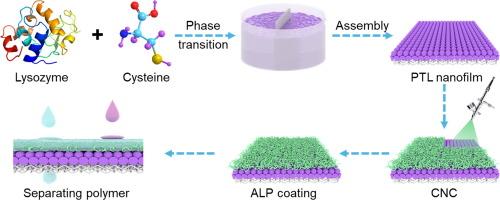
The widespread use of liquid polymers leads to significant waste and environmental pollution due to their leakage into water, and their removal is challenging due to their high viscosity, low fluidity, and strong adhesion. In this study, we introduce a superpolymphobic amyloid-like protein (ALP) coating for the removal of liquid polymers from water. The composite ALP coating, composed of phase-transitioned lysozyme and oxidized cellulose nanocrystals, was applied to a stainless-steel mesh. This ALP-coated mesh demonstrated excellent underwater superpolymphobicity with a polymer contact angle of 167.7 ± 1.1° and a sliding angle of 1.3 ± 0.1°. The coated mesh effectively repelled various liquid polymers (such as polydimethylsiloxane, epoxy resins, and silicone oils), enabling efficient separation of polymer/water mixtures with a separation efficiency of 99.49 %. The coating exhibited remarkable mechanical and chemical stability, maintaining its performance after multiple cycles of use and stringent durability tests, including bending, sandpaper abrasion, ultrasonic treatment, tape peeling, flushing, and exposure to acidic or alkaline solutions. The ALP coating can be applied to commercially available pre-filters, resulting in the production of pure water free from polymer contaminants. Furthermore, the coating can be regenerated for infinite recycling by simply spraying it on. This approach demonstrates direct applicability for retrofitting existing water purification systems, exhibiting enhanced biocompatibility and superior mechanical stability while providing a simple, mild, and scalable strategy to address polymer contamination in aquatic ecosystems.
期刊介绍:
Separation and Purification Technology is a premier journal committed to sharing innovative methods for separation and purification in chemical and environmental engineering, encompassing both homogeneous solutions and heterogeneous mixtures. Our scope includes the separation and/or purification of liquids, vapors, and gases, as well as carbon capture and separation techniques. However, it's important to note that methods solely intended for analytical purposes are not within the scope of the journal. Additionally, disciplines such as soil science, polymer science, and metallurgy fall outside the purview of Separation and Purification Technology. Join us in advancing the field of separation and purification methods for sustainable solutions in chemical and environmental engineering.





 京公网安备 11010802042870号
京ICP备2023020795号-1
京公网安备 11010802042870号
京ICP备2023020795号-1

 分享
分享
 求助内容:
求助内容: 应助结果提醒方式:
 扫码关注我们
