{"title":"高效包晶太阳能电池的界面能量学逆转策略","authors":"Sheng Jiang, Shaobing Xiong, Zhongcheng Yuan, Yafang Li, Xiaomeng You, Hongbo Wu, Menghui Jia, Zhennan Lin, Zaifei Ma, Yuning Wu, Yefeng Yao, Xianjie Liu, Junhao Chu, Zhenrong Sun, Mats Fahlman, Henry J. Snaith, Qinye Bao","doi":"10.1002/adma.202503110","DOIUrl":null,"url":null,"abstract":"<p>Reducing heterointerface nonradiative recombination is a key challenge for realizing highly efficient perovskite solar cells (PSCs). Motivated by this, a facile strategy is developed via interfacial energetics reversal to functionalize perovskite heterointerface. A surfactant molecule, trichloro[3-(pentafluorophenyl)propyl]silane (TPFS) reverses perovskite surface energetics from intrinsic n-type to p-type, evidently demonstrated by ultraviolet and inverse photoelectron spectroscopies. The reconstructed perovskite surface energetics match well with the upper deposited hole transport layer, realizing an exquisite energy level alignment for accelerating hole extraction across the heterointerface. Meanwhile, TPFS further diminishes surface defect density. As a result, this cooperative strategy leads to greatly minimized nonradiative recombination. PSCs achieve an impressive power conversion efficiency of 25.9% with excellent reproducibility, and a nonradiative recombination-induced <i>qV</i><sub>oc</sub> loss of only 57 meV, which is the smallest reported to date in <i>n-i-p</i> structured PSCs.</p>","PeriodicalId":114,"journal":{"name":"Advanced Materials","volume":"37 26","pages":""},"PeriodicalIF":26.8000,"publicationDate":"2025-04-10","publicationTypes":"Journal Article","fieldsOfStudy":null,"isOpenAccess":false,"openAccessPdf":"","citationCount":"0","resultStr":"{\"title\":\"Interfacial Energetics Reversal Strategy for Efficient Perovskite Solar Cells\",\"authors\":\"Sheng Jiang, Shaobing Xiong, Zhongcheng Yuan, Yafang Li, Xiaomeng You, Hongbo Wu, Menghui Jia, Zhennan Lin, Zaifei Ma, Yuning Wu, Yefeng Yao, Xianjie Liu, Junhao Chu, Zhenrong Sun, Mats Fahlman, Henry J. Snaith, Qinye Bao\",\"doi\":\"10.1002/adma.202503110\",\"DOIUrl\":null,\"url\":null,\"abstract\":\"<p>Reducing heterointerface nonradiative recombination is a key challenge for realizing highly efficient perovskite solar cells (PSCs). Motivated by this, a facile strategy is developed via interfacial energetics reversal to functionalize perovskite heterointerface. A surfactant molecule, trichloro[3-(pentafluorophenyl)propyl]silane (TPFS) reverses perovskite surface energetics from intrinsic n-type to p-type, evidently demonstrated by ultraviolet and inverse photoelectron spectroscopies. The reconstructed perovskite surface energetics match well with the upper deposited hole transport layer, realizing an exquisite energy level alignment for accelerating hole extraction across the heterointerface. Meanwhile, TPFS further diminishes surface defect density. As a result, this cooperative strategy leads to greatly minimized nonradiative recombination. PSCs achieve an impressive power conversion efficiency of 25.9% with excellent reproducibility, and a nonradiative recombination-induced <i>qV</i><sub>oc</sub> loss of only 57 meV, which is the smallest reported to date in <i>n-i-p</i> structured PSCs.</p>\",\"PeriodicalId\":114,\"journal\":{\"name\":\"Advanced Materials\",\"volume\":\"37 26\",\"pages\":\"\"},\"PeriodicalIF\":26.8000,\"publicationDate\":\"2025-04-10\",\"publicationTypes\":\"Journal Article\",\"fieldsOfStudy\":null,\"isOpenAccess\":false,\"openAccessPdf\":\"\",\"citationCount\":\"0\",\"resultStr\":null,\"platform\":\"Semanticscholar\",\"paperid\":null,\"PeriodicalName\":\"Advanced Materials\",\"FirstCategoryId\":\"88\",\"ListUrlMain\":\"https://advanced.onlinelibrary.wiley.com/doi/10.1002/adma.202503110\",\"RegionNum\":1,\"RegionCategory\":\"材料科学\",\"ArticlePicture\":[],\"TitleCN\":null,\"AbstractTextCN\":null,\"PMCID\":null,\"EPubDate\":\"\",\"PubModel\":\"\",\"JCR\":\"Q1\",\"JCRName\":\"CHEMISTRY, MULTIDISCIPLINARY\",\"Score\":null,\"Total\":0}","platform":"Semanticscholar","paperid":null,"PeriodicalName":"Advanced Materials","FirstCategoryId":"88","ListUrlMain":"https://advanced.onlinelibrary.wiley.com/doi/10.1002/adma.202503110","RegionNum":1,"RegionCategory":"材料科学","ArticlePicture":[],"TitleCN":null,"AbstractTextCN":null,"PMCID":null,"EPubDate":"","PubModel":"","JCR":"Q1","JCRName":"CHEMISTRY, MULTIDISCIPLINARY","Score":null,"Total":0}
引用次数: 0
摘要
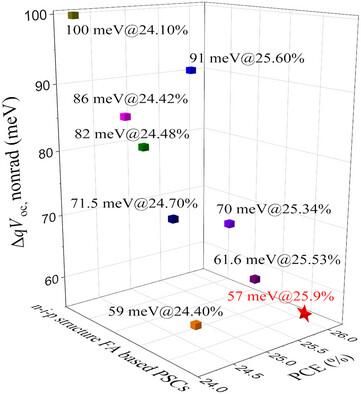
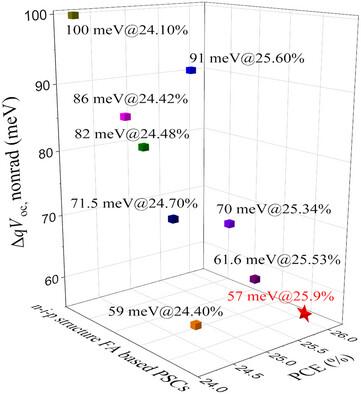
减少异质界面非辐射重组是实现高效包晶太阳能电池(PSCs)的关键挑战。受此启发,我们开发了一种通过界面能量反转使包晶石异质界面功能化的简便策略。一种表面活性剂分子--三氯[3-(五氟苯基)丙基]硅烷(TPFS)可将过氧化物表面能量从固有的 n 型逆转为 p 型,紫外光谱和反向光电子能谱对此进行了证明。重建后的包晶表面能级与上部沉积的空穴传输层非常吻合,实现了精致的能级排列,从而加速了空穴在异质界面上的萃取。同时,TPFS 进一步降低了表面缺陷密度。因此,这种合作策略大大减少了非辐射重组。PSCs 的功率转换效率达到了令人印象深刻的 25.9%,而且具有极佳的可重复性,非辐射重组引起的 qVoc 损耗仅为 57 meV,是迄今为止报道的 ni-p 结构 PSCs 中最小的。
Interfacial Energetics Reversal Strategy for Efficient Perovskite Solar Cells
Reducing heterointerface nonradiative recombination is a key challenge for realizing highly efficient perovskite solar cells (PSCs). Motivated by this, a facile strategy is developed via interfacial energetics reversal to functionalize perovskite heterointerface. A surfactant molecule, trichloro[3-(pentafluorophenyl)propyl]silane (TPFS) reverses perovskite surface energetics from intrinsic n-type to p-type, evidently demonstrated by ultraviolet and inverse photoelectron spectroscopies. The reconstructed perovskite surface energetics match well with the upper deposited hole transport layer, realizing an exquisite energy level alignment for accelerating hole extraction across the heterointerface. Meanwhile, TPFS further diminishes surface defect density. As a result, this cooperative strategy leads to greatly minimized nonradiative recombination. PSCs achieve an impressive power conversion efficiency of 25.9% with excellent reproducibility, and a nonradiative recombination-induced qVoc loss of only 57 meV, which is the smallest reported to date in n-i-p structured PSCs.
期刊介绍:
Advanced Materials, one of the world's most prestigious journals and the foundation of the Advanced portfolio, is the home of choice for best-in-class materials science for more than 30 years. Following this fast-growing and interdisciplinary field, we are considering and publishing the most important discoveries on any and all materials from materials scientists, chemists, physicists, engineers as well as health and life scientists and bringing you the latest results and trends in modern materials-related research every week.






 京公网安备 11010802042870号
京ICP备2023020795号-1
京公网安备 11010802042870号
京ICP备2023020795号-1

 分享
分享
 求助内容:
求助内容: 应助结果提醒方式:
 扫码关注我们
