{"title":"使用大型语言模型的多模态人工智能方法用于专家级滑坡图像分析","authors":"Kittitouch Areerob, Van-Quang Nguyen, Xianfeng Li, Shogo Inadomi, Toru Shimada, Hiroyuki Kanasaki, Zhijie Wang, Masanori Suganuma, Keiji Nagatani, Pang-jo Chun, Takayuki Okatani","doi":"10.1111/mice.13482","DOIUrl":null,"url":null,"abstract":"<p>Climate change exacerbates natural disasters, demanding rapid damage and risk assessment. However, expert-reliant analyses delay responses despite drone-aided data collection. This study develops and compares multimodal AI approaches using advanced large language models (LLMs) for expert-level landslide image analysis. We tackle landslide-specific challenges: capturing nuanced geotechnical reasoning beyond data digitization (specific to geological features and risk assessment), developing specialized transfer learning and data augmentation to mitigate data scarcity and geological diversity in landslide imagery, and establishing tailored evaluation metrics including geological accuracy, risk validity, and decision utility for landslide analysis. Evaluating a visual question answering-large language model (VQA-LLM) hybrid (sequential visual processing) and a multimodal large language model (MLLM, simultaneous vision/text processing) shows that MLLM excels in disaster identification, while the VQA-LLM hybrid demonstrates superior performance in risk assessment, thereby informing optimal AI design choices. Our methodology, structuring 30+ years of expert commentary for AI training and employing a comprehensive evaluation framework including standard text metrics, LLM-based semantic analysis, and expert domain assessment, highlights the potential of hybrid systems and addresses knowledge transfer in data-sparse domains.</p>","PeriodicalId":156,"journal":{"name":"Computer-Aided Civil and Infrastructure Engineering","volume":"40 19","pages":"2900-2921"},"PeriodicalIF":9.1000,"publicationDate":"2025-04-11","publicationTypes":"Journal Article","fieldsOfStudy":null,"isOpenAccess":false,"openAccessPdf":"https://onlinelibrary.wiley.com/doi/epdf/10.1111/mice.13482","citationCount":"0","resultStr":"{\"title\":\"Multimodal artificial intelligence approaches using large language models for expert-level landslide image analysis\",\"authors\":\"Kittitouch Areerob, Van-Quang Nguyen, Xianfeng Li, Shogo Inadomi, Toru Shimada, Hiroyuki Kanasaki, Zhijie Wang, Masanori Suganuma, Keiji Nagatani, Pang-jo Chun, Takayuki Okatani\",\"doi\":\"10.1111/mice.13482\",\"DOIUrl\":null,\"url\":null,\"abstract\":\"<p>Climate change exacerbates natural disasters, demanding rapid damage and risk assessment. However, expert-reliant analyses delay responses despite drone-aided data collection. This study develops and compares multimodal AI approaches using advanced large language models (LLMs) for expert-level landslide image analysis. We tackle landslide-specific challenges: capturing nuanced geotechnical reasoning beyond data digitization (specific to geological features and risk assessment), developing specialized transfer learning and data augmentation to mitigate data scarcity and geological diversity in landslide imagery, and establishing tailored evaluation metrics including geological accuracy, risk validity, and decision utility for landslide analysis. Evaluating a visual question answering-large language model (VQA-LLM) hybrid (sequential visual processing) and a multimodal large language model (MLLM, simultaneous vision/text processing) shows that MLLM excels in disaster identification, while the VQA-LLM hybrid demonstrates superior performance in risk assessment, thereby informing optimal AI design choices. Our methodology, structuring 30+ years of expert commentary for AI training and employing a comprehensive evaluation framework including standard text metrics, LLM-based semantic analysis, and expert domain assessment, highlights the potential of hybrid systems and addresses knowledge transfer in data-sparse domains.</p>\",\"PeriodicalId\":156,\"journal\":{\"name\":\"Computer-Aided Civil and Infrastructure Engineering\",\"volume\":\"40 19\",\"pages\":\"2900-2921\"},\"PeriodicalIF\":9.1000,\"publicationDate\":\"2025-04-11\",\"publicationTypes\":\"Journal Article\",\"fieldsOfStudy\":null,\"isOpenAccess\":false,\"openAccessPdf\":\"https://onlinelibrary.wiley.com/doi/epdf/10.1111/mice.13482\",\"citationCount\":\"0\",\"resultStr\":null,\"platform\":\"Semanticscholar\",\"paperid\":null,\"PeriodicalName\":\"Computer-Aided Civil and Infrastructure Engineering\",\"FirstCategoryId\":\"5\",\"ListUrlMain\":\"https://onlinelibrary.wiley.com/doi/10.1111/mice.13482\",\"RegionNum\":1,\"RegionCategory\":\"工程技术\",\"ArticlePicture\":[],\"TitleCN\":null,\"AbstractTextCN\":null,\"PMCID\":null,\"EPubDate\":\"\",\"PubModel\":\"\",\"JCR\":\"Q1\",\"JCRName\":\"COMPUTER SCIENCE, INTERDISCIPLINARY APPLICATIONS\",\"Score\":null,\"Total\":0}","platform":"Semanticscholar","paperid":null,"PeriodicalName":"Computer-Aided Civil and Infrastructure Engineering","FirstCategoryId":"5","ListUrlMain":"https://onlinelibrary.wiley.com/doi/10.1111/mice.13482","RegionNum":1,"RegionCategory":"工程技术","ArticlePicture":[],"TitleCN":null,"AbstractTextCN":null,"PMCID":null,"EPubDate":"","PubModel":"","JCR":"Q1","JCRName":"COMPUTER SCIENCE, INTERDISCIPLINARY APPLICATIONS","Score":null,"Total":0}
Multimodal artificial intelligence approaches using large language models for expert-level landslide image analysis
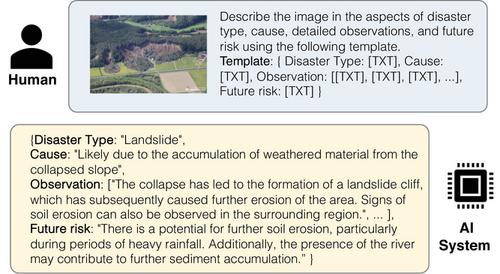
Climate change exacerbates natural disasters, demanding rapid damage and risk assessment. However, expert-reliant analyses delay responses despite drone-aided data collection. This study develops and compares multimodal AI approaches using advanced large language models (LLMs) for expert-level landslide image analysis. We tackle landslide-specific challenges: capturing nuanced geotechnical reasoning beyond data digitization (specific to geological features and risk assessment), developing specialized transfer learning and data augmentation to mitigate data scarcity and geological diversity in landslide imagery, and establishing tailored evaluation metrics including geological accuracy, risk validity, and decision utility for landslide analysis. Evaluating a visual question answering-large language model (VQA-LLM) hybrid (sequential visual processing) and a multimodal large language model (MLLM, simultaneous vision/text processing) shows that MLLM excels in disaster identification, while the VQA-LLM hybrid demonstrates superior performance in risk assessment, thereby informing optimal AI design choices. Our methodology, structuring 30+ years of expert commentary for AI training and employing a comprehensive evaluation framework including standard text metrics, LLM-based semantic analysis, and expert domain assessment, highlights the potential of hybrid systems and addresses knowledge transfer in data-sparse domains.
期刊介绍:
Computer-Aided Civil and Infrastructure Engineering stands as a scholarly, peer-reviewed archival journal, serving as a vital link between advancements in computer technology and civil and infrastructure engineering. The journal serves as a distinctive platform for the publication of original articles, spotlighting novel computational techniques and inventive applications of computers. Specifically, it concentrates on recent progress in computer and information technologies, fostering the development and application of emerging computing paradigms.
Encompassing a broad scope, the journal addresses bridge, construction, environmental, highway, geotechnical, structural, transportation, and water resources engineering. It extends its reach to the management of infrastructure systems, covering domains such as highways, bridges, pavements, airports, and utilities. The journal delves into areas like artificial intelligence, cognitive modeling, concurrent engineering, database management, distributed computing, evolutionary computing, fuzzy logic, genetic algorithms, geometric modeling, internet-based technologies, knowledge discovery and engineering, machine learning, mobile computing, multimedia technologies, networking, neural network computing, optimization and search, parallel processing, robotics, smart structures, software engineering, virtual reality, and visualization techniques.




 京公网安备 11010802042870号
京ICP备2023020795号-1
京公网安备 11010802042870号
京ICP备2023020795号-1

 分享
分享
 求助内容:
求助内容: 应助结果提醒方式:
 扫码关注我们
