{"title":"实验室地震中同时发生的慢速和快速摩擦破裂","authors":"Songlin Shi, Jay Fineberg","doi":"10.1038/s41567-025-02871-3","DOIUrl":null,"url":null,"abstract":"Frictional motion is initiated by interface failure that is mediated by ruptures—akin to earthquakes—that typically accelerate to near-sonic velocities. However, slow ruptures may occur in both laboratory and natural fault settings, but the mechanisms that drive them are not fully understood. Although fracture mechanics describes fast frictional ruptures well, its relevance to slow ruptures is uncertain. Here we experimentally show that both extremely slow and fast ruptures—on scales of cm s–1 and km s–1, respectively—can repeatably propagate within the same frictional interface. We demonstrate that a dynamic equilibrium between the loading rates and velocity dependencies of both interface resistance and fracture energy enables slow ruptures to nucleate and propagate at very low applied shear stresses. In the same interfaces, fast ruptures also occur, but only when their nucleation becomes possible under higher stress conditions. We find that the dynamics and structure of both rupture classes are well described by fracture mechanics. Their existence results from a close interplay between the interface properties and rupture velocity. These results provide key insights into fault dynamics and related frictional motion. Frictional motion of bodies in contact is facilitated by ruptures at their interface. Experiments with laboratory earthquakes now reveal that frictional ruptures at an interface can happen at both slow and fast timescales.","PeriodicalId":19100,"journal":{"name":"Nature Physics","volume":"21 6","pages":"1019-1025"},"PeriodicalIF":18.4000,"publicationDate":"2025-04-14","publicationTypes":"Journal Article","fieldsOfStudy":null,"isOpenAccess":false,"openAccessPdf":"","citationCount":"0","resultStr":"{\"title\":\"Concurrent slow and fast frictional ruptures in laboratory earthquakes\",\"authors\":\"Songlin Shi, Jay Fineberg\",\"doi\":\"10.1038/s41567-025-02871-3\",\"DOIUrl\":null,\"url\":null,\"abstract\":\"Frictional motion is initiated by interface failure that is mediated by ruptures—akin to earthquakes—that typically accelerate to near-sonic velocities. However, slow ruptures may occur in both laboratory and natural fault settings, but the mechanisms that drive them are not fully understood. Although fracture mechanics describes fast frictional ruptures well, its relevance to slow ruptures is uncertain. Here we experimentally show that both extremely slow and fast ruptures—on scales of cm s–1 and km s–1, respectively—can repeatably propagate within the same frictional interface. We demonstrate that a dynamic equilibrium between the loading rates and velocity dependencies of both interface resistance and fracture energy enables slow ruptures to nucleate and propagate at very low applied shear stresses. In the same interfaces, fast ruptures also occur, but only when their nucleation becomes possible under higher stress conditions. We find that the dynamics and structure of both rupture classes are well described by fracture mechanics. Their existence results from a close interplay between the interface properties and rupture velocity. These results provide key insights into fault dynamics and related frictional motion. Frictional motion of bodies in contact is facilitated by ruptures at their interface. Experiments with laboratory earthquakes now reveal that frictional ruptures at an interface can happen at both slow and fast timescales.\",\"PeriodicalId\":19100,\"journal\":{\"name\":\"Nature Physics\",\"volume\":\"21 6\",\"pages\":\"1019-1025\"},\"PeriodicalIF\":18.4000,\"publicationDate\":\"2025-04-14\",\"publicationTypes\":\"Journal Article\",\"fieldsOfStudy\":null,\"isOpenAccess\":false,\"openAccessPdf\":\"\",\"citationCount\":\"0\",\"resultStr\":null,\"platform\":\"Semanticscholar\",\"paperid\":null,\"PeriodicalName\":\"Nature Physics\",\"FirstCategoryId\":\"101\",\"ListUrlMain\":\"https://www.nature.com/articles/s41567-025-02871-3\",\"RegionNum\":1,\"RegionCategory\":\"物理与天体物理\",\"ArticlePicture\":[],\"TitleCN\":null,\"AbstractTextCN\":null,\"PMCID\":null,\"EPubDate\":\"\",\"PubModel\":\"\",\"JCR\":\"Q1\",\"JCRName\":\"PHYSICS, MULTIDISCIPLINARY\",\"Score\":null,\"Total\":0}","platform":"Semanticscholar","paperid":null,"PeriodicalName":"Nature Physics","FirstCategoryId":"101","ListUrlMain":"https://www.nature.com/articles/s41567-025-02871-3","RegionNum":1,"RegionCategory":"物理与天体物理","ArticlePicture":[],"TitleCN":null,"AbstractTextCN":null,"PMCID":null,"EPubDate":"","PubModel":"","JCR":"Q1","JCRName":"PHYSICS, MULTIDISCIPLINARY","Score":null,"Total":0}
Concurrent slow and fast frictional ruptures in laboratory earthquakes
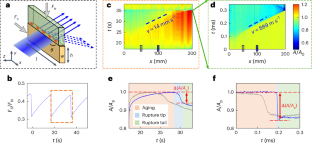
Frictional motion is initiated by interface failure that is mediated by ruptures—akin to earthquakes—that typically accelerate to near-sonic velocities. However, slow ruptures may occur in both laboratory and natural fault settings, but the mechanisms that drive them are not fully understood. Although fracture mechanics describes fast frictional ruptures well, its relevance to slow ruptures is uncertain. Here we experimentally show that both extremely slow and fast ruptures—on scales of cm s–1 and km s–1, respectively—can repeatably propagate within the same frictional interface. We demonstrate that a dynamic equilibrium between the loading rates and velocity dependencies of both interface resistance and fracture energy enables slow ruptures to nucleate and propagate at very low applied shear stresses. In the same interfaces, fast ruptures also occur, but only when their nucleation becomes possible under higher stress conditions. We find that the dynamics and structure of both rupture classes are well described by fracture mechanics. Their existence results from a close interplay between the interface properties and rupture velocity. These results provide key insights into fault dynamics and related frictional motion. Frictional motion of bodies in contact is facilitated by ruptures at their interface. Experiments with laboratory earthquakes now reveal that frictional ruptures at an interface can happen at both slow and fast timescales.
期刊介绍:
Nature Physics is dedicated to publishing top-tier original research in physics with a fair and rigorous review process. It provides high visibility and access to a broad readership, maintaining high standards in copy editing and production, ensuring rapid publication, and maintaining independence from academic societies and other vested interests.
The journal presents two main research paper formats: Letters and Articles. Alongside primary research, Nature Physics serves as a central source for valuable information within the physics community through Review Articles, News & Views, Research Highlights covering crucial developments across the physics literature, Commentaries, Book Reviews, and Correspondence.





 京公网安备 11010802042870号
京ICP备2023020795号-1
京公网安备 11010802042870号
京ICP备2023020795号-1

 分享
分享
 求助内容:
求助内容: 应助结果提醒方式:
 扫码关注我们
