Matthias R. Kollert, Martin Krämer, Nicholas M. Brisson, Victoria Schemenz, Serafeim Tsitsilonis, Taimoor H. Qazi, Peter Fratzl, Viola Vogel, Jürgen R. Reichenbach, Georg N. Duda
{"title":"与细胞外基质结合的水和离子驱动应力弛豫,有助于通过核磁共振成像检测肿胀相关病变","authors":"Matthias R. Kollert, Martin Krämer, Nicholas M. Brisson, Victoria Schemenz, Serafeim Tsitsilonis, Taimoor H. Qazi, Peter Fratzl, Viola Vogel, Jürgen R. Reichenbach, Georg N. Duda","doi":"10.1038/s41551-025-01369-w","DOIUrl":null,"url":null,"abstract":"Swelling-associated changes in extracellular matrix (ECM) occur in many pathological conditions involving inflammation or oedema. Here we show that alterations in the proportion of loosely bound water in ECM correlate with changes in ECM elasticity and stress relaxation, owing to the strength of water binding to ECM being primarily governed by osmolality and the electrostatic properties of proteoglycans. By using mechanical testing and small-angle X-ray scattering, as well as magnetic resonance imaging (MRI) to detect changes in loosely bound water, we observed that enhanced water binding manifests as greater resistance to compression (mechanical or osmotic), resulting from increased electrostatic repulsion between negatively charged proteoglycans rather than axial contraction in collagen fibrils. This indicates that electrostatic contributions of proteoglycans regulate elasticity and stress relaxation independently of hydration. Our ex vivo experiments in osmotically modulated tendon elucidate physical causes of MRI signal alterations, in agreement with pilot in vivo MRI of inflammatory Achilles tendinopathy. We suggest that the strength of water binding to ECM regulates cellular niches and can be exploited to enhance MRI-informed diagnostics of swelling-associated tissue pathology. Magnetic resonance imaging of swollen tendons suggests that the elasticity and stress relaxation of extracellular matrix depend on electrostatic repulsions between proteoglycans rather than on hydration-associated changes.","PeriodicalId":19063,"journal":{"name":"Nature Biomedical Engineering","volume":"9 5","pages":"772-786"},"PeriodicalIF":26.3000,"publicationDate":"2025-04-15","publicationTypes":"Journal Article","fieldsOfStudy":null,"isOpenAccess":false,"openAccessPdf":"https://www.nature.comhttps://www.nature.com/articles/s41551-025-01369-w.pdf","citationCount":"0","resultStr":"{\"title\":\"Water and ions binding to extracellular matrix drives stress relaxation, aiding MRI detection of swelling-associated pathology\",\"authors\":\"Matthias R. Kollert, Martin Krämer, Nicholas M. Brisson, Victoria Schemenz, Serafeim Tsitsilonis, Taimoor H. Qazi, Peter Fratzl, Viola Vogel, Jürgen R. Reichenbach, Georg N. Duda\",\"doi\":\"10.1038/s41551-025-01369-w\",\"DOIUrl\":null,\"url\":null,\"abstract\":\"Swelling-associated changes in extracellular matrix (ECM) occur in many pathological conditions involving inflammation or oedema. Here we show that alterations in the proportion of loosely bound water in ECM correlate with changes in ECM elasticity and stress relaxation, owing to the strength of water binding to ECM being primarily governed by osmolality and the electrostatic properties of proteoglycans. By using mechanical testing and small-angle X-ray scattering, as well as magnetic resonance imaging (MRI) to detect changes in loosely bound water, we observed that enhanced water binding manifests as greater resistance to compression (mechanical or osmotic), resulting from increased electrostatic repulsion between negatively charged proteoglycans rather than axial contraction in collagen fibrils. This indicates that electrostatic contributions of proteoglycans regulate elasticity and stress relaxation independently of hydration. Our ex vivo experiments in osmotically modulated tendon elucidate physical causes of MRI signal alterations, in agreement with pilot in vivo MRI of inflammatory Achilles tendinopathy. We suggest that the strength of water binding to ECM regulates cellular niches and can be exploited to enhance MRI-informed diagnostics of swelling-associated tissue pathology. Magnetic resonance imaging of swollen tendons suggests that the elasticity and stress relaxation of extracellular matrix depend on electrostatic repulsions between proteoglycans rather than on hydration-associated changes.\",\"PeriodicalId\":19063,\"journal\":{\"name\":\"Nature Biomedical Engineering\",\"volume\":\"9 5\",\"pages\":\"772-786\"},\"PeriodicalIF\":26.3000,\"publicationDate\":\"2025-04-15\",\"publicationTypes\":\"Journal Article\",\"fieldsOfStudy\":null,\"isOpenAccess\":false,\"openAccessPdf\":\"https://www.nature.comhttps://www.nature.com/articles/s41551-025-01369-w.pdf\",\"citationCount\":\"0\",\"resultStr\":null,\"platform\":\"Semanticscholar\",\"paperid\":null,\"PeriodicalName\":\"Nature Biomedical Engineering\",\"FirstCategoryId\":\"5\",\"ListUrlMain\":\"https://www.nature.com/articles/s41551-025-01369-w\",\"RegionNum\":1,\"RegionCategory\":\"医学\",\"ArticlePicture\":[],\"TitleCN\":null,\"AbstractTextCN\":null,\"PMCID\":null,\"EPubDate\":\"\",\"PubModel\":\"\",\"JCR\":\"Q1\",\"JCRName\":\"ENGINEERING, BIOMEDICAL\",\"Score\":null,\"Total\":0}","platform":"Semanticscholar","paperid":null,"PeriodicalName":"Nature Biomedical Engineering","FirstCategoryId":"5","ListUrlMain":"https://www.nature.com/articles/s41551-025-01369-w","RegionNum":1,"RegionCategory":"医学","ArticlePicture":[],"TitleCN":null,"AbstractTextCN":null,"PMCID":null,"EPubDate":"","PubModel":"","JCR":"Q1","JCRName":"ENGINEERING, BIOMEDICAL","Score":null,"Total":0}
Water and ions binding to extracellular matrix drives stress relaxation, aiding MRI detection of swelling-associated pathology
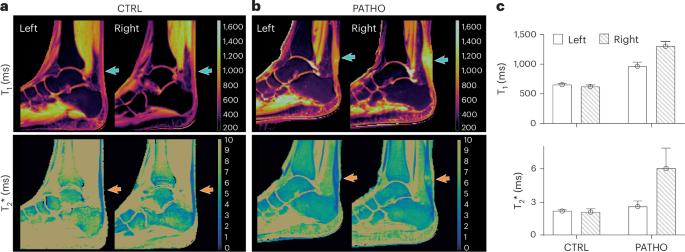
Swelling-associated changes in extracellular matrix (ECM) occur in many pathological conditions involving inflammation or oedema. Here we show that alterations in the proportion of loosely bound water in ECM correlate with changes in ECM elasticity and stress relaxation, owing to the strength of water binding to ECM being primarily governed by osmolality and the electrostatic properties of proteoglycans. By using mechanical testing and small-angle X-ray scattering, as well as magnetic resonance imaging (MRI) to detect changes in loosely bound water, we observed that enhanced water binding manifests as greater resistance to compression (mechanical or osmotic), resulting from increased electrostatic repulsion between negatively charged proteoglycans rather than axial contraction in collagen fibrils. This indicates that electrostatic contributions of proteoglycans regulate elasticity and stress relaxation independently of hydration. Our ex vivo experiments in osmotically modulated tendon elucidate physical causes of MRI signal alterations, in agreement with pilot in vivo MRI of inflammatory Achilles tendinopathy. We suggest that the strength of water binding to ECM regulates cellular niches and can be exploited to enhance MRI-informed diagnostics of swelling-associated tissue pathology. Magnetic resonance imaging of swollen tendons suggests that the elasticity and stress relaxation of extracellular matrix depend on electrostatic repulsions between proteoglycans rather than on hydration-associated changes.
期刊介绍:
Nature Biomedical Engineering is an online-only monthly journal that was launched in January 2017. It aims to publish original research, reviews, and commentary focusing on applied biomedicine and health technology. The journal targets a diverse audience, including life scientists who are involved in developing experimental or computational systems and methods to enhance our understanding of human physiology. It also covers biomedical researchers and engineers who are engaged in designing or optimizing therapies, assays, devices, or procedures for diagnosing or treating diseases. Additionally, clinicians, who make use of research outputs to evaluate patient health or administer therapy in various clinical settings and healthcare contexts, are also part of the target audience.





 京公网安备 11010802042870号
京ICP备2023020795号-1
京公网安备 11010802042870号
京ICP备2023020795号-1

 分享
分享
 求助内容:
求助内容: 应助结果提醒方式:
 扫码关注我们
