Fatme Jardali, Jenny L. Chong, Yeonju Yu, R. Stanley Williams, Suhas Kumar, Patrick J. Shamberger, Timothy D. Brown
{"title":"设计电热神经元的材料选择原则","authors":"Fatme Jardali, Jenny L. Chong, Yeonju Yu, R. Stanley Williams, Suhas Kumar, Patrick J. Shamberger, Timothy D. Brown","doi":"10.1002/aelm.202400938","DOIUrl":null,"url":null,"abstract":"<p>Artificial neurons exhibiting volatile threshold switching and action potential-like oscillations are crucial for brain-inspired computing. While Complimentary Metal-Oxide-Semiconductor (CMOS)-based strategies require hundreds of transistors to simulate each neuron, neuronal oscillations arise spontaneously in individual electro-thermal devices due to nonlinearities like the Mott transition in VO<sub>2</sub>. Despite improved understanding of the physics, quantitative connections between neuronal performance and material properties remain under-explored, preventing predictive neuron design and rational materials selection. In this work, a physics-aware forward design methodology is developed for interrogating a wide palette of materials with properties varying by orders of magnitude, and their performance (high frequency, high dynamical reconfigurability and low power) under external circuit and device geometry constraints is assessed. The space of viable materials is identified to be much larger than previously recognized, with candidates from a range of materials classes, including Ge, GaP and MoS<sub>2</sub>. CMOS-compatible performance (such as 100 GHz oscillating frequencies) can be achieved with CMOS-compatible node sizes (≈10 nm). Finally, combinations of material properties yielding desired neuronal performance under uncertain design constraints are considered. This work solidifies forward design principles for electro-thermal neuron devices, a necessary pre-condition for inverse design from desired neuronal performance to required materials properties.</p>","PeriodicalId":110,"journal":{"name":"Advanced Electronic Materials","volume":"11 11","pages":""},"PeriodicalIF":5.3000,"publicationDate":"2025-04-15","publicationTypes":"Journal Article","fieldsOfStudy":null,"isOpenAccess":false,"openAccessPdf":"https://onlinelibrary.wiley.com/doi/epdf/10.1002/aelm.202400938","citationCount":"0","resultStr":"{\"title\":\"Materials Selection Principles for Designing Electro-Thermal Neurons\",\"authors\":\"Fatme Jardali, Jenny L. Chong, Yeonju Yu, R. Stanley Williams, Suhas Kumar, Patrick J. Shamberger, Timothy D. Brown\",\"doi\":\"10.1002/aelm.202400938\",\"DOIUrl\":null,\"url\":null,\"abstract\":\"<p>Artificial neurons exhibiting volatile threshold switching and action potential-like oscillations are crucial for brain-inspired computing. While Complimentary Metal-Oxide-Semiconductor (CMOS)-based strategies require hundreds of transistors to simulate each neuron, neuronal oscillations arise spontaneously in individual electro-thermal devices due to nonlinearities like the Mott transition in VO<sub>2</sub>. Despite improved understanding of the physics, quantitative connections between neuronal performance and material properties remain under-explored, preventing predictive neuron design and rational materials selection. In this work, a physics-aware forward design methodology is developed for interrogating a wide palette of materials with properties varying by orders of magnitude, and their performance (high frequency, high dynamical reconfigurability and low power) under external circuit and device geometry constraints is assessed. The space of viable materials is identified to be much larger than previously recognized, with candidates from a range of materials classes, including Ge, GaP and MoS<sub>2</sub>. CMOS-compatible performance (such as 100 GHz oscillating frequencies) can be achieved with CMOS-compatible node sizes (≈10 nm). Finally, combinations of material properties yielding desired neuronal performance under uncertain design constraints are considered. This work solidifies forward design principles for electro-thermal neuron devices, a necessary pre-condition for inverse design from desired neuronal performance to required materials properties.</p>\",\"PeriodicalId\":110,\"journal\":{\"name\":\"Advanced Electronic Materials\",\"volume\":\"11 11\",\"pages\":\"\"},\"PeriodicalIF\":5.3000,\"publicationDate\":\"2025-04-15\",\"publicationTypes\":\"Journal Article\",\"fieldsOfStudy\":null,\"isOpenAccess\":false,\"openAccessPdf\":\"https://onlinelibrary.wiley.com/doi/epdf/10.1002/aelm.202400938\",\"citationCount\":\"0\",\"resultStr\":null,\"platform\":\"Semanticscholar\",\"paperid\":null,\"PeriodicalName\":\"Advanced Electronic Materials\",\"FirstCategoryId\":\"88\",\"ListUrlMain\":\"https://advanced.onlinelibrary.wiley.com/doi/10.1002/aelm.202400938\",\"RegionNum\":2,\"RegionCategory\":\"材料科学\",\"ArticlePicture\":[],\"TitleCN\":null,\"AbstractTextCN\":null,\"PMCID\":null,\"EPubDate\":\"\",\"PubModel\":\"\",\"JCR\":\"Q2\",\"JCRName\":\"MATERIALS SCIENCE, MULTIDISCIPLINARY\",\"Score\":null,\"Total\":0}","platform":"Semanticscholar","paperid":null,"PeriodicalName":"Advanced Electronic Materials","FirstCategoryId":"88","ListUrlMain":"https://advanced.onlinelibrary.wiley.com/doi/10.1002/aelm.202400938","RegionNum":2,"RegionCategory":"材料科学","ArticlePicture":[],"TitleCN":null,"AbstractTextCN":null,"PMCID":null,"EPubDate":"","PubModel":"","JCR":"Q2","JCRName":"MATERIALS SCIENCE, MULTIDISCIPLINARY","Score":null,"Total":0}
Materials Selection Principles for Designing Electro-Thermal Neurons
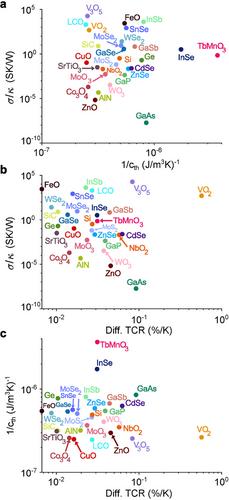
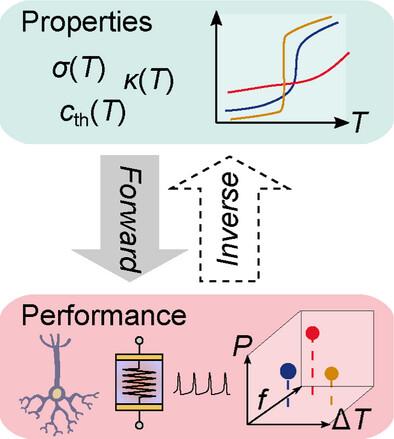
Artificial neurons exhibiting volatile threshold switching and action potential-like oscillations are crucial for brain-inspired computing. While Complimentary Metal-Oxide-Semiconductor (CMOS)-based strategies require hundreds of transistors to simulate each neuron, neuronal oscillations arise spontaneously in individual electro-thermal devices due to nonlinearities like the Mott transition in VO2. Despite improved understanding of the physics, quantitative connections between neuronal performance and material properties remain under-explored, preventing predictive neuron design and rational materials selection. In this work, a physics-aware forward design methodology is developed for interrogating a wide palette of materials with properties varying by orders of magnitude, and their performance (high frequency, high dynamical reconfigurability and low power) under external circuit and device geometry constraints is assessed. The space of viable materials is identified to be much larger than previously recognized, with candidates from a range of materials classes, including Ge, GaP and MoS2. CMOS-compatible performance (such as 100 GHz oscillating frequencies) can be achieved with CMOS-compatible node sizes (≈10 nm). Finally, combinations of material properties yielding desired neuronal performance under uncertain design constraints are considered. This work solidifies forward design principles for electro-thermal neuron devices, a necessary pre-condition for inverse design from desired neuronal performance to required materials properties.
期刊介绍:
Advanced Electronic Materials is an interdisciplinary forum for peer-reviewed, high-quality, high-impact research in the fields of materials science, physics, and engineering of electronic and magnetic materials. It includes research on physics and physical properties of electronic and magnetic materials, spintronics, electronics, device physics and engineering, micro- and nano-electromechanical systems, and organic electronics, in addition to fundamental research.





 京公网安备 11010802042870号
京ICP备2023020795号-1
京公网安备 11010802042870号
京ICP备2023020795号-1

 分享
分享
 求助内容:
求助内容: 应助结果提醒方式:
 扫码关注我们
